From Margaret Flowers, M.D. and activist with the Physicians for a National Health Planto friends of the Tikkun Community and Network of Spiritual Progressives:
Beginning on October 6, 2011, we (thousands of individuals) will gather together to occupy Freedom Plaza in Washington, D.C.We will hold a rally that day starting at noon with music and speakers, including Rabbi Michael Lerner. Then those of us who are able will participate in a nonviolent resistance action. At the end of the day, we will stay in the Plaza. We are determined to stay until we see action being taken to end corporatism and militarism and move towards a peaceful, just and sustainable society.
LOGAN — Imagine being able to put your fingers on the pulse of America's biosphere — keeping real-time track of weather, water/soil temperature, animal populations and much more. Armed with this information, scientists would be able to detect sudden shifts in climate, perhaps even predict them, allowing the nation to prepare for potential disasters.
Click on Image to Enlarge
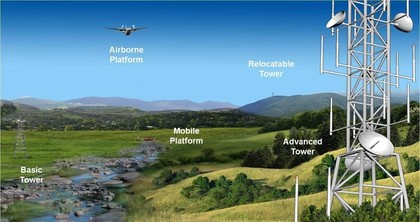
The National Science Foundation has given the financial go-ahead to begin construction of the nation's first coast-to-coast network of observatories, including one in Utah, to measure real-time climate changes.
The National Ecological Observatory Network, or NEON, is designed to gather vast amounts of data, every second, from around the country using satellites, observation towers, aircraft sensors, mobile motorized sensors and field work by scientists. From insect samples to weather data, the information will be fed into a central lab to build a picture of the nation's ecological health.
What scientists will keep an eye out for are “threshold events,” or sudden changes in climates, that can lead to droughts, floods, even the spread of diseases, said James MacMahon, dean of Utah State University's College of Science and chairman of NEON's board of directors.
Phi Beta Iota: The most righteous thing the White House has done in our view, starting under Clinton-Gore and continued by Bush-Cheney, has been the Earth Science information-sharing initiative. The above article neglects the importance of the same initiative being carried out across the oceans, 75% of the Earth's surface. This particular initiative would do well to adopt the four fundamental opens: Open Source Software, Open Data Access, Open Spectrum, and Open Source Intelligence.
Phi Beta Iota: This report, while responsible (unlike the current food fight a year later), does not go far enough. It allows the borrowing of one trillion a year to continue, while observing that interest on the debt could reach one trillion a year by 2020. The principle recommendations, all sound but insufficient, are listed in the Overview section.
The rhetoric of people rushing to rescue Pentagon spending from “completely unacceptable” cuts is quite hysterical. Leading the chorus has been Secretary of Defense Leon Panetta. He termed the possible defense budget cuts (about $850 billion over 10 years according to most) a “doomsday mechanism,” if the automatic sequestration trigger of Obama’s debt deal with the Republicans in Congress is pulled. Some think tank types, opining in the Washington Post and the New York Times, have deemed these reductions “indiscriminately hacking away” at the Pentagon’s budget and something that could “imperil America’s national security.” Their defense spending allies, including multiple generals and admirals sitting atop various Pentagon bureaucracies, confirm it all with descriptions like “very high risk” and “draconian.”
It should be pointed out that these people are underestimating the size of the potential cuts the new debt deal could theoretically cause. The $850 billion supposition measures the reductions against an artificial “baseline” from the Congressional Budget Office (CBO) that does not include the actual budget growth the Pentagon had scheduled for itself. Todd Harrison of the Center for Strategic and Budgetary Assessments tells us in a useful analysis (“Defense Funding in the Budget Control Act of 2011”) that the debt deal’s automatic sequesters, if implemented, would mean $968 billion in cuts over ten years from the DOD budgets heretofore planned – over $100 billion more in cuts.
Obama’s surge and de-surge has, therefore, created a reinforcing dynamic that is playing into the hands of the insurgents by seducing the United States into increasing its reliance on a pointless, reactive, “whack-a-mole” strategy. Like a judo specialist, the insurgents will use the expenditure of American energies to exhaust American forces and paralyze American political willpower by inducing our military to over and under react to an unfolding welter widely dispersed insurgent attacks
Phi Beta Iota: At home, the teen riots have started in Philadelphia. More riots are certain to follow, and more “random” shootings of anyone representing the US Government are likely west of the Mississippi. This is almost the perfect storm–all that is missing is a water failure in New York City followed by a firestorm, and massive epidemic across California.
As anticipated, we're on the brink of a global economic depression (again).
There's a strong possibility that a long running global depression will lead to a reshuffling of the global economic and political landscape. IF that happens, many of the fiat currencies we currently use will simply evaporate.
Given this backdrop, here's today's big question:
If the dollar and euro implode…
…will the next global currency be gold or networked virtual currencies (like bitcoin)?
Until the new currency platform emerges, the safest hedge for the future is building, buying, or trading for anything that can produce food, energy, water, and products locally.
Phi Beta Iota: George Soros has dumped gold and is largely off the stock market. John Robb is one of the best observers of chaos versus resilience–his advice above coincides with William Greider's finding in Come Home America, to wit, financial offerings are fraud, asset investments (at the local level) are real. What all of this leads up to is that we should all stop investing in old systems, and instead do the right thing: invest in bottom-up localized resilience that yields sustainable benefits for all–real assets for real people.
Here is a presentation by David Eaves (from three years ago), on the importance of collaboration, facilitation, and conflict resolution skills for successful free and open source software and content projects (as well as the need for better on-line tools to support all that):
His key point is that “facilitation” (enabling the community) is an essential part of open source software collaborations or open content collaborations, and that we have not prioritized for “facilitation” either in who runs such projects, the companies built around them, how people are trained, or what our online tools are actually good at supporting.
He makes a point that (in round numbers) written text over the web only conveys about 10% of human communication intent, with about another 40% being intonation and the last 50% being body language (so, 90%+ of communicated intent is lost by using text).
He says this is a reason a lot of web communications go wrong with various emotional-related misinterpretations of what people wrote, especially when people have no common face-to-face history together. He presents a model of negotiation where people build “relationship” and “communication”, and then iteratively explore “interests”, “options” to pursue those interests, and “legitimacy” (or likelihood an option will succeed) to find common ground they can work together on as a “commitment” instead of pursuing “alternatives” to the collaboration.
He contrasts that with a competitive up-front take-it-or-leave it style of advocacy for specific actions by others (a style which does not first explore broader common interests that are behind why the specific actions are desired, where common ground might be easier to find by taking a step back from the specific apparent conflict to see a bigger picture of common interests and creative ways to pursue those together).
He suggests that every conversation has four aspects (Inquire, Paraphrase, Acknowledge, and Advocate) and says people spend too much time on “Advocate” to the exclusion of these other important aspects and related skills. In general, he suggests these communications issues are why so many free and open source projects have problems and that we need better tools to support this sort of facilitation across all aspects of a project (coding, marketing, fundraising, tracking defects, providing support, etc.).