Operation Ajax tells the true story of the CIA’s involvement in the Middle East and the roots of the modern American conflict with Iran.
Experience history through the eyes of a nameless protagonist, whose identity was redacted from declassified CIA records, as he recalls the dramatic and real events he was involved in with heads of state, covert agents, and underground political activists.
Posted with permission. Provided by Dr. James Spohrer in response to a request from Phi Beta Iota for a “snap-shot” overview of the “soul” of IBM going into the 21st Century.
1. Cities: here is a short IBM video (YouTube 4:15) on cities as the nodes in the planetary system of systems
Features Mike Wing, Irving Wladawsky-Berger, Julia Grace. Cities as planetary accupunture points of intervention. Cities are HUMAN–computers cannot handle the unpredictable. Dominos analogy–everything is interconnected and knowledge or information are the “energy” being exchanged among individual people, the HUMAN element. It is the mixture of people and hardware, and software that is so elegant and exciting.
2. Universities in Cities: My current job at IBM builds from the notion that universities are the knowledge batteries of city/regions… see slide #34 in this presentation on Service Science: Progress and Directions (64 Slides), connected with Handbook of Service Science (Springer, 2010). NOTE: Downloading presentation enables viewing of Notes for each slide.
Click on Image to Enlarge
Overview of IBM University Programs focusing on 5 R's (Research, Readiness, Recruiting, Revenue, Responsibilities); Quality of Life balance between local and global optimization; Ecology–study of all things in relation to all life forms; and Holistic Service Systems with cities and within cities, universities, and the fundamental “intelligent” building blocks. Emphasis on information information exchanges and life-long learning. Slide #34:
3. Connecting Universities and Cities Locally and Globally: My global team at IBM University Programs is funding connecting the universities locally with their cities, and globally with each other – networked improvement communities in Doug's language… Really connecting service systems, see Slide #16 in this presentation.
North Korea-China: North Korea will develop the islet of Hwanggumpyong on the Yalu River Delta linking Sinuiju with the Chinese city of Dandong as a special economic zone in cooperation with Chinese businessmen, Chosun Ilbo reported 18 January. North Korean Cabinet already approved a law on the development that will be announced in March or April.
Comment: This is another example of Chinese business tutelage for North Korea. All other special economic zones have either failed for lack of investors or been troubled by North Korean government meddling. In the last category are the Mount Kumgang resort on the east coast and the Kaesong joint industrial park, north of Panmunjom.
One would surmise that a joint venture with the Chinese would be relieved of the unpredictability of North Korean leadership whims, which have undermined the profitability of the joint ventures with the South Koreans. More importantly, every Chinese economic lifeline tossed into the North Korean economic morass is a burden on China and a restraint on North Korea.
The Chinese are moving slowly, but steadily based on their understanding of the magnitude of North Korean economic mismanagement. Thus far, they appear to be helping North Korean enterprises that have prospects of profitability, such as textiles, and Chinese enterprises that benefit from North Korean geography, such as ports and infrastructure on the Sea of Japan.
North Korea never has been self-reliant and its condition of dependency on the global economy has steadily deepened under Kim Chong-il. The Chinese appear determined to salvage what they can and rebuild the rest of North Korea in a different, more sustainable direction, slowly, by converting some North Korean activities into extensions of China's economy.
Phi Beta Iota: The Chinese are out-thinking and out-maneuvering the USA on all fronts, and in a fascinating twist, may be egging the USA on to the same military-industrial death march that led to the end of the Soviet Union. The above development should be studied in relation to WASHINGTON RULES: US-Korea-China-NK NAFTA. In both instances, leaders are making strategic moves for reasons they consider valid, but that have nothing to do with the well-being of their respective publics.
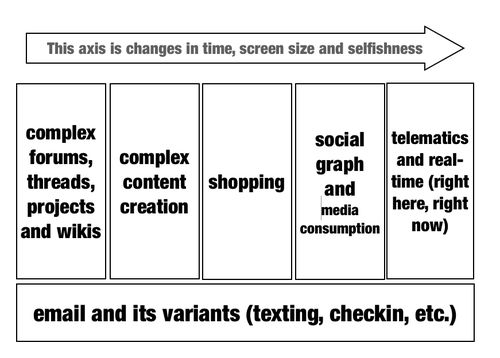
It might be about the size of the screen and whether or not you're standing up.
Start at the bottom. For the first five years of the Internet, the most used function was email. Email remains a bedrock of every device and system that's been built on top of the internet, though sometimes it looks like a text message or a mobile check in. This is the layer for asynchronous person to person connection, over time.
Moving from left to right, we see how the way we use the thing we call the internet has evolved over time. We also see how devices and technology and bandwidth have changed the uses of the net and, interestingly, how a growth in mass has led to a growth in self-motivated behavior.
Early online projects were things like Archie and Veronica and checking in changes to the Linux code base. You needed patience, a big screen and a sense of contribution.
Layer on top of this a practice that is getting ever more professional, which is creating content for others to consume. Sometimes in groups, sometimes using sophisticated software and talented cohorts.
Click on Image to Enlarge
As we move to the right (and through time) we see the birth of online shopping. Still to this day, most online shopping happens on traditional devices, often sitting down.
The sitting down part is not a silly aside. Ted Leonsis theorized twenty years ago that the giant difference between TV and the internet was how far you sat from the screen. TV was an 8 foot activity, and you were a consumer. The internet was a 16 inch activity, and you participated. I think the sitting down thing is similar. You're not going to buy an armoir while standing on the subway.
Moving over in time and device and intent, we see the idea of consuming content. While tablets get their share of shopping, this is where they really shine. I think 2011 is going to be the year of the tablet, from the Kindle to the iPad to the thing we used to call a phone.
It's in the last two categories that these other devices, things that don't involve sitting down, are superior, not just a mobile substitute. The social graph is a very low bandwidth, peripheral attention interaction, perfect for this audience and this medium. And the last category–tell me where I am, where to eat, who's near me, what's the weather, get me a cab right now–is all about me and now and here.
I don't believe this is a winner take all situation, any more than one bestselling book makes all other books obsolete. I think different pillars work for different devices, and there will continue to be winners in all of them.
… in the Hall of Mirrors that is Versailles on the Potomac
ps … good report, notwithstanding the fact that Politico is one of those slimy publications that thrives on the bottom-feeding cocktail circuit of Washington, which is funded by … who?
Candidate Barack Obama repeatedly pledged on the campaign trail that working in his administration would not be “about serving your former employer, your future employer or your bank account.”
But with his administration at its midpoint, a traditional time for personnel turnover, it’s clear that despite Obama’s avowals, a longtime truism of Washington life — that a prestigious-sounding administration post can be a lucrative career enhancer — remains unchanged.
Tunisia: Politics. The Speaker of the Parliament is the new temporary President of Tunisia, in accord with the constitutional succession and as announced by Prime Minister Ghannouchi two days ago.
Local television broadcast on 17 January the formation of the new government — the national unity government. The cabinet includes the defense, finance and foreign ministers when Ben Ali was president. Three leaders of opposition parties are included in the cabinet for the first time.
Prime Minister Ghannouchi created three high-level panels, for political reform, to investigate the recent violence and to investigate reform. He also ordered political prisoners released.
Security
Some gun shots were fired on the 17th but the worst of the fighting occurred over the weekend when Army soldiers and armed citizen groups fought gun battles with Presidential guards from the Ben Ali regime.
The government announced that 78 people died in the past week of violence.
About 1,000 protesters who assembled near the Interior Ministry called for the ruling party to relinquish power. News services reported the protesters chanted: “Out with the RCD!” and “Out with the Party of the Dictatorship!”
Comment: The government appears to be in transition from a strong presidency to a government led by parliament. The Prime Minister, not the temporary president, is leading the political metamorphosis. The announcement of a unit government has quieted conditions in Tunis, by most accounts, but its adequacy and genuineness are questionable.
The uprising was not fundamentally political and not a challenge to authority, until the government made it such. The demonstrations primarily were about economic conditions – the price and availability of food, according to contacts in Tunis, and unemployment, according to the international press. As yet the new government has made no statements about its plan to tackle either.
In other words, the mismatch between public grievances and government remedies portends more unrest that may yet usher in a revolution – a change of government system not just a change in the head of government. At this point no revolution has occurred. The leaders of the pre-existing regime are maintaining themselves in office and that looks like political deception. [Emphasis Added.]

 Operation Ajax tells the true story of the CIA’s involvement in the Middle East and the roots of the modern American conflict with Iran.