With the decline of state capitalism, capitalist governments and corporations now dream of the internet as the tool for corporate growth through ontological colonialism, free to expand within the mind and the planet, exploiting everyone alike.
Nicolas Mendoza is a scholar, artist and researcher in global media from The University of Melbourne.
Al Jazeera, 15 February 2012
Click on Image to Enlarge
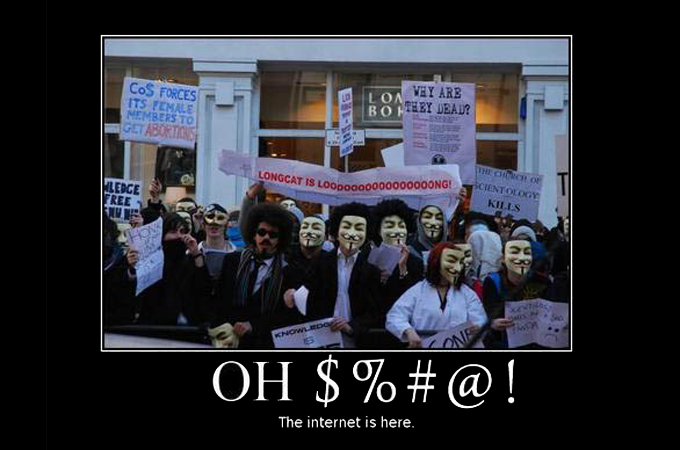
Chiang Mai, Thailand – “OH $%#@!”, reads the caption under the image depicting a group of protesters wearing Guy Fawkes masks and holding both humorous and denunciatory signs, “The internet is here”. The caption not only conveys the sentiment that drove US congressmen to drop their support of the SOPA (Stop Online Piracy Act) and PIPA (Protect Intellectual Property Act) bills, but can also be said to summarise the analysis of the January 18 blackout by several of the most prominent media experts and scholars.
Larry Downes eloquently describes the January 18 events as “the dramatic introduction of bitroots politics”. In case the leaks, springs and occupations of 2011 left any room for doubt, the recognition of the internet as a political force in itself has moved from academic theoretical discussion to hard tangible reality. Lawrence Lessig portrays this sense of general underlying bewilderment by using the haunting metaphor of “a giant” when describing the web as a political force:
For the first time ever, the internet had taken on Hollywood extremists and won. And not just in a close fight: the power demonstrated by internet activists was wildly greater than the power Hollywood lobbyists could muster. They had awoken a giant. They had no clue about just how angry that giant could be.
However, the “January 18 blackout” victory guarantees “the internet” nothing. As Clay Shirky explained a few days before the blackout, rather than the end of this struggle, the SOPA/PIPA incident is just one chapter in the greater project of crippling the internet to eliminate its autonomy:
The hard thing is this: get ready, because more is coming. SOPA is simply a reversion of COICA [Combating Online Infringement and Counterfeits Act], which was proposed last year, which did not pass. And all of this goes back to the failure of the DMCA [Digital Millenium Copyright Act] to disallow sharing as a technical means. And the DMCA goes back to the Audio Home Recording Act, which horrified those industries. (…) PIPA and SOPA are not oddities, they're not anomalies, they're not events. They're the next turn of this particular screw, which has been going on 20 years now. And if we defeat these, as I hope we do, more is coming.
Special Operations forces have long enjoyed an elite position in the United States military, and achieved something like folk-hero status when Navy Seals killed Osama bin Laden in Pakistan last May. The admiration is well-deserved, but an article in Monday’s Times drew attention to the power they’ve accrued of late, and raised questions about just how much independence they should have.
Carol Giacomo, who covers foreign affairs for the editorial board, says that the Obama administration has increasingly made Special Operations Forces its military tool of choice to handle threats overseas. It plans to rely on them even more widely as it draws down conventional troops from Afghanistan.
Eventually, Special Ops Forces will make up the bulk of any residual force left in Afghanistan, hunting down militants and helping train Afghan security forces. Administration and military officials are also talking about using them in regions where they have not operated in large numbers for the past decade, including Asia (the Philippines, specifically), Africa and Latin America.
The article on the front page of Monday’s Times reported that the top Special Operations officer, Adm. William H. McRaven, is now seeking authority to move his forces faster and outside of normal Pentagon deployment channels. The proposal has not been fully explained publicly but The Times reported that it would give him more autonomy to position his forces and their equipment where intelligence and global events indicate they are most needed.
Among congressional, staff—who have not yet been briefed on the proposal—there are questions about how such new authority might affect operations. “What problem are they trying to solve?” one aide asked. A Pentagon official, who spoke on background, insisted that Admiral McRaven “is not trying to fix something that’s broken. The proposal is anticipating what the future will be for these guys and getting ahead of it.”
The Pentagon official stressed that Admiral McRaven “is not looking for complete autonomy unanswerable to anybody” and that Special Operations Forces would still be ordered on specific missions by the regional four-star commander. But one concern is that the new plan would cut out the State Department. In the past, some ambassadors in crisis zones have opposed increased deployments of Special Operations teams, and they have demanded assurances that diplomatic chiefs of missions will be fully involved in their plans and missions.
The “global war on terror” has been used to justify a lot of things. But not everything changed on Sept. 11, 2001. Civilian control of the military is one thing that did not change. I can’t imagine a circumstance under which it should.
For almost 5 years I've been involved with envisioning and creating a “pattern language” for group process. (A pattern language is a set of design factors to guide people in creating things that are wholesome and life-giving – vibrant communities, effective curricula, engaging software… and great conversations.) That process has now come to fruition.
In 2008 Peggy Holman and I did an all day workshop on “A Pattern Language for Conversations that Matter” to introduce the idea of pattern languages to professionals in the National Coalition for Dialogue and Deliberation (NCDD). That winter, Tree Bressen invited me to a multi-day gathering at her home to actually construct a pattern language on group process. That session began what proved to be a profoundly complex and challenging task facilitated by Tree and her tiny core team of volunteers – all pieced together on a gigantic wiki and Google docs and dozens of meetings. I participated in a few more of their multi-day work sessions over the years, but about a dozen other volunteers did far more work than I did. Last year I wrote a blog post on the project for NCDD – http://ncdd.org/4535 – and a couple of weeks ago wrote a personal blog post – http://post.ly/534Wr – on the transformational potential of pattern languages of all kinds – and why I consider them profoundly important. But the big news now is that the pattern language so many of us labored for so many hours to produce has now been released as a gorgeous card deck.
I can't recommend this resource highly enough for anyone seeking to create high quality conversations of any kind for any purpose. This card deck is THE premier navigational tool for powerful conversations. It goes deeper than methodology and is more practical than theory. It is designed to help us understand what is going on and how to make it better. It offers greater flexibility and power to our practices of dialogue, deliberation, mediation, choice creating, and conversation of all types. It is available electronically FREE for the taking – and only costs $25 if you want a physical printed boxed deck.
And to top it all off – it is beautiful.
So I hereby invite you into a new world of conversational adventure and insight, available to you right now.
I have begun drafting my portion of the new Handbook of Intelligence Studies (Routledge, 2013), it is a chapter early on entitled “The Craft of Intelligence.” I pick up where Allen Dulles and Sherman Kent left off. My graphic on Intelligence Maturity captures the essence of my thinking at the strategic level, but of course there is more to come, including the desperate need to restore integrity to all that we do.
In 1988 I ghost-wrote for the Commandant of the Marine Corps an article that he enhanced and signed, “Global Intelligence Challenges in the 1990's.” At that time my focus was on the difference between the conventional threat and the emerging unconventional threat.
Now my focus is on the purpose and process of intelligence as decision-support. We must — we will — move from secret intelligence for the few to open intelligence for the many; from expensive centralized largely worthless intelligence to free and low-cost distributed intelligence relevant to every person at every level on every issue; from intelligence as window-dressing for channeling $80 billion a year to banks and corporations, to intelligence as an integral element of every aspect of a Smart Nation.
Today Owl sent me a link to an article, Philip E. Tetlock and Barabara A Mellers, “Intelligent Management of Intelligence Agencies,” American Psychologist, 2011, pp. 1-12. I respect Owl, so I printed it and read it twice.
This article is completely out of touch with reality and the authors have not bothered to familiarize themselves with the literatures pertinent to their endeavor. Out of 89 cited sources 12 are non-intelligence-related prior publications of the lead author, 1 is a prior publication of the second author, and 11 are ostensibly about intelligence but truly marginal selections. So 12% sources on the subject, 13% self-citation, and 75% escoteric psycho-babble irrelevant to the actual challenge. As an intelligence professional, I am offended that two ostensibly erudite individuals would dare to publish this trype without even a semblance of understanding of the subject under discussion.
Trust is an essential building block of any economic and social system. Systems that attempt to operate without it inevitably fail. A loss of trust typically preceeds a collapse in legitimacy.
The book is all about the mechanisms for building trust. There are four mechanisms:
moral controls,
reputational pressure (shame),
institutional pressure (legal system), and
security controls (encryption, locks, etc.).
He contends (rightly) that in the modern world, we don't typically make/have the personal relationships required to build moral and reputational trust. We typically make impersonal relationships when we interact with a global economic system (you buy stuff made by people you don't know). As a result, we rely up on institutional (legal compliance) and security (to guard against bad behavior) to provide the level of trust necessary to make the global economy work.
There are two massive problems with that.
Legal compliance is increasingly a farce. Take the mortgage settlement the US government and the financial industry reached over rampant fraud in mortgage lending. I wrote a bit more about it on the Resilient Community blog if you want more detail. What does this mean? That even at the national level in a “developed country” it is impossible to use legal means to enforce trustworthiness (let's not even talk about compliance at the global level). It's doesn't work anymore. It's just too easy for anybody with financial means, to buy off country's legal system for pennies on the dollar (to the damage caused). The compliance system is broken.
So, that leaves us with security as the only way to prevent bad actors from running away with the global system. This leads me to a great presentation I heard yesterday by Dan Geer. He's another philosopher “king” of crypto-security (but for the CIA). Very smart guy. He made a convincing case that security is scaling slower than data, bandwidth, node, and user growth. It is falling behind and will continue to fall behind as the global system grows.
Upshot: it's already nearly impossible to secure big organizations. Every Fortune 500 company has and will continue to compromised. The government's systems are already a sieve. There's almost nothing that can be done about it and it will get increasingly worse. Forget about securing a single person trying to connect to the global system. They are just sheep ready for slaughter.
So, what happens now?
The global system will continue to grow. Trust will continue to leak as attempts at compliance and security fail to work effectively. The economic depression we have already started gets worse and worse and worse. Disorder erupts. It grows….
Is there a solution? An alternative form of social order that can provide a scalable global solution?
Yes. Resilient communities. Resilient communities rescale your life down to a rational level. They make personal relationships with the people that economically interact with you possible (again).
Hey, let the rest of the world sink into the squalor of a trust free world. It will make that system easier to trounce in head to head competition for people.
Although I held clearances until 2006 from 1976 when I was the S-1/Adjutant for Battalion Landing Team 3/4 out of Okinawa (six countries, six ships, six months), it was not until 15 August 1979, when I entered on duty with the Central Intelligence Agency, that the “truth” became my calling. My class was one of two (79 and 82) where they changed the profile to recruit self-starters and free-thinkers instead of go-along blind obedience types. The bulk of both classes quit within five years. I lasted nine, and bless the US Marine Corps for my freedom, an invitation to create the Marine Corps Intelligence Center, today a Command. [My clearances were revoked in 2006 for declaring 7,500 foreign contacts; there have been enormous improvements to the management of clearances since then [the Office of Personnel Management now rules] and I do not anticipate others suffering the abuse I did before OPM took over, an abuse that cost me $1 million dollars in lost income over four years after I was asked for “by name” to be Chief Instructor for Intelligence and Information Operations at COINSOC in Iraq and denied a SECRET-level reinstatement.]
“Ye shall know the truth and the truth shall set you free” (John 8:32) is for me both a sacred and a practical manifesto of the obvious.
Sadly, it has received only lip service from my colleagues, who not only should know better, but from whom I expect the highest ethical standards at all times. Being an intelligence officer is in my view a sacred duty to the Republic. Lies kill. Allowing honest intelligence to be ignored is also a betrayal of the public trust. Not doing honest intelligence in the first place is in my view an impeachable offense.
My horizons broadened in 2000, when I was shocked by the blatant theft of the election in Florida, a theft well-documented three months in advance by Greg Palast, writing for The Observer in England — no US media dared to speak the truth then or since. In 2008, after having also watched the theft of the presidential election in 2004, and then seen the rush of money to “company man” Barack Obama and away from “controlled opposition” John McCain, I wrote ELECTION 2008: Lipstick on the Pig (EIN, 2008). Included in that volume was an essay on “Paradigms of Failure,” in which I discuss the loss of integrity across the eight tribes of intelligence: academia, civil society, commerce, government, law enforcement, media, military, and non-governmental / non-profit.
In recent months I have been heartened by the clear and present emergence of a public as well as a professional disposition to re-examine the fundamentals. Who should government be serving? Should government be allowed to lie at will to the Court, the public, Congress, and allies? What is the point of having a government?
Today the Catholic Church is confronting the reality that I have embraced since 1979 and never abandoned, never foresaken for temporary convenience or out of misplaced loyalty to a chain of command that is at best incompetent and at worst treasonous. The following caught my eye:
“The teaching … that truth is at the basis of justice explains why a deadly culture of silence, or ‘omerta,' is in itself wrong and unjust,” Scicluna said in his address to the four-day symposium which brings together some 200 people including bishops, leaders of religious orders, victims of abuse and psychologists. Source
As I observe the public blow-back on false economic statistics from the US Government, and the professional blow-back from the Armed Forces Journal report on Afghanistan that indicts many but not all flag officers, senior executive service officers, and political appointees for impeachable lies to Congress and the public, I dare to hope that our national crisis has finally broken the back of “rule by secrecy” as well as “rule by theater.”
As Karl Denninger, a Tea Party co-founder says in his book, LEVERAGE: How Cheap Money Will Destroy the World, “the math is never wrong.” Similarly, as I have found in the course of three decades of pursuing the truth, the last two with a good appreciation for true cost economics, “the truth at any cost reduces all other costs.”
We are in a crisis of our own making. It is a crisis most likely to be resolved if we can all get a grip on the truth, speak the truth only, and demand that all others speak the truth. We professionals swear an oath to defend and support the Constitution against all enemies, domestic and foreign. We do not swear an oath to obey the chain of command irrespective of how insanely criminal and intellectually hollow its orders might be.
In my view, Colonel Paul Yingling opened the door to restoring the integrity of our national security cadre with his direct articulation of “The Failure of Generalship” that obviously also includes Admirals and Senior Executive Service elements. While others have been “blowing the whistle” for decades, notably Chuck Spinney, Pierre Sprey, and Winslow Wheeler on defense, Mark Lewis, John Bogle, and William Greider on finance, it is only now that We the People appear to be listening. This should encourage those who wish to reconnect to their integrity and begin pushing back from within.
Nothing has discouraged me more these past decades than to have flag officers who ignored me while on active duty suddenly begin to parrot me upon their retirement. Integrity cannot be an afterthought, a luxury to wallow in after retirement. It must be integral to everything we do at all times, and it is MOST valuable when we are working for the government, ostensibly in the public service, and able to contribute in every small way possible, to the renunciation of corruption including all forms of turf protection at any cost. Integrity is making a comeback as the core attribute of every professional. Transparency, truth, and trust are the foundation for restoring the Republic, America the Beautiful.
Phi Beta Iota: The following is a comment posted to the reviewby Robert Steele of Robert Maxwell, Israel's Superspy: The Life and Murder of a Media Mogul (Carroll & Graf, 2002). It is a combination of Constitutional and religious counterintelligence commentary that we found to be encouraging–most American Jews are not Zionist sayanim [traitors to the USA, clandestine assets for the Mossad].
FULL EXTRACT:
Oh c'mon as Jew I'm offended. You doing that only proves him right, jeez dude way to be reactionary. It's more about the state of Israel. There are plenty of American Jews that see Israelis as arrogant to say the least…
I'm an American first. Well….it's not like the people that run the place have any sense of loyalty beyond money and family so to my own ears they sound hallow, but it's the only thing we have left right? Anyway Sanayim was removed from wikipedia so waybackmachine led me to a former Mossad intelligence officer Victor_Ostrovsky who actually admitted to it's existence and wrote at length.
Also on censorship, those who fear something usually react. So I take the side of whoever says something, provides evidence and then doesn't have a history of trying to crush the dissenting opinion of others who disagree with them. Even if I categorically disagree with their conclusions, the reactionary, who hides behind “such and such is inflammatory and therefore he must be REPORTED to protect the minds and hearts of others is even less of a human being and even more reproachable. I'm a black biracial Jew so I know what being persecuted is.
In 7th grade re-enacting a supreme court case about media censorship we were given hypotheticals as to what decisions we would make as justices. The important part about protecting the constitution is defending the rights of those you disagree with as long as they are non-violent and don't impose on the civil liberties of others. Imagine the audacity of me being the only student in class writing that the klan should be able to march in Midtown Manhattan exercising their first amendment right…why you ask? So they could embarrass themselves, heck maybe even get punched in the face? You lose liberty when you aren't willing to defend people you ideologically disagree with. Defend your convictions with fact by fact analysis and come to a conclusion that best supports the data.
Also that same year in 7th grade I learned what Nuclear Deterrence theory meant, what the Bush doctrine was, who George F Kennan Was, and most importantly what Project For New American Century is…all because of something called the 9/11 Commission Report I needed to make my case for the mock supreme court trial about whether a newspaper in Denver Colorado was breaching the espionage act by reporting on the environmental effects of government chemical testing. I was a middle schooler in the top class of a considerably bad school from South Jamaica Queens, in a lower middle class household. I did exceedingly well on standardized tests, but had a lax GPA.
I'm building this backstory to say what? That anything is possible from any ruling class(foreign or domestic)when Sarah Palin can be viewed as a credible running mate by over 40% of the voting block. Neoliberalism with the doublethink of Neoconservatism definitely proves the current regime of Israel and the policies of the United States government as the greatest threats to democracy the world has ever seen since the rise of the Third Reich.
This isn't just a message to the above commenter, but anyone who's on amazon scanning to be better informed. Be self-sufficient and remember to research, research, research, regardless of whatever your religion, class, or creed may do to disarm you emotionally.