Over the weekend there was a hackathon held to promote the Internet of Things (IoT), when real world objects get connected to the Internet. The event was run by London-based IoT platform company Pachube. So what got created at this hackathon and what does it tell us about how the Internet of Things is progressing?
Strangely enough, with all the nightmare scenario's currently playing out, their corollary, our best dreams are also playing out.
The stuff about being targeted and persecuted, shut-down etc. becomes irrelevant in the face of a few billion users who are able to leapfrog the existing infrastructure and communicate directly with one another. Meanwhile the Electronic Frontier Foundation (EFF) would probably be happy to extend their wing for us to gather under.
The prolific depth of mobile phone access around the world, along with the radical decrease in cost of web capable devices, paints a picture of a planetary population about to demand an alternative method of communicating besides paying a monthly fee to some telco.
Cheap hardware plus electricity should equal communicative ability!
If we don't do it, some kid in Kinshasa will – well, she will, whether we do it or not.. maybe she already has.
There are also other discussions happening and the most relevant I see is this one:
Anon is having a brainstorming session on 14th April, all day, to discuss “a parallel internet”. You can find their IRC room at: irc.anonops.net #anonsec
In terms of sheer numbers of users and real world trial and error/lessons learned recently with the efforts to support Egypt, Tunisia, Libya, Yemen, Bahrain, Syria, China using a variety of ‘darknet' and packet management techniques; there is a very compelling case for us all to attend.
This is a user community that would gravitate toward anything that worked ‘better' and are very capable of driving a meme into production.
In the end, everyone will gravitate to whatever works better. Slow and free with a prospect of getting much, much, faster is also qualified as being ‘better' by a growing population. Slow, free and available in the bush is also ‘better' for about four Billion people. Enough to start things off anyway. By the time it gets fast enough, Western consumers will gladly jump onboard.
Phi Beta Iota: Infinite free energy is close and will not be “locked up.” That will enable local to global clouds. Open Farm approach applied to Open Communications is going to take us the rest of the way, starting with OpenBTS (Range Networks).
Iranian journalist Maziar Bahari was held in a Tehran jail for 118 days in 2009. His arrest came as he worked for western media outlets, including BBC Panorama. In this analysis, Mr Bahari explains why the regime fears information, the internet and a free press.
“Information is a weapon, and in the wrong hands it is even more dangerous than a real gun!”
This was my torturer's message to me in the summer of 2009 after my arrest.
As we become more comfortable with sharing ourselves on the ‘social web,’ we’re revealing a lot of valuable information about our interests, preferences and social connections, and it’s strewn across the web in many different 3rd party silos. One slice of me may be at home on Facebook, another segment of relationships and topics I follow are on Twitter, my online buying habits are known by Amazon and eBay, and a range of companies unknown to me are tracking the ‘digital exhaust’ I leave as I visit websites and travel around the web. There is a growing recognition of the value of all this data to assist us in decision-making, and a concern about who owns it currrently and what’s being done with it.
According to a recent W3C report, there are at least 4 main issues that arise when our data is trapped in 3rd party walled gardens:
1. Portability – The option of taking my personal information and social connections with me across any platform or marketplace is unavailable to me, so I’m forced to reenter and duplicate my data over and over again on different websites.
2. Identity – Instead of having a federated identity that is secure and interoperable across any website, I have an overwhelming (and growing) amount of usernames, passwords and accounts, making my online identity fractured and fragmented.
3. Linkability – People may be mentioning me or sharing photos of me on networks in which I am not a member, making that information invisible to me.
4. Privacy – Once I upload or add content to a site, I have no way of controlling the context of how it’s shared or creating permissions for what can be done with it.
In light of these concerns, I’ve been exploring the emerging tools and solutions for personal data ownership, unified online identity, and a federated social web that puts the user at the center of their online experience.
One of the recurring themes I’ve seen is the call for “personal data stores” or “personal data lockers.” This is the idea of a database that would store all of your personal information. The range of its functionality varies, but here is a comprehensive overview of what it could entail (from Mydex site):
Data Storage – a single access point for my information that is currently scattered
Data Management – a toolset for analyzing and understanding what my data means
Data Sharing – the ability to choose how to share my information and with whom
Data Collection – the ability to track my purchases, preferences, and activities
Verifications – the ability to authenticate sensitive information generated by 3rd parties
Identity Assurance – the ability to prove I am who I say I am
Privacy Management – my info has a privacy setting determined by me, not organizations
Manage Permissions – deciding the communication channels between me & my contacts
Express Interests & Intentions – the ability to announce what I want to buy, do or access
Plan & Implement Projects – a life management system for how I use my info over time
Below is a list I’ve been assembling of startups, open source projects, organizations, and standards that are defining what this next stage of the web will look like, where individuals are empowered by the ownership and understanding of their data and ability to verify identity. I’ve done my best to organize these, but am open for suggestions of how to arrange the list more usefully. And as always, if I’ve missed some vital information, please add to the comments section and I’ll keep the post updated.
Relying on a UN Security Council Resolution, but without asking Congress or the American people, President Obama attacked Libya on 19 Mar 2011. He finally got around to explaining his actions on 28 March 2011 in a nationally televised speech given at the National Defense University. Attached below are two analyses of that speech:
Story 1 by Ed Felien appeared in The Rag Blog on April 5, a spunky left-leaning website based in the hinterlands of Austen Texas. It is harshly critical of the speech by comparing Obama's assertions to conditions in Libya and the tensions within Libya that have created a civil war.
Story 2 by Anne Marie Slaughter appeared in the the New York Review of Books blog on 20 March 2011. The New York Review of Books appeals to a far more high-falutin readership than The Rag Blog, and is a kind of a forum for the panjandrums in what's left of the American Left. Dr. Slaughter gushes over Obama's speech, saying it made an “important contribution to the Libya debate.” She bases her conclusion (“let us protect the Libya's civilians by any means necessary”) by analyzing (a word I use charitably) some impenetrable comparisons of interests versus interests to interests versus values, but curiously, she says nothing about actual conditions in Libya, or who is fighting whom, or why they are fighting.
The contrast between information and puffery in these two essays is stunning and says a lot about what's wrong with the American Left.
Phi Beta Iota: Dr. Slaughter means well, but has drunk the kool-aid. No one in Washington appears capable of reconnecting with reality and using clarity, diversity, and integrity to actually understand how far the US Government has diverged from core values of the Republic, and the public interest. The right/neo-conservatives have cost the US tens of trillions of dollars in fraud, waste, and abuse–Dick Cheney and the Iraq/Afghanistan faux wars on terror being the current classic–but so also has the left/Demopublicans so intent on keeping their own money flowing they have completely lost sight of basic principles of governance. These are all good people trapped in a bad system–all it takes to fix this is ONE LEADER committed to transparency, the truth, and trust. Barack Obama is clearly NOT that leader.
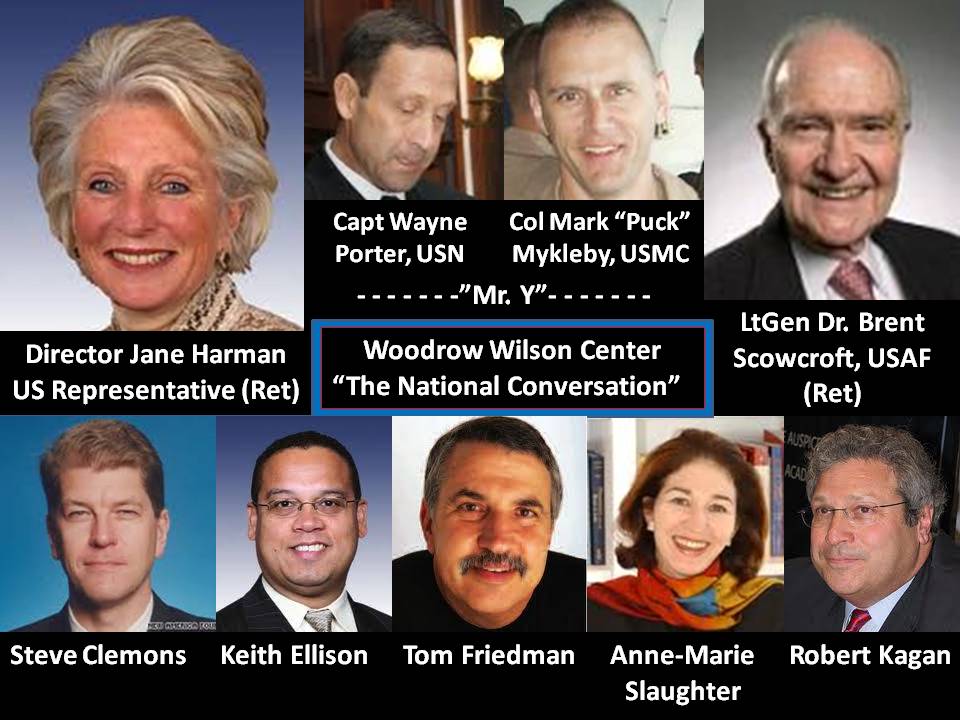
The Woodrow Wilson International Center for Scholars has announced a new initiative launching April 8, 2011: The National Conversation at the Woodrow Wilson Center. The National Conversation will examine overarching themes of U.S. international and domestic policy, drawing on high-profile guests and experts from all sides of the political sphere to provide thoughtful, intelligent explorations of challenging issues with the goal of informing the national public policy debate.
From uprisings in the Arab world to troubled economies around the globe, challenges to America’s role in the global community have seldom been greater or more complex. And with economic woes at home and our military capacity stretched thin through involvement in Afghanistan, Iraq, and Libya, many are left wondering about our ability to respond and adapt to a rapidly changing world. At a time when national unity around a shared vision is lacking, there is a growing belief that a new national security narrative must emerge that defines the role of the U.S. in global affairs for a new century. But can we achieve such a national consensus in this era of hyper-partisanship? A possible answer comes in the form of an anonymous “white paper.” Two US military officers have written an essay describing a vision for the missing narrative under the authorship of “Mr. Y.” Join our panel as it discusses the ideas contained in this provocative paper from an unexpected source. Is this the blueprint for the narrative we seek?
The inaugural National Conversation kicks off April 8 from 12:00 to 1:30 p.m., with a discussion on the search for a new national security narrative to guide U.S. policy in the 21st Century. Five panelists will participate in a discussion moderated by award-winning New York Times columnist and author Thomas Friedman. The panel will feature: Steve Clemons, founder of the American Strategy Program at the New America Foundation; Representative Keith Ellison (D-MN), the first Muslim American to be elected into the U.S. Congress; Robert Kagan, senior fellow for foreign policy at the Brookings Institution; Brent Scowcroft, U.S. national security adviser to President Ford and President H.W. Bush; and Professor Anne Marie Slaughter, former director for policy planning for the U.S. Department of State and current Bert G. Kerstetter '66 University Professor of Politics and International Affairs at Princeton University.

 The State of the Internet of Things – Is There Enough Commercial Activity?
 Maziar Bahari faces jail if he returns to Iran