Open source protest, an organizational method that allows many, many small groups to come together to take on larger foes, has been spreading by leaps and bounds. It's now reached Moscow. A picture from today: The crowds on Moscow's Bolotnaya Square (and the spires of the Kremlin beyond). Here are some nice aerial shots.
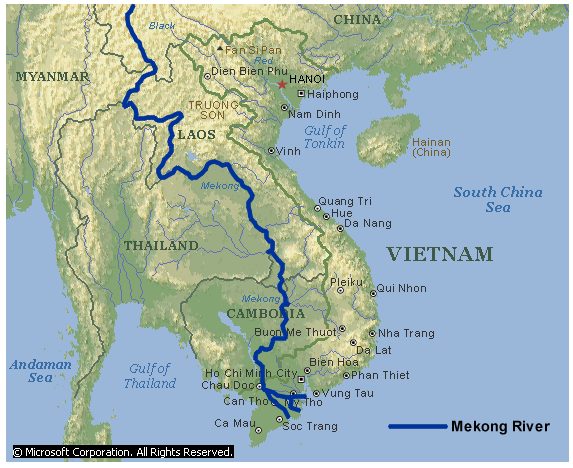
China-Mekong River Nations: Chinese press reported that joint security patrols with Thailand, Laos and Burma/ Myanmar will begin along the Mekong River. At a ministerial meeting in Beijing, the four countries agreed to begin the first patrol before 15 December and that the operation's headquarters be located in China. The patrols will allow shipping to restart and guarantee security with China to help train and equip police in Laos and Myanmar.
Comment: Many younger Readers might not know that the Mekong River originates in southwest China and flows southwards through Southeast Asia to the South China Sea. The omission of Cambodia from the joint agreement indicates the security problems are in the upper reaches of the river. Thus, the security problems are in effect, inland waterways security issues along navigable waterways.
The interesting dynamic is the Chinese success in moving southward, by exploiting lapses of local security along a key waterway, to extend the Chinese sphere of influence. The Chinese have not had Chinese patrol boats or river security advisors on the Mekong along the Laos, Burma and Thai borders in centuries.
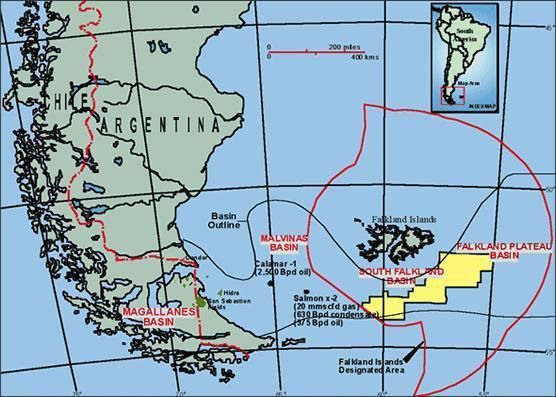
Phi Beta Iota: Viet-Nam, long a co-equal and counter-weight to China in Southeast Asia, is not mentioned. As the map illuminates, Cambodia and Viet-Nam control the entry points to the Mekong River. Viet-Nam's control of the eastern coast also precludes–absent an agreement–an obvious option for future commerce, a major canal or rail cut from the Mekong east to Vinh, one of four Grade 1 cities in Viet-Nam, a major ground transport hub, and a notable port.
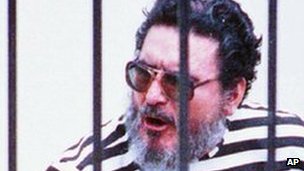
The arrest of Shining Path founder Abimael Guzman in 1992 hastened the group's demise
Peru's Shining Path rebel movement has been defeated, one of the group's few active remaining leaders has admitted.
Comrade Artemio, who heads a group in northern Peru, said they were ready to talk to the government about ending their armed rebellion.
It is not known if other rebels would be prepared to give up their arms.
The arrest of Shining Path founder Abimael Guzman in 1992 hastened the group's demise
An estimated 70,000 people died in the conflict with the Shining Path, which was at the height of its powers in the 1980s and early 1990s.
Speaking to reporters from his jungle hideout, Comrade Artemio said the Shining Path had been defeated.
“I am not going to deny that,” he said.
He said his group was prepared for dialogue with the authorities, but added that they would only surrender their weapons if the government were serious about wanting to end the armed conflict.
The Shining Path guerrillas launched their armed struggle in 1980 to remove what they saw as Peru's bourgeois democracy.
The rebels' avowed aim was to establish a communist government, of Maoist inspiration.
The arrest of Shining Path founder and leader Abimael Guzman, in 1992, and a fierce campaign during the government of President Alberto Fujimori all but dismantled the organisation.
Remnants of the guerrilla group are still active in Peru's cocaine-producing regions, engaging in sporadic clashes with police and soldiers.
While Obama worries about appeasing Israel and Jewish vote at home, as well as being pressured to support threats of an Israeli attack on Iran, the government of Israel beavers away as usual, creating new facts on the ground.
Here (portions of which are quoted below) is an editorial in Ha'aretz, one of Israel's leading newspapers, describing one way the Israeli government continues to plant seeds for the eventual cleansing of Palestinians from Jerusalem and the West Bank by exploiting the paralysis it created in what is absurdly known as the “peace process.”
Discussions on Jerusalem were postponed to a later stage of the final-status negotiations, but it was never agreed that this interlude be exploited to create facts on the ground.
Haaretz Editorial, 7 December 2011
As the diplomatic process has sunk deeper into hibernation, acts whose sole purpose is to tighten Israel's annexation of East Jerusalem have multiplied. Thus even as the Palestinians have given the Quartet a proposal on security arrangements and permanent borders in the West Bank, Israel is advancing proposals to change the master plans of neighborhoods over the Green Line.
Spinny Note: My favorite translations of Sun Tzu's classic are Thomas Cleary's for a political/phlosophical orientation and Samuel B. Griffith's for a military orientation. Readers interested in a modern application of Sun Tzu's ideas, and especially the art of using Cheng & Ch'i operations to unravel an adversary's decision cycle, will find them embedded throughout Col. John Boyd's seminal study of conflict, A Discourse on Winning and Losing, especially Patterns of Conflict and The Strategic Game.
While much of the world is in crisis and protests are erupting throughout Europe and the United States, Latin American and Caribbean nations are building consensus, advancing social justice and increasing positive cooperation in the region. Social, political and economic transformations have been taking place through democratic processes in countries such as Venezuela, Bolivia, Ecuador, Nicaragua, Uruguay, Argentina and Brazil throughout the past decade, leading to a massive reduction in poverty and income disparity in the region, and a substantial increase in social services, quality of life and direct participation in political process.
One of the major initiatives of progressive Latin American governments this century has been the creation of new regional organizations that promote integration, cooperation and solidarity amongst neighboring nations. Cuba and Venezuela began this process in 2004 with the founding of the Bolivarian Alliance for the Peoples of Our America (ALBA), that now includes Bolivia, Ecuador, Nicaragua, Dominica, St. Vincent’s and the Grenadines and Antigua and Barbuda. ALBA was initially launched in response to the US government’s failed attempt to impose its Free Trade Agreement of the Americas (FTAA) throughout the region.
Click on Image to Enlarge
Today ALBA is a thriving multilateral organization with member nations that share similar political visions for their countries and for the region, and includes numerous cooperation agreements in economic, social and cultural areas. The fundamental basis of trade amongst ALBA nations is solidarity and mutual benefit. There is no competition, exploitation or attempt to dominate amongst ALBA states. ALBA even counts on its own currency, the SUCRE, which allows for trade between member nations without dependence on the US dollar.
In 2008, the Union of South American Nations (UNASUR) was formally established as a regional body representing South American states. While ALBA is much more consolidated as a unified political voice, UNASUR represents a diversity of political positions, economic models and visions for the region. But UNASUR members share the common goal of working towards regional unity and guaranteeing the resolution of conflicts through peaceful and diplomatic means. UNASUR has already played a key role in peacefully resolving disputes in Bolivia, particularly during an attempted coup against the government of Evo Morales in 2008, and has also successfully moderated a severe conflict between Colombia and Venezuela, leading to the reestablishment of relations in 2010.
Two hundred years ago, South American Independence hero Simon Bolivar, a native of Venezuela, dreamed of building regional unity and creating a “Patria Grande” (Grand Homeland) in Latin America. After achieving independence for Venezuela, Bolivia, Ecuador and Colombia, and fighting colonialists in several Caribbean nations, Bolivar attempted to turn this dream of Latin American unity into reality. His efforts were sabotaged by powerful interests opposing the creation of a solid regional bloc, and eventually, with the aid of the United States, Bolivar was ousted from his rule in Venezuela and died isolated in Colombia several years later. Meanwhile, the US government had proceeded to implement its Monroe Doctrine, a decree first declared by President James Monroe in 1823 to ensure US domination and control over the newly-freed nations in Latin America and the Caribbean.
Nearly two hundred years of invasions, interventions, aggressions, coup d’etats and hostilities led by the US government against Latin American nations shadowed the 19th and 20th centuries. By the end of the 20th century, Washington had successfully imposed governments in every Latin American and Caribbean nation that were subordinate to its agenda, with the exception of Cuba. The Monroe Doctrine had been achieved, and the US felt confident in its control over its “backyard”.
The unexpected turn at the beginning of the 21st century in Venezuela, formerly one of Washington’s most stable and subservient partners, came as a shock to the US. Hugo Chavez had been elected President and a Revolution had begun. A coup d’etat attempt in 2002 failed to subvert the advancement of the Bolivarian Revolution and the spread of revolutionary fever throughout the region. Soon Bolivia followed, then Nicaragua and Ecuador. Argentina, Brazil and Uruguay elected socialist presidents, two of them former guerrilla fighters. Major changes began to occur throughout the region as the peoples of this vast, diverse and rich continent assumed power and made their voices heard.
Social transformations in Venezuela that gave voice to people’s power became exemplary for others in the region, as did President Chavez’s defiance of US imperialism. A powerful sentiment of Latin American sovereignty and independence grew stronger, even reaching those with governments aligned with US interests and multinational control.
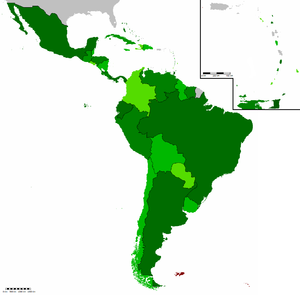
On December 2-3, 2011, the Community of Latin American and Caribbean States (CELAC) was born and the overwhelming force of a continent nearly 600 million strong, achieved a 200-year dream of unity. The 33 member nations of CELAC all agree on the unquestionable necessity to build a regional organization that represents their interests, and that excludes the overbearing presence of the US and Canada. While CELAC will take time to consolidate, the exceptional commitment evidenced by the 33 states present at its launching in Caracas, Venezuela, cannot be underestimated.
CELAC will have to overcome attempts to sabotage and neutralize its expansion and endurance, and the threats against it and intents to divide member nations will be numerous and frequent. But the resistance of the peoples of Latin America and the Caribbean who have resumed this path of unity and independence after nearly two hundred years of imperialist aggression, demonstrates the powerful force that has led this region to become an inspiration for those seeking social justice and true freedom around the world.
Phi Beta Iota: Emphasis added. This is largely a Cuban G-2 puff-piece, but it also represents real potential. A great deal will depend on whether Cuba and Venezuela get serious about creating the M4IS2 capabilities needed to harmonize internal spending while shutting out predatory external influences. We would not be surprised to find CIA Stations shut down across Central and South America in the next few years, as these governments stop tolerating incompetent but active spy units operating from official installations.
Phi Beta Iota: Variants of this stuff are for sale at Brookstone and Best Buy. The US has consistently refused to be serious about emission control, downlink security, and real-time processing. This is a “disaster” only to the degree that it reveals–once again–how immature the US “intelligence” archipelago of fiefdoms actually is.
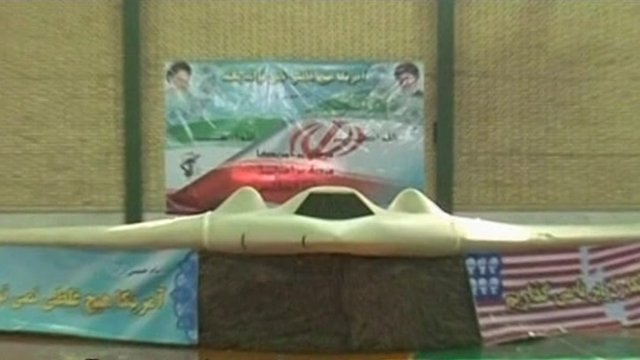
Iranian TV has shown the first video footage of an advanced US drone aircraft that Tehran says it downed near the Afghan border.
Images show Iranian military officials inspecting the RQ-170 Sentinel stealth aircraft which appears to be undamaged.
US officials have acknowledged the loss of the unmanned plane, saying it had malfunctioned.
However, Iranian officials say its forces electronically hijacked the drone and steered it to the ground.
Click on Image to Enlarge
BBC security correspondent Frank Gardner says the intact condition of the Sentinel tends to support their claim.
Iran's Press TV said that the Iranian army's “electronic warfare unit” brought down the drone on 4 December as it was flying over the city of Kashmar, about 140 miles (225km) from the Afghan border.
Nato said at the weekend that an unarmed reconnaissance aircraft had been flying a mission over western Afghanistan late last week when its operators lost control of it.
Pentagon officials have said they are concerned about Iran possibly acquiring information about the technology.
Phi Beta Iota: Our first impression has been that Iran has downed the UAV with an Electromagnetic Pulse (EMP) beam. This is much cooler. As with the Taliban in Afghanistan able to hijack the downlinks, the Iranians simply hijacked the entire aircraft. From where we sit, the Chinese (who ride electric power circuits into “isolated” computers) and the Iranians [Persians, more PhDs per capita than most] are laughing at us, while the Russians simply ignore us. Newsflash for the Pentagon: our technology is not that great. Classifying the idiot vulnerabilities does not work–something we have been pointing out for twenty years.
Bob Seelert, Chairman of Saatchi & Saatchi Worldwide (New York):When things are not going well, until you get the truth out on the table, no matter how ugly, you are not in a position to deal with it.
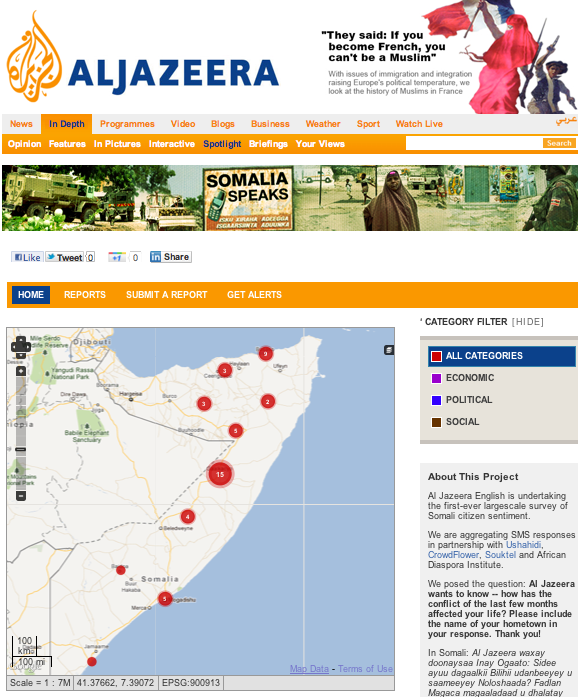
Somalia has been steadily slipping from global media attention over the past few months. The large scale crisis is no longer making headline news, which means that advocacy and lobbying groups are finding it increasingly difficult to place pressure on policymakers and humanitarian organizations to scale their intervention in the Horn of Africa. I recently discussed this issue with Al-jazeera’s Social Media Team whilst in Doha and pitched a project to them which has just gone live this hour.
The joint project combines the efforts of multiple partners including Al-Jazeera, Ushahidi, Souktel, Crowdflower, the African Diaspora Institute and the wider Somali Diaspora. The basis of my pitch to Al-jazeera was to let ordinary Somalis speak for themselves by using SMS to crowdsource their opinions on the unfolding crisis.
. . . . . . .
I am often reminded of what my friend Anand Giridharadasof the New York Times wrote last year vis-a-vis Ushahidi. To paraphrase:
They used to say that history is written by the victors. But today, before the victors win, if they win, there is a chance to scream out with a text message, a text message that will not vanish, a text message that will remain immortalized on a map for the world to bear witness. What would we know about what passed between Turks and Armenians, Germans and Jews, Hutus and Tutsis, if every one of them had had the chance, before the darkness, to declare for all time: