Let the word go out, indeed. “Those are OUR streets, and we will always be there to demonstrate… people learned a lot… we are no longer that post ideological generation, we are no longer that generation that doesn’t care… we are now the generation that will stand with everyone who’s fighting back…” They’re mad as hell, and they’re not going to take it anymore.
15 year old Tells Establishment to Stick-it.
Coalition of Resistence National Conference 27 November 2010 Camden UK
Not many know that GroupOn, Andrew Mason‘s initiative funded by Eric Lefkofsky, started as Policy Tree “Taking People Out of Politics”. Citizens were not interested in Policy Tree back then for two reasons: the outrage at mortgage fraud, Wall Street derivatives fraud, and Federal Reserve fraud had not peaked yet, and the power of GroupOn to move markets and nations had not been demonstrated. Now that GroupOn has turned down Google's offer of six billion, there is no doubt.
Put simply, GroupOn now has more power than George Soros, to take one example. GroupOn can:
1) Publish true costs for any product or service that is seriously harmful to all of us, and kill it.
2) Publicize a product or service that is good for the community, and make it a standard.
4) Organize citizens to do participatory legislation and participatory policy and participatory budgeting and participatory regulatory and propriety oversight in relation to specific issue areas, zip codes, countries, or states, and empower them as a group that cannot be ignored.
GroupOn has done what all others have failed to do: harnessed citizens in the aggregate. They have just begun. When combined with the emergence of digital natives as a political force whose outrage is now maturing (see Jon Lebkowsky's “The Kids Are All Right“), GroupOn is the game changer–not MoveOn.org, not No Labels, not Americans Elect, not IndependentVoting.org–all “old” models dominated by apparatchicks and not at all open to the collective. GroupOn. As in Group ON, dude!
Some things sell for not much more than they cost to make. Things like steel.
Others? They sell for high multiples of cost. Spa services, fancy ties, long haul airplane tickets, coaching, books–these are things that might cost a bunch to set up, but once the factory is rolling, the marginal cost of one more unit is really low. The challenge, then, is to find a way to get new customers without alienating the folks that have paid full price. Even better, to turn those new trial customers into loyal customers.
One of the challenges of selling to new customers cheap is that you might end up with a price shopper, someone who is always cheap, someone who will never convert into the kind of customer your high margin business needs to survive.
Priceline was a pioneer in figuring out how to isolate one customer type from another. The reason the original Priceline was so incredibly difficult to use (with blind reverse auctions, etc.) was that they wanted it that way. Anyone who was willing to through that hassle and anxiety to save $100 bucks for a ticket on Delta was clearly not someone Delta was going to have an easy time selling a regular ticket to. In other words, Jay Walker had figured out how to create a second type of air travel. One for cheapskates. The alternative to Priceline was a bus ticket or no travel at all… And Delta was fine with offloading excess seats to them, because they didn't have to worry about alienating their core customer.
Groupon is a very different thing. Here, it's not a hassle, it's the fun factor. Buying this way is exciting, you never know what's next, you do it with friends, the copy is funny, it's an adventure. As a result, many Groupon customers in fact do convert to becoming long time patrons of the place they tried, because they're not inherently cheap shoppers. When they're on Groupon they're hunting for fun. But if you offer an astonishing product and great service after they try you, they may convert into shopping with you for the long haul, not because you're a Groupon replacement, but because you bring them more than the alternatives.
And the magic basket? Tim Ferriss just finished offering more than $1600 worth of high-margin items in a basket to people who bought 30 copies of his new book. The marketing partners get trial among a group of people who are each paying more than the cost of a single item in the basket, these customers are proving they're not among the ultra-cheap. And the products are quasi-aligned, appealing to the same sort of consumer. Is there a cheaper way for one of these companies to reach this precise person? I'm not sure there is.
Imagine taking this even further and leaving out the book part. A basket of aligned items, all high margin, none from the market dominator, each holding out the possibility of future business… You could do this with an 8 pack of computer games or phone apps, or drink coupons from a dozen bars in the same town, or even clothing for guys size 38. Alex has experimented with this at Swagapalooza. I'm betting that there's quite a lot to be done in becoming this market creator/differentiator/middleman.
What's missing so far is an intelligent way to get permission, to follow up, to further organize those that do a trial and teach them and connect them so that they see a further incentive in sticking with the thing they just tried.
What's also missing is a willingness on the part of high-margin marketers to use their products and these sort of interactions as a replacement for the unmeasurable and largely ineffective lifestyle advertising they use now.
The net, once again, is making it easier to find and organize tribes of people, even for short durations. When you intersect these aligned groups with high-margin products, you can create fascinating commerce opportunities.
When you think about who might topple a software giant like a Microsoft or a Google, you might be inclined to think of Goliaths like, well Google and Microsoft. The same is true of any industry, you probably think of a company of similar size or larger as being the type of company that would win a battle, or a war.
Actual battles and wars end up being an interesting analogy. If you think if big battles like World War I and World War II, that’s exactly what happened – giants fighting giants from big, knowable centralized points of command. But there are some other wars that have been fought where the little guy won (or hasn’t lost in the case of one ongoing war) and there’s a common element in all of them. No centralized physical location to “take out” to win. When everything is dispersed and there isn’t any one thing to take out, it’s hard to really know how big or how small opposing force is, and they can be substantially more agile. In this situation, an organization of any size can pose a major threat to an enormous organization. The war on terror is an ongoing war that fits this profile – it’s virtually impossible to know how big or small the opposition is, or where they are at any given time, so it’s very hard to be ready for an attack from them. Viet Nam was a tough one for the US to really stand a chance in because it was in unfamiliar territory and there was no central location to take out to declare victory. One could even make the same argument (at a high level) for why the British lost the American revolution.
So if you don’t know who Rovio or CCP are, I have already made significant progress on the path of making my point.
If I didn’t know better, I would think the whole “No Labels” movement was a giant, self-parodying prank.
I tuned in to the webcast of the group’s kickoff to hear a woman saying, “You just have to look to Arizona to see extremists who are trying to divide us.” I guess I know how the group feels about the Arizona immigration enforcement law. Of course, I thought the point of the group was to stop labeling people; but I guess it’s okay to label the overwhelming majority of Arizonans “extremists.”
Bruce Braley, D-Iowa, introduced himself “a proud Democrat… who is also proud that he grew up in a no-labels house in a proud no-labels town.” He continued to sing the joys of the label-free lifestyle in a manner that probably should make his constituents look to their shoes in shame: “The most important place I go every day is the House gym. Because there are no labels in the House gym.”
I can’t help but notice that the Republicans involved all lost primaries or fled the party: Bob Inglis, Mike Castle, Charlie Crist, Michael Bloomberg.
Early Comments by Others:
Dan Davis: Funny how the people behind “No Labels” seem to be people that were sporting labels that Americans rejected in a resounding manner. Labels are not the problem. It is the worldviews and ideals that they themselves imbued said labels with! Ditching the labels is a short term solution.
EMC Geek: So if something doesn't have a label, isn't that an indication it's reached it's expiration date?
Blackhawks: I don't totally disagree with their stated goals, but their “no labels” reminds me a little too much of the “No Logo” Naomi Klein book, which I definitely disagreed with.
Davidinvirginia: Well, after all, some of the best and funniest self-parody is completely unintentional. 🙂
This bunch is almost too sad and pathetic to be funny, though.
A new movement called “No Labels” is hoping to help tone down the heated rhetoric in Washington. Headed by New York Mayor Michael Bloomberg, a veritable ‘who's who' of moderate politicians are participating in the No Labels launch in New York City. Among the participants are: retiring Sen. Evan Bayh (D-Ind.), Sen. Kirstin Gillibrand (D-N.Y.), Rep. Bob Inglis (R-S.C.), former Rep. Tom Davis (R-Va.), Sen. Joe Lieberman (I-Conn.) and Republican-turned-independent Florida Gov. Charlie Crist.
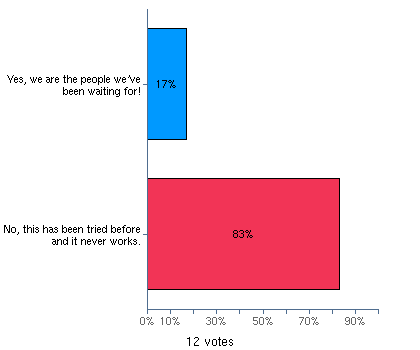
Phi Beta Iota: These folks mean well, but they are totally without a clue when it comes to actually embracing, empowering, and exploiting (in the positive sense of the word) the collective intelligence of the Republic. This is an apparatchik move through and through, and the manner in which it has been organized, the money behind it, and the total absence of any intelligent structure (e.g. electoral reform, virtual cabinet, online participatory policy-budget exercise) make it clear that it is a dead end. Preliminary voting suggested that most are not fooled and see it for the negative it is–another theatrical display lacking in authenticity.
“..providing the most accurate and up-to-date information on seafood available in the U.S. FishWatch is brought to you by NOAA Fisheries Service, the U.S. authority on marine fisheries science, conservation, and management.” ;
Also see:
+ Seafood harvest calendar + FishPhone: Text 30644 with the message FISH and the name of the fish in question. We'll text you back with our assessment and better alternatives to fish with significant environmental concerns. Also: text the word BLUE to 30644 to opt-in to receive ocean-alerts, info on new seafood rankings and cooking tips.