Journal: Haiti Highlights Death of US C4I

Collaboration Zones, Communities of Practice, Ethics, Key Players, Methods & Process, Mobile, Policies, Real Time, Threats
Full Story Online

Things are going to get a lot worse in Haiti before they get better, and that was never clearly articulated by the President, State Department, SOUTHCOM, or Rajiv Shah to the American people, who may begin to doubt our governments efforts in the very near future. President Obama is positioned to take a political hit for what happens over the next 48-72 hours for apparently having advisors who are treating Haiti as anything but the most important event of his political career to date.

Phi Beta Iota: The USG, the US IC, and DoD have been told for 21 years, beginning with General Al Gray's 1989 article, “Global Intelligence Challenges in the 1990's,” and ending most recently with General Mike Flynn's Fixing Intel–A Blueprint for Making Intelligence Relevant in Afghanistan, that they are not being serious about Open Sources, Multinational Engagement, the Eight Tribes, and on and on and on.  We need a Defense Open Source Center (DOSC) with an embedded Multinational Decision Support Center (MDSC) that simultaneously creates a global grid with the 90 countries that have OSINT centers within their military C4I structure, and regional grids that are under the control and in the service of the various regional unions, beginning with UNASUR and then AU and SCO and ASEAN, and so on–our money, their information.  Haiti is Obama's Katrina–not because he's a bad President or has an inattentive Cabinet, but because the “system” of governance is Industrial-Era C4I totally out of touch with modern possibilities.
Journal: Haiti Public Intelligence Emergent

08 Wild Cards, Analysis, Budgets & Funding, Collaboration Zones, Communities of Practice, Ethics, Geospatial, InfoOps (IO), IO Mapping, Methods & Process, Mobile, Policies, Real Time, Threats, Tools

Full Story Online

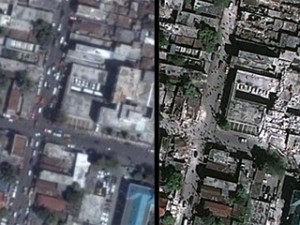
Google Maps updates with new Haiti pics: Hours-old satellite images show destruction

Google has released a new KML overlay — tech speak for map layer — that includes fresh images of Port-au-Prince.

According to GeoEye , the satellite imagery company that provided the photos, they were taken at 10:30 a.m. yesterday from a satellite 423 miles up.

By toggling the new image layer on and off, it’s easy to compare what the city looked like before the earthquake with the way it looks now.

Aside from the obvious destruction, one of the most striking features of the new images is the large number of presumably homeless people in the streets of the ruined neighborhoods.

Click here to see the new images in Google Maps.

Phi Beta Iota: Finally, but kudos never-the-less.  This should always be the first thing done, perhaps with a global arrangement that has regional cost-sharing in place and can use military air breathers where commercial are not immediately available, but respecting Google's software and end-user delivery offering.  There is still the matter of getting to shared Spacial Reference Systems (SRS).  This could and should be used to “plot” Twitter messages that identify need, and in the back office, matching RapidSMS messages that can be aggregated to fund need resolution.

Where Are Haiti Earthquake Relief Funds Going?

Millions in donations have been raised since the earthquake in Haiti on Tuesday, but where is the money going?

Like Wyclef Jean's Yele Haiti which is urging people to text “Yele” to 501501 to donate $5 to the cause — which has raised more than $2 million so far — many other relief organizations have used mobile messaging to quickly gather funds.

Phi Beta Iota: What is most interesting about this is the fact that fund-raising (financial incentive for the organizers that take a 5% to 50% “cut) is very well developed and moving money, while the other end (requirements definition, logistics coordination, and “by household” delivery” is NOT developed at all.  This is a good start toward the Global to Local Range of Needs Table, when that is developed, this will “flip” in that people will give for SPECIFIC itemized needs, not as a leap of faith in intermediaries that generally do NOT deliver full value.

What is LACKING is a single trusted Multinational Decision Support Center with both regional and global non-profit “cachet” as well as two-way reachback into all eight tribes of all nations, that can be the single point orchestrating the receipt and integration of all information in all languages in near-real-time, and the trusted point for validating both needs and the resolution of needs through the application of fundss.

See Also:

Continue reading “Journal: Haiti Public Intelligence Emergent”

Journal: MILNET Selected Headlines

04 Inter-State Conflict, 05 Civil War, 06 Genocide, 07 Other Atrocities, 08 Wild Cards, 10 Security, Cultural Intelligence, Military, Peace Intelligence

British Search And Rescue Team Turned Away From Port-Au-Prince

There were reports that the airport at Port-au-Prince had run out of aviation fuel, one of the factors that is understood to have led the US military to close it. . . . The scene at Santo Domingo airport was one of chaos, uncertainty and often despair for aid workers.

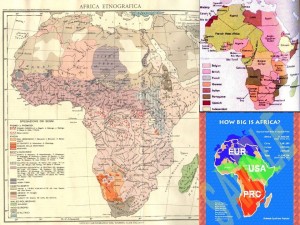
Ethno-Colonial BIG Africa

Phi Beta Iota: Lesson learned by the USMC the hard way (as of 1992):  need Forward Area Refueling Points (FARP) in the FIRST lift.

U.S. Army Africa Boss: ‘I Feel Like The Lone Ranger…'

“Africa’s not high on America’s priority list these days.

Sometimes I feel like the Lone Ranger trying to get people to bring resources to bear out here.”

I had pointed out in an earlier interview that U.S. Army Africa and Africa Command in general are notably absent from the wars in Democratic Republic of Congo and Sudan, conflicts Garrett said are “currently the world’s two deadliest.”

Full Story Online

For Israel, a Reckoning

A new global movement is challenging Israel's violations of international law with the same strategies that were used against apartheid

Phi Beta Iota: Israeli influence on the US Government has been as bad as post-war Nazi influence on the Cold War ubbas–both have spawned policies that have murdered and displaced millions, with attendant atrocities.

Pakistan: U.S.-Backed Broadcast Begins

Phi Beta Iota: Too little too late and they almost certainly have no idea about the history of the Pashtun Peace Army.

Full Story Online

Taliban steps up violence in Afghanistan

Recent Pakistani military operations in insurgent strongholds in Pakistan also have driven greater numbers of Pakistan-based Taliban back into Afghanistan, the officer said.

UK plans ‘trust fund' to woo Taliban fighters

Phi Beta Iota: Turn in one weapon, get enough money for two…or go enlist and training and food along with a new weapon.  Money corrupts and it is not a substitute for Whole of Government Stabilization & Reconstruction accomplishments.

How To Apply ‘Smart Power' In Yemen

Developing a coherent strategy focused on the right objectives is important, and hard to do. The country team in any normal American embassy (like the one in Sana) does not have the staff, resources or experience to do so. The limited American military presence in Yemen does not either. Despite years of talk about the need to develop this kind of capability in the State Department or elsewhere in Washington, it does not exist. It must be built now, and quickly.

Phi Beta Iota: Start with Tony Zinni's The Battle for Peace and implement Robert Steele's DoD OSINT-M4IS2  Strategy along with Whole of Government Intelligence (Decision-Support).

Journal: Critique of Government Banking Policies

03 Economy, Civil Society, Commerce, Commercial Intelligence, Ethics, Government
Chuck Spinney

President Obama has a rapidly vanishing opportunity to achieve historical greatness as a trust buster by breaking up the banks.  Trust busting is an almost risk free path to lasting respect — Teddy Roosevelt's honored place in American history is more a result of his trust busting than his gross imperialism.

In the attached article, my good friend Marshall Auerback explains why Obama's faux populism attacks the symptom rather than the disease now infecting our financial system.

My guess is that Obama's “reform” policies — i.e., change we can believe in — will not even be smart politics in the long run, because at the end of the day, suckering the Tea Baggers (not to mention the so-called progressives) with phony populist appeals, while supporting cosmetic banking reforms, will alienate just about everyone except the oligarchical elites benefitting from his protectionist policies.  In this sense, Mr. Obama is rapidly becoming just another Bill Clinton, a highly intelligent, self-made man of the people who squandered his opportunity for greatness on the altar of short-sighted service to the rich and powerful.

Chuck Spinney

Full Story Online

Attack the Disease, Not the Symptoms

Marshall Auerback Jan 13,2010

Obama still doesn’t get it on how to rein in Wall Street.

Conceptual confusion remains at the heart of President Obama’s economic policy.

Journal: Second Amendment versus “Police Pirvacy”

07 Other Atrocities, 09 Justice, 11 Society, Civil Society, Collective Intelligence, Cultural Intelligence, Ethics, Law Enforcement, Peace Intelligence, Real Time
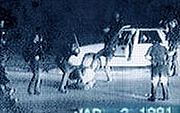
Rodney King Video Wiki Page

Police fight cellphone recordings: Witnesses taking audio of officers arrested, charged with illegal surveillance

Crooked cops in Boston arresting citizens for recording misconduct with cellphones

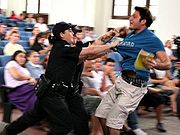
Don't Tase Me Bro Wiki

Phi Beta Iota: The police will not only lose this one, we anticipate that one day the Second Amendment will apply to radar detectors and other forms of defense against state excesses.  Certainly the public needs to take its right to be armed–both with weapons and with hip-pocket recording devices, with the utmost seriousness.

Three observations:

1.  Society has forgotten how to be civil at the same time that government has forgotten how to govern (satisfy most of the people most of the time, deal humanely with the rest).

2.  Police have become increasingly militarized and the 9/11 pork has made them more so, at the same time that the FBI and similar forms of authority have forgotten how to do arrests without a SWAT team crashing through the door first.

3.  If you tell the truth and act according to the truth, such counter-surveillance is utlimately beneficial to the truth teller rather than the abuser.

Ultimately, in our view, public use of public technologies to create public intelligence about police abuse and government waste and corporate externalizations of cost (Taiwan now pays for citizen cell recordings of pollution discharges), will be a beneficial means of restoring the public's power over “it's” police forces.

Journal: MILNET Selected Headlines

10 Security

U.S. Mobilizes to Send Assistance to Haiti

Phi Beta Iota: US military has been slow but more attentive than in the past.  They still lack Peace Jumpers, rapid-response peace flights, and multinational intelligence and logistics coordination “in a box.”  Afterthought:  PSYOP facilities, personnel, budget, and air leaflet capabilities could all be beneficially transfered to the Army Civil Affairs Brigade–drop peace instead of propaganda…

China's Google dilemma: Soften on censorship or anger millions of Internet users

Phi Beta Iota: Google is slinking out of town under false pretenses. Baidu and related Chinese offerings are not only better than Google, including voice to text and text to voice better than Google per Jim Fallows of the Atlantic Monthly now resident in China, they have been less arrogant about respecting China's concerns.  Look for Baidu to expand into Africa, South America, and Central Asia.  The Google Wave has crested.

What Happens When They Change Targets? (Richard Forno in CounterPunch)

…given the erratic and schizophrenic security responses to terrorism involving aircraft since 9/11, what will be our national response when our adversaries shift their focus towards other non-aviation targets? Here, I refer to things closer to our homes and families, such as schools, movie theaters, and shopping malls.

Phi Beta Iota: The US “government” at the political and policy level still thinks it owns the big stick and has not figured out that legitimacy and morality are what keep 90% of the potential “threat” neutral so that the last 10% can be dealt with using repressive measures  Dr. Col Max Manwaring of the U.S. Army Strategic Studies Institute has it figured out, see his 21st Century Security Trilogy.

Lawmaker Challenges Gates' 80-Percent Solution Effort (Full Text Below the Fold)

Phi Beta Iota: Gates is right, this is a US Navy go-around, time to fire the CNO for two reasons: 1) insubordination; and 2) too ignorant or obstinant to create a 450 ship Navy within the existing gold-plated budget.  This is the same CNO that interpreted “Irregular Warfare” as a life-best for SSBN's and focused all money on creating new things to throw out of the five-foot wide tubes, instead of trolling for pirates the way CENTCOM J-2P suggested in 2005.

Continue reading “Journal: MILNET Selected Headlines”

Journal: Endless Money for War, No Checks & Balances

04 Inter-State Conflict, 05 Civil War, 09 Terrorism, 10 Security, Military, Strategy
Chuck Spinney

It is becoming increasingly clear that 1981 was a watershed year in the history of the American political economy. What checks and balances that remained broke down. Deregulation, for example, took off and the bomb of private debt exploded (recall the chart I circulated earlier). The trade deficit skyrocketed after 1981, and deindustrialization, which started in the late 1960s took off with a vengeance. The growth in real income stagnated and gap between the rich and poor began to expand rapidly.

The same collapse of political-eocnomic checks and balances occurred in what was already a poorly checked defense sector. During the first 30 years of the Cold War with the Soviet superpower, between 1950 and 1980, the defense budget never experienced more than three consecutive years of real growth (i.e., after removing the effects of inflation) before going into decline. During war and peace, the inflation adjusted budget oscillated around a relatively constant or slightly growing median value (if one believes the Pentagons estimates of inflation). That pattern changed radically with the ascent of Ronald Reagan to the presidency. The budget began to grow much more rapidly and the checking process weakened markedly during the 1980s and especially the mid 1990s, when the budget began increasing even though the superpower threat evaporated.

With the election of George Bush II in 2000, any remaining checks on budget growth came off (as can been seen in Slide 1 of my June 2002 statement to Congress, which can be downloaded here), and then, spurred on by the politics of fear which enveloped the US after 911, the checking process to ceased completely and the defense budgeting process spun out of control, as a part of it went to fight never ending guerrilla wars but most of it went to propping up a modernization program and force structure that is an outmoded legacy of the Cold War.

Now, if there is any truth to the attached AP report, Bush's insane madness has captured President Obama and he is power boosting the defense budget further, albeit with feeble promises of small declines in the future, which will no doubt be forgotten in the unfolding politics of the permanent war economy.

Chuck

AP Exclusive: Obama wants $33 billion more for war

By ANNE GEARAN and ANNE FLAHERTY

The Associated Press  January 12, 2010

The Obama administration plans to ask Congress for an additional $33 billion to fight unpopular wars in Afghanistan and Iraq, on top of a record request for $708 billion for the Defense Department next year, The Associated Press has learned.

noble gold