Reference: Contours of 21st Century Conflict

02 China, 04 Inter-State Conflict, 06 Russia, 10 Security, 11 Society, Advanced Cyber/IO, Cultural Intelligence, DoD, Government, InfoOps (IO), Military, Officers Call, Strategy, White Papers
Berto Jongman Recommends...

Worth a read. Interesting report based on innovative research method.  From the Hague Centre for Strategic Studies.

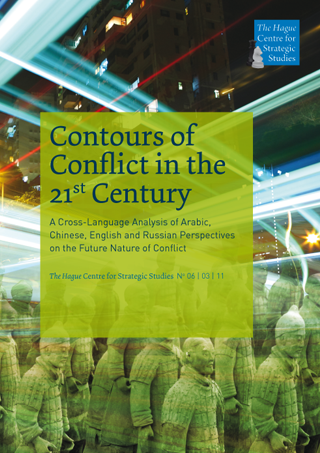
Report: Contours of Conflict in the 21st Century

EXTRACT from Overview:

In gaining a better understanding of the future nature of conflict, it is therefore of the utmost importance to go beyond the traditional Western (English) language domain experts, and include views from regions across the world. The main purpose of the Future Nature of Conflict project is therefore to map and analyze global perspectives about the future nature of conflict published over the last two decades across four language domains – Arabic, Chinese, English and Slavic.
Click on Image to Enlarge

Phi Beta Iota:  Finally!  For years we have talked about the need to do multi-lingual perspectives and statements (e.g. charting Chinese, Vietnamese, Philippine, and Australian statements on the Spratley Islands going back 200 years).  The protocol developed by this team must be –along with M4IS2–the future of strategic dialog, policy, acquisition, and operations.  Any intelligence community that is unable to do this for any issue, any question, may as well go out of business.

Reading through the report is a real pleasure, with all sources being spelled out in footnotes that are actively linked to the original sources.  This is a marvelous gift to scholars and practitioners at multiple levels.

A few highlights:

Continue reading “Reference: Contours of 21st Century Conflict”

Chuck Spinney: Dysfunctional West Sharply Unstable

07 Other Atrocities, Blog Wisdom, Budgets & Funding, Civil Society, Corruption, Counter-Oppression/Counter-Dictatorship Practices, Cultural Intelligence, Government, IO Deeds of War, IO Impotency, Misinformation & Propaganda, Money, Banks & Concentrated Wealth, Power Behind-the-Scenes/Special Interests
Chuck Spinney

Item 1 is an insightful essay by Patrick Seale outlining the common characteristics of the political instabilities and revolutionary pressures now sweeping Europe and the Middle East.  Although Seale uses the term Global Intifada to describe these instabilities, the term Intifada evolved out of the Palestinian struggle against occupation.  He suggests the instabilities may be following a more general dynamic.  The common causal factors he describes in the second paragraph also bring to mind a very loose comparison of the unrest unleashed in 2011 to the explosion of revolutions in 1848 across Europe.  That many of Seale's common factors also exist in varying degrees in the United States makes one wonder why the politics of rage in the US remain confined to the right side of political spectrum. Item 2, “The World Consequences of US Decline,” is an equally insightful essay by Immanuel Wallerstein that suggests obliquely that this may be a temporary condition.

Chuck Spinney
Nice, France

Continue reading “Chuck Spinney: Dysfunctional West Sharply Unstable”

John Robb: Failure of Government in One Anecdote

01 Brazil, 01 Poverty, 04 Education, 10 Security, 11 Society, Blog Wisdom, Civil Society, Cultural Intelligence, Government, IO Deeds of Peace, IO Impotency, Methods & Process, Military
John Robb

Status check on Brazil's specialized police units trying to supplant illicit drug governance in the favelas. Per an upcoming law, these units will be in place for 25 years. “Many communities previously relied on the drug gangs for services from water to wireless internet, and critics have pointed out that the state has been slow to replace them.”

Phi Beta Iota:  The program has been successful in applying ruthless pervasive special violence to displace the drug gangs and insert permanent police presence.  The program has FAILED in two respects: it has not been accompanied by the rapid provision of normal services from water to wireless; and it has not provided for the education of the people, something that requires call centers and free cell access to the Internet (they don't have the time to sit in a classroom for N years).

In their own words:

“People in the favela don't believe in themselves. What is really needed in the long term is more education.”

Reference: US Secret Intelligence, US Banks, Illicit Gold, Murder of the Global Economy, RECAP

04 Inter-State Conflict, 07 Other Atrocities, 10 Security, 10 Transnational Crime, 11 Society, Budgets & Funding, Commerce, Commercial Intelligence, Corruption, Counter-Oppression/Counter-Dictatorship Practices, Cultural Intelligence, Director of National Intelligence et al (IC), Government, History, Intelligence (government), IO Deeds of War, Military, Misinformation & Propaganda, Money, Banks & Concentrated Wealth, Officers Call, Power Behind-the-Scenes/Special Interests, Secrecy & Politics of Secrecy

The memorandum “Collateral Damage: U.S. Covert Operations and the Terrorist Attacks on September 11, 2001” has been circulating for years on the Internet, studiously ignored by most.  It was previously posted as a journal item on this website.  Since then, the public has learned a great deal more about both gold and greed, and the memorandum is once again circulating.

This is by no means the complete story, and there are some leaps of imagination and speculation that must be deeply investigated or discounted.  Central to appreciating the magnitude of the government cover-up is the FACT that MONTHS before 9/11 Dick Cheney set in motion the national counter-terrorism exercise that gave him complete control on “the day” of 9/11.

What is clear is that there is a great deal more investigation to be done, and that a truth and reconciliation commission should be created in  time to put Dick Cheney and the others on the stand before they either die a natural death or are assassinated by foreign governments righteously angry over what has been done to them by American children playing with fire.

Here are a few extracts that today have a greater likelihood of being appreciated for their substance.

Continue reading “Reference: US Secret Intelligence, US Banks, Illicit Gold, Murder of the Global Economy, RECAP”

Winslow Wheeler: Leon Panetta Misleads Public

10 Security, 11 Society, Civil Society, Corruption, DoD, Government, IO Deeds of War, Military, Officers Call, Peace Intelligence
Winslow Wheeler
Secretary of Defense Panetta used an invitation to the National War College as an opportunity to lobby against cutting the defense budget more than the $350 billion he has already agreed to.  In the absence of any informed or probing questions, Panetta's extreme rhetoric has also oozed into new Washington DC hysteria resulting from reports about a new round of Pentagon budget cuts.  Even the most severe version of the cuts being bandied about would leave DOD quite flush with money in historic terms.
These are the themes in a new piece, “Elitist Tripe on Defense Spending,” at AOL Defense.

The invitation came to me from Secretary of Defense Leon Panetta's public affairs office to attend a “conversation” with Panetta and Secretary of State Hilary Clinton at the prestigious National Defense University in Washington. Although I knew it wasn't me they wanted to talk to, I sat in the audience to hear Panetta and Clinton in action, especially on the subject of my prime interest: the defense budget.

Continue reading “Winslow Wheeler: Leon Panetta Misleads Public”

Sandy Heierbacher: Deliberative Policy Engagement – Nine Principles

Advanced Cyber/IO, Collective Intelligence, Communities of Practice, Ethics, Methods & Process, Policies, White Papers
Sandy Heierbacher

Deliberative Public Engagement: Nine Principles

Posted by   |  August 18th, 2011

Deliberative is a distinctive approach to involving people in . It is different from other forms of engagement in that it is about giving participants time to consider and discuss an issue in depth before they come to a considered view. The aim of this 18-page background paper (2008) from Involve and the National Consumer Council is to encourage and support deliberative in public policy.

itself – where a range of people learn, discuss and work out solutions together – is not new. Forums, advisory groups, partnerships and some forms of consultation have done this for years and are becoming increasingly sophisticated. More recently, citizens’ juries and large-scale citizens’ summits have found favour with government and public service providers at both local and national levels.

Involve and the National Consumer Council (NCC) believe that deliberative can be valuable in helping to create better public services, promote social cohesion and foster a thriving democracy. There is already good practice throughout the UK, and the full potential contribution of to improving the quality of decisions and policy solutions, and to enhancing representative democracy is becoming clearer as experience grows.

The government and other public bodies are currently developing general guidelines on public and stakeholder engagement – making it timely for Involve and NCC to draw on the growing body of learning and evidence to contribute a set of specific principles on deliberative public engagement from outside government.

This is far from being the last word. Over the next year Involve and NCC will continue to monitor the field, listen to feedback on the value and relevance of these principles, and consider the potential need for more detailed guidance. In the mean time, we hope our work will contribute to the already-flourishing debate on the role of deliberative public engagement in Britain today.

Resource Link

Phi Beta Iota:  The 18 page document is available in English, French, and Turkish.  The nine principles of public engagement discussed in the document are:

  • The process makes a difference.
  • The process is transparent.
  • The process has integrity.
  • The process is tailored to circumstances.
  • The process involves the right number and types of people.
  • The process treats participants with respect.
  • The process gives priority to participants' discussions.
  • The process is reviewed and evaluated to improve practice.
  • Participants are kept informed.

See Also:

Tom Atlee: Citizen Deliberations – Chart and Options

Participatory Budgeting Practices, Games, Resources

Memoranda: Policy-Budget Outreach Tool


Patrick Meier: Crowdsourcing Imagery Analysis

Advanced Cyber/IO, Analysis, Blog Wisdom, Collective Intelligence, Geospatial, InfoOps (IO), Methods & Process, Threats
Patrick Meier

Analyzing Satellite Imagery of the Somali Crisis Using Crowdsourcing

EXTRACT:

Here’s the plan. He talks to UNOSAT and Google about acquiring high-resolution satellite imagery for those geographic areas for which they need more information on. A colleague of mine in San Diego just launched his own company to develop mechanical turk & micro tasking solutions for disaster response. He takes this satellite imagery and cuts it into say 50×50 kilometers square images for micro-tasking purposes.

We then develop a web-based interface where volunteers from the Standby Volunteer Task Force (SBTF) sign in and get one high resolution 50×50 km image displayed to them at a time. For each image, they answer the question: “Are there any human shelters discernible in this picture? [Yes/No].” If yes, what would you approximate the population of that shelter to be? [1-20; 21-50; 50-100; 100+].” Additional questions could be added. Note that we’d provide them with guidelines on how to identify human shelters and estimate population figures.

Read more….

noble gold