Seed Money for Ideas Addressing Global Health Challenges–and the Fly in the Milk Bowl

01 Poverty, 02 Infectious Disease, 07 Health, 12 Water, Gift Intelligence, Peace Intelligence, Technologies

Unorthodox thinking is essential to overcoming the most persistent challenges in global health. Vaccines were first developed over 200 years ago because revolutionary thinkers took an entirely new approach to preventing disease. Grand Challenges Explorations fosters innovation in global health research.

The Bill & Melinda Gates Foundation has committed $100 million to encourage scientists worldwide to expand the pipeline of ideas to fight our greatest health challenges.Launched in 2008, Grand Challenge Explorations grants have already been awarded to 340 researchers from 34 countries.

Open to All Disciplines: Anyone Can Apply
The grant program is open to anyone from any discipline, from student to tenured professor, and from any organization – colleges and universities, government laboratories, research institutions, non-profit organizations and for-profit companies.

Agile, Accelerated Grant-Making
The initiative uses an agile, accelerated grant-making process with short two-page applications and no preliminary data required.

Applications are submitted online, and winning grants are chosen approximately 4 months from the submission deadline.Initial grants of $100,000 are awarded two times a year. Successful projects have the opportunity to receive a follow-on grant of up to $1 million.

Example: Water Sanitation Challenge that earns $100,000

De-compartmentalizing science through Grandchallenges.org

Phi Beta Iota: The problem with this well-intentioned initiative is that it throws money as items in isolation.  All well and good.  It would be much more impressive if it had a strategic analytic model that emphasized healthy lifestyle, healthy environment, and natural/alternative cures; and if it demanded some form of intelligence coordination in relation to all the other policies that impact on health far more negatively that we can solve–the bottom line is that we are killing our species faster than any amount of innovation can help it survive.  In our humble opinion.

Google, MSoft, IBM, HP, Oracle, Intel (chips), National Security and Perceived Internet Threats

04 Education, 04 Inter-State Conflict, 10 Security, Commerce, Computer/online security, Cyberscams, malware, spam, Government, Military, Misinformation & Propaganda, Secrecy & Politics of Secrecy, Technologies
  • U.S. Strategy: Control The World By Controlling The Internet
    A Chinese Perspective, by Chen Baoguo, August 24, 2010
    In May 2009, Microsoft announced on its website that they would turn off the Windows Live Messenger service for Cuba, Syria, Iran, Sudan and North Korea, in accordance with US legislation. In January 2010, Google, the company which owns the largest Internet information resources, declared that in order to establish a more open Internet environment, they had to abandon the Chinese market.What is even more worrying is that Senator Joseph Lieberman, chairman of US Homeland Security Committee, recently presented to the US Senate a bill titled “Protecting Cyberspace as a National Asset. “To control the world by controlling the Internet has been a dominant strategy of the US.From the network infrastructure protection of the Clinton era to the network anti-terrorism of the Bush era and to the “network deterrence” of the Obama era, the national information security strategy of the US has evolved from a preventative strategy to a preemptive one.Meanwhile, the methodology has moved from trying to control Internet hardware to control of Internet content.

  • Video: “The cyber-threat has been grossly exaggerated” debate between Marc Rotenberg & Bruce Schneier VERSUS Mike McConnell & Jonathan Zittrain

  • China Cyber-army Talk Pulled from Black Hat
    By: Brian Prince 2010-07-15
    A presentation on Chinese state-sponsored hacking has been pulled from the Black Hat security conference due to pressure from the Taiwanese government. The talk, titled “The Chinese Cyber Army: An Archaeological Study from 2001 to 2010,” was to be held by Wayne Huang, CTO of Web application security firm Armorize Technologies.

CrisisWatch N°85, 1 September 2010

09 Terrorism, CrisisWatch reports

Five actual or potential conflict situations around the world deteriorated and none improved in August 2010, according to the new issue of the International Crisis Group’s monthly bulletin CrisisWatch, released today.

The situation in Somalia continued to deteriorate as al-Shabaab stepped up its attacks and fighting intensified in Mogadishu. Late in the month the militant Islamist group stormed a hotel in the capital killing at least 35 people, including six MPs; days later four AMISOM peacekeepers were killed when insurgents shelled the presidential palace. There were also worrying developments in the previously stable semi-autonomous region of Puntland when Islamist militants under Mohamed Said Atom clashed with government troops.

Kyrgyzstan’s provisional government was further weakened in August. The month began with an attempted coup and culminated with the mayor of the southern city of Osh – the epicenter of June’s pogroms – defying the President’s orders to resign.

Continue reading “CrisisWatch N°85, 1 September 2010”

Journal: Cognitive Dissonance in Afghanistan

07 Other Atrocities, 08 Wild Cards, Methods & Process, Military
Marcus Aurelius Recommends

The author was “ordered home” within 24 hours (took three days to get him out).  Multiple commentaries suggest that he is actually “understated” in his remarks.  Below the line is balance of article, Small Wars Journal intelligence commentary, and link to illustrated blog with added value.  EDIT of 7 Sep 2010 to add comment from LtCol  Karen Kwiatkowski, USAF (Ret), at end.

Outside View: PowerPoints ‘R' Us

United Press International (UPI)

Aug 24 10:19 AM US/Eastern

KABUL, Afghanistan, Aug. 24 (UPI) — Throughout my career I have been known to walk that fine line between good taste and unemployment. I see no reason to change that now.

Consider the following therapeutic.

I have been assigned as a staff officer to a headquarters in Afghanistan for about two months. During that time, I have not done anything productive. Fortunately little of substance is really done here, but that is a task we do well.

We are part of the operational arm of the International Security Assistance Force commanded by U.S. Army Gen. David Petraeus. It is composed of military representatives from all the NATO countries, several of which I cannot pronounce.

Officially, IJC was founded in late 2009 to coordinate operations among all the regional commands in Afghanistan. More likely it was founded to provide some general a three-star command. Starting with a small group of dedicated and intelligent officers, IJC has successfully grown into a stove-piped and bloated organization, top-heavy in rank. Around here you can't swing a dead cat without hitting a colonel.

Continue reading “Journal: Cognitive Dissonance in Afghanistan”

Journal: Facing prison for filming US police

07 Other Atrocities, 09 Justice, Corruption, Cultural Intelligence, Law Enforcement, Peace Intelligence
Facing prison for filming US police
By Chris Arsenault

When police arrested Anthony Graber for speeding on his motorbike, the 25-year-old probably did not see himself as an advocate for police accountability in the age of new media.

But Graber, a sergeant with the Maryland Air National Guard, is now facing 16 years in prison, not for dangerous driving, but for a Youtube video he posted after receiving a speeding ticket.

FULL STORY at Al Jazeera Not in USA

Phi Beta Iota: A society with a sense of humor would establish a monthly “film the police” day.  Such lunacy.  When the law gets really stupid it is time to change the law, e.g. it used to be legal to abuse women and people of color.

Tip of the Hat to Steve Kirby at Facebook.

Journal: Denmark Ceases on Afghanistan

04 Inter-State Conflict, 05 Civil War, 07 Other Atrocities, 08 Wild Cards, 10 Security, Military, Peace Intelligence

Afghanistan-Denmark-NATO: Today the Danish Foreign Minister said Denmark has turned down a NATO request to send F-16 fighters to Afghanistan because it believes it has done enough for the international military mission there.

“We are one of the countries that contributes the most to Afghanistan,” Foreign Minister Lene Espersen told the media after a meeting of parliament's foreign affairs committee. “This is why we rejected the NATO request” which was also made to other member countries, she said.

Espersen said the committee “has a strong desire to scale down engagement” in Afghanistan as the Danish defense budget was “under pressure” and the government “is under no obligation to do more” there. Denmark “can be proud” of its role in Afghanistan, she said, adding that “it's up to other countries to play a role and meet demands”.

NIGHTWATCH Comment: Denmark has 750 soldiers in Afghanistan serving in the International Security Assistance Force force, primarily in Helmand province. Its small contingent has sustained, proportionally, the heaviest losses of any ISAF nation with 34 combat deaths. The fight in Afghanistan is not popular in NATO. More countries may be expected to decline further involvement and pursue early withdrawal in 2011.

NIGHTWATCH KGS Home

Phi Beta Iota: Denmark spends more than most on waging peace, and its government is vastly more intelligent and holistic than the US Government (USG).  The raw truth is that the US made a huge mistake in both Iraq and Afghanistan, Denmark felt obliged to honor its NATO commitment when NATO compounded the mistake by making Afghanistan a NATO mission (equivalent to asking Mexico to declare Cuba a threat to national security–we all die laughing).  The USG is incapable of demonstrating any return on investment for its foreign and national security policies, and the US public is among the losers for this lack of intellectual integrity.

Reference: Citation Analytics 201

About the Idea, Advanced Cyber/IO, Analysis, Analysis, Articles & Chapters, Augmented Reality, Balance, Budgets & Funding, Collaboration Zones, Collective Intelligence, Communities of Practice, History, ICT-IT, info-graphics/data-visualization, InfoOps (IO), Maps, Methods & Process, Multinational Plus, Policies, Policies-Harmonization, Policy, Political, Politics of Science & Science of Politics, Power Behind-the-Scenes/Special Interests, Processing, Real Time, Research resources, Secrecy & Politics of Secrecy, Strategy-Holistic Coherence, Threats, Tools, Tribes

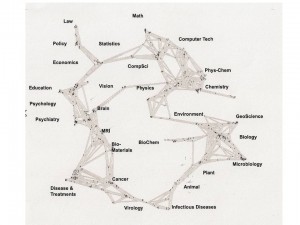
Phi Beta Iota: Most serious analysts now understand Citation Analytics 101.  It's time to move to Citation Analytics 202, and there is no better way to introduce the art of the possible than by pointing to Kevin W. Boyack, Katy Borner, and Richard Klavans (2007), “Mapping the Structure and Evolution of Chemistry Research (11th International Conference of Scientometrics and Infometrics, pp. 112-123.

Full Article with Color Graphics
Graphic as Printable Single Page PPT

There are several take-aways from this article, which is more or less the “coming out” of the Klavens-inspired infometrics field now that he has won his law-suit and has unchallenged access to all Institute of Scientific Information (ISI) access [this was one of the sources we used to win the Burundi Exercise before the Aspin-Brown Commission in 1995].

Continue reading “Reference: Citation Analytics 201”

noble gold