384 KB at 300 DPI (CMYK color) at 2 inch X 3.5 inch business card size. After clicking on the image below, the image will display, then right click the image and choose “save as.” From a Linux based laptop using an old Firefox browser, an error occurred. If you need another way to download, it is posted at this Flickr URL.
Overall, the number of security incidents increased significantly, compared to previous years and contrary to seasonal trends. [II 18, p. 4]
The three political priorities include support for elections, reconciliation and reintegration, and regional cooperation; the fourth priority is aid coherence. [III A. p. 5]
Rotting Oder of Pentagon Info Op Signals Effort to Shore Up its Great Game in the Hindu Kush
On 13 June, James Risen of the New York Times conveniently (at least for the Pentagon and the war party) reported that the “United States has discovered $1 trillion in untapped mineral deposits in Afghanistan [also attached below for your convenience]. I say convenient, because time is running out for the Pentagon in Afghanistan, and this report introduces a ‘new’ reason for occupying Afghanistan. The timing of this report was noticed very quickly by several skeptical commentators ( e.g., here and here).
But there is more. The NYT report has the rotting odor of yet another Pentagon misinformation operation to lather up the masses using the willing offices of the tired old Gray Lady of journalism. The oder is intense, because Risen’s Pentagon-inspired geological report coincides with the growing disenchantment with Afghan adventure. And more people are coming to appreciate the disconnect between (1) a spate of credible reports (e.g., here) describing the lack of progress in Afghanistan, particularly the failure of the showcase Marja COIN strategy to deliver its predicted result and (2) the requirement imposed by President Obama to show progress by the end of this summer. Bear in mind, Obama’s ‘requirement’ was imposed on the Pentagon when he improved the flawed McChrystal/Petraeus surge plan and sold it to the American people last fall. The military and spokesmen for the Obama administration began immediately to back away from the deadline shortly after its inception, and it has already been stretched to coincide with the mid-term elections in November — which goes to show that domestic politics do not end at the water’s edge?
Although the several commentators expressed their justifiable skepticism about the timing of the NYT report, to the best of my knowledge, none have addressed the substance of the mineral estimate. Shortly after it was published, my good friend and colleague Pierre Sprey, who has been called a vampire because he does his best work in the dark after midnight, got to the heart of the latter question and put the entire story together in an elegantly brief email that he distributed in the dark early hours of 14 June.
Attached for your reading pleasure is Pierre’s incisive critique:
Pierre Sprey
U.S. Identifies Vast Riches of Minerals in Afghanistan
Pierre Sprey 14 June 2010
The timing of this release of ancient mining news–especially when floated with Petraeus' name plastered all over it in a tried-and-true government propaganda outlet like the N.Y. Times–smells to me like a last ditch attempt to invent an economic justification for hanging on many more years in the hopeless Afghani morass.
Note that the now sacrosanct 1980s Russian mineral survey was “stumbled on” six years ago in 2004 by an American reconstruction team foraging in the Afghan Geological Survey Library. Then, according to the Times' (read Petraeus and DoD) spin, nothing happened until two years later when the U.S. Geological Survey launched a 2006 aerial mineral survey followed by another in 2007, supposedly yielding all-new evidence of astonishing mineral wealth (iron, gold, copper, lithium, supposedly a trillion dollar's worth) just waiting to be tapped. Supposedly, this astonishing new evidence was then ignored by all until a Pentagon business development task force “rediscovered” the ignored USGS mineral data in 2009.
This spin is quite untrue: in 2005, the Afghan government, quite aware of their mineral resources, opened bidding on copper mining leases in Logar Province, bidding that was won by the Chinese in 2007. As for the reliability of the USGS data, note that they report 1.8 billion tons of potential lithium deposits (lithium is very trendy with the greens these days) but only a puny 111 million tons in proven or probable deposits.
But none of this purportedly astonishing USGS aerial survey data has raised much dust in the international mining world, despite the fact that the entire current New York Times scoop was thoroughly covered by Reuters and Mining Exploration News a year ago in April of 2009.
So what turned the ho-hum Reuters news of April, 2009 into a hot Times scoop in June of 2010? Is there any connection with the desperate need of McChrystal, Petraeus and Gates for a life jacket, now that the Afghan surge they floated is sinking so rapidly?
WASHINGTON — The United States has discovered nearly $1 trillion in untapped mineral deposits in Afghanistan, far beyond any previously known reserves and enough to fundamentally alter the Afghan economy and perhaps the Afghan war itself, according to senior American government officials.
The previously unknown deposits — including huge veins of iron, copper, cobalt, gold and critical industrial metals like lithium — are so big and include so many minerals that are essential to modern industry that Afghanistan could eventually be transformed into one of the most important mining centers in the world, the United States officials believe.
An internal Pentagon memo, for example, states that Afghanistan could become the “Saudi Arabia of lithium,” a key raw material in the manufacture of batteries for laptops and BlackBerrys.
Chapter 20, “21st Century Counterintelligence: Evaluating the Health of the Nation,” especially Dereliction of Duty (Defense); Disinformation, Other Information Pathologies, & Repression; Emprire as a Cancer including Betrayal & Deceit; Impeacahable Offenses (Modern); Institutionalized Ineptitude; and Intelligence (Lack Of), all in the online hyperlinked version of INTELLIGENCE for Earth: Clarity, Diversity, Integrity, & Sustainability (pages 179-205, in Part III.
Talk of wealth from minerals by US geologists and Pentagon personnel add to the darkening view that those involved in war, corruption and disregard for the people of Afghanistan (and sacrificed soldiers + more to be sacrificed) will prosper…
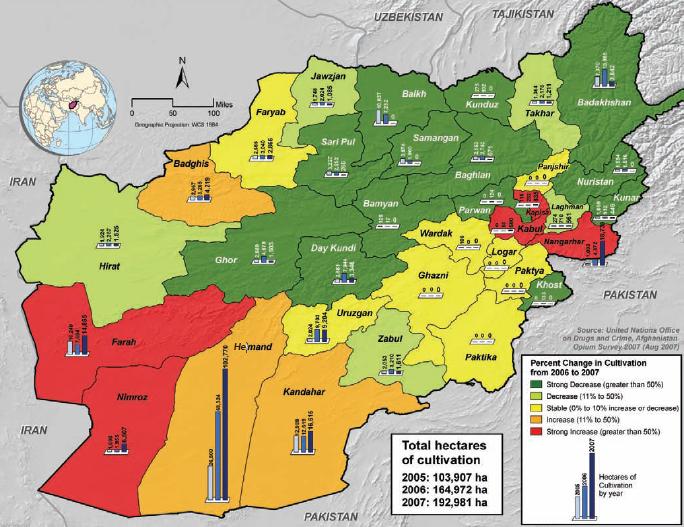
Income from cannabis per ha (gross/net) US$ 3,900 / US$ 3,341 | Income from opium per ha (gross/net) US$ 3,600 / US$ 2,005 | Income from wheat per ha (gross/net) US$ 1,200 / US$ 960
+ Gas Pipeline attempts = 1998 Congressional record related to Unocal/U.S. interests in Central Asia & November 2001 Asia Times article about the book “Bin Laden, la verite interdite (Bin Laden, the forbidden truth)” mentioning the US government's main objective in Afghanistan was to consolidate the position of the Taliban regime to obtain access to the oil and gas reserves in Central Asia.
“To be truthful about it, there was no way we could have got the public consent to have suddenly launched a campaign on Afghanistan but for what happened on September 11”
-Tony Blair (London Times, 7/17/02)
originally at http://www.timesonline.co.uk/article/0,,2-358038,00.html but no longer at that URL
Excellent May 31, 2010 New Yorker article by William Finnegan called Letter from Mexico, Silver or Lead which is unfortunately only available by subscription only (click here for link to abstract also pasted below) The most telling two words of the article = “state capture.”
ABSTRACT: LETTER FROM MEXICO about La Familia Michoacana and the pervasive power of drug traffickers in the country. Writer visits the hill town of Zitácuaro in the Mexican state of Michoacán. On the morning before his arrival, the dismembered body of a young man was left in the middle of the main intersection. It was an instance of what people call corpse messaging. Usually it involves a mutilated body and a handwritten sign. “Talked too much.” “You get what you deserve.” The corpse’s message—terror—was clear enough and everybody knew who left it: La Familia Michoacana, a crime syndicate whose depredations pervade the life of the region.
Mexico’s president, Felipe Calerón declared war—his metaphor—on the country’s drug traffickers when he took office, in December, 2006. It was a popular move. Although large-scale trafficking had been around for decades, the violence associated with the drug trade had begun to spiral out of control. More than twenty-three thousand people have died since Calderón’s declaration. La Inseguridad, as Mexicans call it, has become engulfing, with drugs sliding far down the list of public concerns, below kidnapping, extortion, torture, unemployment, and simple fear of leaving the house. The big crime syndicates still earn billions from drugs, but they have also diversified profitably. In Michoacán a recent estimate found eight-five per cent of legitimate businesses involved in some way with La Familia. Among Mexico’s drug trafficking organizations, La Familia is the big new kid on the block. It first gained national attention in September, 2006, when five severed heads rolled onto the dance floor at a night club in Uruapan, Michoacán. A senior American official in Mexico City told the writer, “La Familia is looking more and more like an insurgency and less like a cartel.” Mentions one of La Familia’s leaders, Nazario Moreno González, who is also known as El Chayo, or El Más Loco (the Craziest). Writer discusses La Familia’s activities with a local politician and relates how the cartel has, in some places, filled the vacuum created by public distrust of the police and the courts.
The overwhelming growth of organized crime in Mexico in the past decade is often blamed on multiparty democracy. Until 2000, the country was basically a one-party state for seventy-one years under the Institutional Revolutionary Party (PRI). Drug trafficking flourished, but its practitioners enjoyed stable relations with officialdom. Describes how the election of Vicente Fox in 2000 changed the status quo between drug traffickers and government. Writer gives a survey of other significant Mexican drug cartels, including the Sinaloa cartel, and the Zetas, who had previously occupied Michoacán. Tells about the rise of La Familia in 2006 and its expansion into nearby states. Discusses U.S.-Mexico relations and the drug trade. Writer visits a drug-rehabilitation center in Zamora. Describes acts of kidnapping and extortion perpetrated by La Familia.
Somalia anti-piracy patrol: Reuters Africa published a report that European Union foreign ministers are expected to extend the bloc's anti-piracy mission off the coast of Somalia for another year next week.
Rear Admiral Peter Hudson, Commander of the European Union Naval Force Somalia, said he expected a new extension of its mandate which expires in December to be cleared at Monday's regular meeting of EU ministers. “Over the last two years, there has been real growth in the area the pirates are operating in, as they become more adventurous, more fearless and more determined to strike merchant ships in the Indian Ocean,” he told a news conference.
Since December 2008, the EU's ‘Operation Atalanta' has protected ships delivering food aid to Somalia and others passing through the Gulf of Aden and near the Somali coast. The task group normally comprises 13 ships, one submarine and four patrol aircraft from ten countries. It is separate from the US anti-piracy Combined Task Force, as well as ships of Russia, Iran and Asian countries.
Naval forces disrupted 59 pirate groupings in the Somali basin between March and May this year, one of the two main piracy seasons of the year, up sharply from last year. Pirates hold more than 350 sailors and 17 ships.
Seminal Article on Maritime Threat & Response (Declined by the US Naval Institute Proceedings as either controversial or inconsistent with the prevailing flag views on reality)
Phi Beta Iota: Despite twenty years of robust thinking by a few about asymmetric warfare, those in positions of power are still without a clue. General Al Gray, USMC (Ret), then Commandant of the Marine Corps, got it right in 1989, as did a number of other Marines including honorary Marines Bill Lind and Col John Boyd, USAF (Ret), Col G.I. Wilson, USMC (Ret), still a top mentor on this topic, and Robert Steele, who has disappeared into Latin America. Illegal parallel structures will continue to proliferate for two big reasons:
1. Governments are failing across the board–not just the 175+ “failed states” (up from 25 at the start of the Bush-Cheney regime)–but the states of the Americas, Asia, and Europe that are failing to represent their publics and failing to do holistic strategic analytics. If you screw enough people all of the time, eventually they do something about it.
2. That lead's to the second half of the equation: the impotence of imperial “state on state” forces in the face of asymmetric challengers that combine morality (in their view), ruthlessness, a willingness to die trying, and a plethora of “surprise” techniques not least being the ability to strike anywhere.
Below are just a couple of references long-ignored by anyone with a modicum of power–as was written in 1997, the gap between people with power and people with knowledge has grown catasclysmic–that was in 1997. Daniel Elsberg had it right when he lectured Heny Kissinger in the 1970's: given enough power and enough top secret waste products, our political and policy leaders have become like morons, unable to learn from others, however knowledgeable. Here is the complete quote:
The danger is, you’ll become like a moron. You’ll become incapable of learning from most people in the world, no matter how much experience they have in their particular areas that may be much greater than yours” [because of your blind faith in the value of your narrow and often incorrect secret information].
This report was prepared by the USCG Intelligence Coordination Center (ICC) in support of the Yemen Virtual Intelligence Team Community of Interest (COI) regarding the current political, military, economic, and social situations in Yemen.
KEY ISSUES
• The Yemeni Government’s internal northern war against the Zaidi Shia or “Huthi” rebels escalated with the August 2009 government offensive. The continuing sectarian and separatist conflict is responsible for the 77,000 Internally Displaced Persons (IDPs) in Northern Yemen since the
beginning of the conflict in 2004.
• Increased counter-terrorism measures in Iraq and Saudi Arabia have driven the newly formed al-Qa’ida in the Arab Peninsula (AQAP) to Yemen, where it has been responsible for as many as 30 attacks on Westerners, oil infrastructure, and security and government targets.
• The number of Somali and Ethiopian immigrants crossing into Yemen this year rose to 50,400, as they flee famine, drought, war, and persecution at home. Though Yemen grants automatic asylum to immigrants who prove persecution, there is increasing concern about the serious economic burden
this immigration is creating within Yemen.







 Excellent May 31, 2010 New Yorker article by William Finnegan called Letter from Mexico, Silver or Lead which is unfortunately only available by subscription only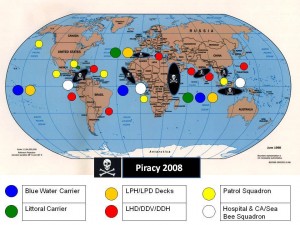
 This report
