As internet and mobile phone use explodes worldwide, governments are adopting new and multiple means for controlling these technologies that go far beyond technical filtering. Freedom on the Net provides a comprehensive look at these emerging tactics, raising concern over trends such as the “outsourcing of censorship” to private companies, the use of surveillance and the manipulation of online conversations by undercover agents. The study covers both repressive countries such as China and Iran and democratic ones such as India and the United Kingdom, finding some degree of internet censorship and control in all 15 nations studied.
Phi Beta Iota: Although somewhat dated, the report is worth a look. If overlain with the countries where poverty makes Internet access or control moot, the global picture is clear: despots and poverty are coincident with the physical and digital impoverishment of the people. The emergence on multiple fronts of movement to create the Autonomous Internet using the Open Source Tri-Fecta is encouraging.
Anon is having a brainstorming session on 14th April, all day, to discuss “a parallel internet”. You can find their IRC room at: irc.anonops.net #anonsec
Iranian journalist Maziar Bahari was held in a Tehran jail for 118 days in 2009. His arrest came as he worked for western media outlets, including BBC Panorama. In this analysis, Mr Bahari explains why the regime fears information, the internet and a free press.
“Information is a weapon, and in the wrong hands it is even more dangerous than a real gun!”
This was my torturer's message to me in the summer of 2009 after my arrest.
Relying on a UN Security Council Resolution, but without asking Congress or the American people, President Obama attacked Libya on 19 Mar 2011. He finally got around to explaining his actions on 28 March 2011 in a nationally televised speech given at the National Defense University. Attached below are two analyses of that speech:
Story 1 by Ed Felien appeared in The Rag Blog on April 5, a spunky left-leaning website based in the hinterlands of Austen Texas. It is harshly critical of the speech by comparing Obama's assertions to conditions in Libya and the tensions within Libya that have created a civil war.
Story 2 by Anne Marie Slaughter appeared in the the New York Review of Books blog on 20 March 2011. The New York Review of Books appeals to a far more high-falutin readership than The Rag Blog, and is a kind of a forum for the panjandrums in what's left of the American Left. Dr. Slaughter gushes over Obama's speech, saying it made an “important contribution to the Libya debate.” She bases her conclusion (“let us protect the Libya's civilians by any means necessary”) by analyzing (a word I use charitably) some impenetrable comparisons of interests versus interests to interests versus values, but curiously, she says nothing about actual conditions in Libya, or who is fighting whom, or why they are fighting.
The contrast between information and puffery in these two essays is stunning and says a lot about what's wrong with the American Left.
Phi Beta Iota: Dr. Slaughter means well, but has drunk the kool-aid. No one in Washington appears capable of reconnecting with reality and using clarity, diversity, and integrity to actually understand how far the US Government has diverged from core values of the Republic, and the public interest. The right/neo-conservatives have cost the US tens of trillions of dollars in fraud, waste, and abuse–Dick Cheney and the Iraq/Afghanistan faux wars on terror being the current classic–but so also has the left/Demopublicans so intent on keeping their own money flowing they have completely lost sight of basic principles of governance. These are all good people trapped in a bad system–all it takes to fix this is ONE LEADER committed to transparency, the truth, and trust. Barack Obama is clearly NOT that leader.
Here are the concise references focused on revolution. For corruption, collective intelligence, open space and other methods of non-violent consensus building and emergence, see the lists at the end of this post.
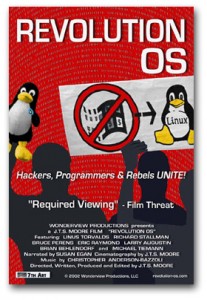
REVOLUTION OS tells the inside story of the hackers who rebelled against the proprietary software model and Microsoft to create GNU/Linux and the Open Source movement.
On June 1, 2001, Microsoft CEO Steve Ballmer said “Linux is a cancer that attaches itself in an intellectual property sense to everything it touches.”
Microsoft fears GNU/Linux, and rightly so. GNU/Linux and the Open Source & Free Software movements arguably represent the greatest threat to Microsoft's way of life. Shot in cinemascope on 35mm film in Silicon Valley, REVOLUTION OS tracks down the key movers and shakers behind Linux, and finds out how and why Linux became such a potent threat.
REVOLUTION OS features interviews with Linus Torvalds, Richard Stallman, Bruce Perens, Eric Raymond, Brian Behlendorf, Michael Tiemann, Larry Augustin, Frank Hecker, and Rob Malda. To view the trailer or the first eight minutes go to the ifilm website for REVOLUTION OS.
The first is “A revolution against neoliberalism” by Abu Atris, it appeared in Al Jazeera on 24 Feb. The second is “Of the 1%, by the 1%, and for the 1%” by Joseph Stiglitz. One is about the Arab Revolt in Egypt and the other is about income inequality in the United States … they raise stunningly similar — and very disturbing — themes when compared to each other. I urge readers to read each carefully and think about the likenesses and differences between them.
Americans have been watching protests against oppressive regimes that concentrate massive wealth in the hands of an elite few. Yet in our own democracy, 1 percent of the people take nearly a quarter of the nation’s income—an inequality even the wealthy will come to regret.


 Maziar Bahari faces jail if he returns to Iran