Journal: US Army Civil Affairs Left for Dead…

08 Wild Cards, Civil Society, Corruption, Government, Methods & Process, Military, Non-Governmental, Officers Call, Policies

14 December 2010 CRYTOME

US Army Starving its Civil Affairs Functions: Prefers New Age HTS, PRT’s

by John Stanton

“If the expansion of the Human Terrain System gains traction at TRADOC it could kill any efforts to develop a cultural expertise construct by the Civil Affairs community, specifically the Civil Affairs Proponent at USA JFK SWCS. Everybody is looking to get as much money as they can for their organizations as the Defense budget begins to get squeezed. Naturally there could be a potential dog fight between TRADOC and any other Army organization making claims for HTS-like capability. Once something becomes institutionalized in the military it is difficult to change the new status quo.”

Read full article….

Phi Beta Iota: The US Army Civil Affairs Brigade got off to a very good start under Col Ferd Irizzarry, USA, and then he got sent to Afghanistan to punch his pre-flag combat operations ticket and it took a nose dive.  HRT is the most badly managed–unethically managed–program in the DoD Human Intelligence inventory.  While recognizing that the author above is on a vendetta against HRT, the bottom-line is that he is right, HRT is wrong, and TRADOC does not know the difference.

See Also:

2010: Human Intelligence (HUMINT) Trilogy Updated

Reference: How to Organize a Retreat

Blog Wisdom, Methods & Process

Seth Godin Home

How to organize a retreat

(actually, to steal a phrase from Alan and Bill, an advance. Retreat is too negative).

There's a tremendous opportunity to create events where people connect. Unfortunately, it's also easy to turn these events into school-like conferences, not the emotional connections that are desired.

You can create an advance with a team that knows one another from work, or even more profoundly, with a bunch of independent thinkers who come together to energize, inspire and connect.

I've been to a bunch and here's what I've learned, in no particular order:

  • Must be off site, with no access to electronic interruption
  • Should be intense. Save the rest and relaxation for afterwards
  • Create a dossier on each attendee in advance, with a photo and a non-humble CV of who they are and what they do and what their goals are
  • Never (never) have people go around a circle and say their name and what they do and their favorite kind of vegetable or whatever. The problem? People spend the whole time trying to think of what to say, not listening to those in front of them (I once had to witness 600 people do this!!)
  • Instead, a week ahead of time, give each person an assignment for a presentation at the event. It might be the answer to a question like, “what are you working on,” or “what's bothering you,” or “what can you teach us.” Each person gets 300 seconds, that's it.
  • Have 11 people present their five minutes in an hour. Never do more than an hour in a row. The attendees now have a hook, something to talk to each presenter about in the hallway or the men's room. “I disagree with what you said this morning…”
  • Organize roundtable conversations, with no more than 20 people at a time (so if you have more attendees than this, break into groups.) Launch a firestarter, a five minute statement, then have at it. Everyone speaks up, conversations scale and ebb and flow.
  • Solve problems. Get into small groups and have the groups build something, analyze something, create something totally irrelevant to what the organization does. The purpose is to put people in close proximity with just enough pressure to allow them to drop their shields.
  • Do skits.
  • Have a moderator who is brave enough and smart enough to call on people, cut people off, connect people and provoke them in a positive way.
  • Invite a poker instructor or a horseshoe expert in to give a lesson and then follow it with a competition.
  • Challenge attendees to describe a favorite film scene to you before the event. Pick a few and show them, then discuss.
  • Don't serve boring food.
  • Use nametags at all times. Write the person's first name REALLY big.
  • Use placecards at each meal, rotating where people sit. Crowd the tables really tightly (12 at a table for 10) and serve buffet style to avoid lots of staffers in the room. Make it easy for people to leave boring tables and organically sit together at empty ones.
  • Do something really interesting after 10 pm.
  • Serve delicious food, weird food, vegan food, funky food. Just because you can.
  • Don't worry about being productive. Worry about being busy.
  • Consider a tug of war or checkers tournament.
  • Create an online site so attendees can check in after the event, swap email addresses or post promised links.
  • Take a ton of pictures. Post them as the advance progresses.

Here's the goal: new friends. Here's the output: a new and better to-do list.

Journal: Sun Tzu is with the Taliban in Afghanistan

02 Diplomacy, 03 Economy, 07 Other Atrocities, 08 Wild Cards, 10 Security, 11 Society, Budgets & Funding, Civil Society, Commerce, Corruption, Cultural Intelligence, Military, Non-Governmental, Officers Call, Peace Intelligence
Chuck Spinney Sounds Off....

December 14, 2010

Memo From Sun Tzu to President Obama

Who is the Wise General in Afghanistan?

By FRANKLIN C. SPINNEY Counterpunch

In the first treatise written on the art of war, sometime around 450 BC [1], Sun Tzu explained why “the wise general sees to it that his troops feed on the enemy,”

EXTRACT:  The militarization of development aid is a central pillar of General Petaeus's counterinsurgency strategy to buy the hearts and minds of the Afghan people, ninety per cent of whom are spread out in remote rural areas. So it should not be surprising that the military is controlling the bulk of the billions of dollars in aid money flowing into (and being smuggled out of) Afghanistan.

In the very important CounterPunch report on 13 December, Patrick Cockburn, certainly one of the most informed observers of insurgencies in the Middle East and Central Asia, described how the militarization of development aid in Afghanistan is riven with corruption.

Read full article….

Reference: The Kids Are All Right–Mad as Hell!

03 Economy, 04 Education, 11 Society, Academia, Civil Society, Collective Intelligence, Counter-Oppression/Counter-Dictatorship Practices, Cultural Intelligence, Reform
Jon Lebkowsky Bio

Let the word go out, indeed. “Those are OUR streets, and we will always be there to demonstrate… people learned a lot… we are no longer that post ideological generation, we are no longer that generation that doesn’t care… we are now the generation that will stand with everyone who’s fighting back…” They’re mad as hell, and they’re not going to take it anymore.

15 year old Tells Establishment to Stick-it.

Coalition of Resistence National Conference 27 November 2010 Camden UK

You Tube 4:50 Minutes

See Also:

Ady Cousins, Counterfire.org

Journal: GroupOn’s Potential Part II

Civil Society, Collective Intelligence, Commercial Intelligence, Corporations, Counter-Oppression/Counter-Dictatorship Practices, Cultural Intelligence, InfoOps (IO), International Aid, Journalism/Free-Press/Censorship, Methods & Process, microfinancing, Mobile, Open Government, Policies, Real Time, Reform, Strategy, Technologies, Waste (materials, food, etc)

Not many know that GroupOn, Andrew Mason‘s initiative funded by Eric Lefkofsky, started as Policy Tree “Taking People Out of Politics”.  Citizens were not interested in Policy Tree back then for two reasons: the outrage at mortgage fraud, Wall Street derivatives fraud, and Federal Reserve fraud had not peaked yet, and the power of GroupOn to move markets and nations had not been demonstrated.  Now that GroupOn has turned down Google's offer of six billion, there is no doubt.

Put simply, GroupOn now has more power than George Soros, to take one example.  GroupOn can:

1)  Publish true costs for any product or service that is seriously harmful to all of us, and kill it.

2)  Publicize a product or service that is good for the community, and make it a standard.

3)  Organize micro-giving across an entire nation (e.g. Haiti) using a Global Range of Nano-Needs Table.

4)  Organize citizens to do participatory legislation and participatory policy and participatory budgeting and participatory regulatory and propriety oversight in relation to specific issue areas, zip codes, countries, or states, and empower them as a group that cannot be ignored.

GroupOn has done what all others have failed to do: harnessed citizens in the aggregate.  They have just begun.  When combined with the emergence of digital natives as a political force whose outrage is now maturing (see Jon Lebkowsky's “The Kids Are All Right“), GroupOn is the game changer–not MoveOn.org, not No Labels, not Americans Elect, not IndependentVoting.org–all “old” models dominated by apparatchicks and not at all open to the collective.  GroupOn.  As in Group ON, dude!

See Also:

Journal: GroupOn’s Potential Part I

Could Rovio or CCP kill Microsoft or Google?

Analysis, Augmented Reality, Budgets & Funding, Collaboration Zones, Collective Intelligence, Communities of Practice, Computer/online security, Counter-Oppression/Counter-Dictatorship Practices, info-graphics/data-visualization, InfoOps (IO), IO Mapping, IO Multinational, IO Sense-Making, Journalism/Free-Press/Censorship, Key Players, Methods & Process, Mobile, Policies, Real Time, Reform, Standards, Strategy, Technologies, Threats, Tools
Ric Merrifield

When you think about who might topple a software giant like a Microsoft or a Google, you might be inclined to think of Goliaths like, well Google and Microsoft.  The same is true of any industry, you probably think of a company of similar size or larger as being the type of company that would win a battle, or a war.

Actual battles and wars end up being an interesting analogy.  If you think if big battles like World War I and World War II, that’s exactly what happened – giants fighting giants from big, knowable centralized points of command.  But there are some other wars that have been fought where the little guy won (or hasn’t lost in the case of one ongoing war) and there’s a common element in all of them.  No centralized physical location to “take out” to win.  When everything is dispersed and there isn’t any one thing to take out, it’s hard to really know how big or how small opposing force is, and they can be substantially more agile.  In this situation, an organization of any size can pose a major threat to an enormous organization.  The war on terror is an ongoing war that fits this profile – it’s virtually impossible to know how big or small the opposition is, or where they are at any given time, so it’s very hard to be ready for an attack from them.  Viet Nam was a tough one for the US to really stand a chance in because it was in unfamiliar territory and there was no central location to take out to declare victory.  One could even make the same argument (at a high level) for why the British lost the American revolution.

So if you don’t know who Rovio or CCP are, I have already made significant progress on the path of making my point.

Continue reading “Could Rovio or CCP kill Microsoft or Google?”

No Labels No Confidence — Same Old Apparatchiks

07 Other Atrocities, 11 Society, Civil Society, Collective Intelligence, Commerce, Cultural Intelligence, Methods & Process

Can ‘No Labels' change the tone in Washington?

By Matt DeLong

Washington Post, 13 December 2010

A new movement called “No Labels” is hoping to help tone down the heated rhetoric in Washington. Headed by New York Mayor Michael Bloomberg, a veritable ‘who's who' of moderate politicians are participating in the No Labels launch in New York City. Among the participants are: retiring Sen. Evan Bayh (D-Ind.), Sen. Kirstin Gillibrand (D-N.Y.), Rep. Bob Inglis (R-S.C.), former Rep. Tom Davis (R-Va.), Sen. Joe Lieberman (I-Conn.) and Republican-turned-independent Florida Gov. Charlie Crist.

Read rest of article….

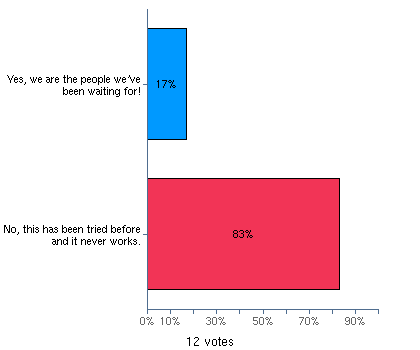
Phi Beta Iota:  These folks mean well, but they are totally without a clue when it comes to actually embracing, empowering, and exploiting (in the positive sense of the word) the collective intelligence of the Republic.  This is an apparatchik move through and through, and the manner in which it has been organized, the money behind it, and the total absence of any intelligent structure (e.g. electoral reform, virtual cabinet, online participatory policy-budget exercise) make it clear that it is a dead end.  Preliminary voting suggested that most are not fooled and see it for the negative it is–another theatrical display lacking in authenticity.

noble gold