Journal: End of Airwave Tyranny & Corruption

08 Wild Cards, Collective Intelligence, Communities of Practice, Counter-Oppression/Counter-Dictatorship Practices, InfoOps (IO), microfinancing, Mobile, Open Government, Peace Intelligence, Real Time, Reform, Tools

INTELLIGENCE ONLINE is “the” single best global intelligence monitor.

Click for Printable Slide

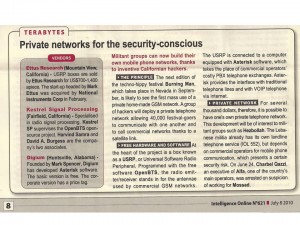
Phi Beta Iota: We've been anticipating this since first pointing at Haggle and FreeNet. This is the single greatest piece of news for the public in this era.  What this means is the end of toll-booths and extortion in local to global communications; it means the end of government ignorance in trying to control spectrum–we are now in Open Spectrum time.  For so many reasons, all centered on conscious revolution, evolutionary activism, holistic Darwinism, non-zero, and collective intelligence, this one bit of news changes everything.

Burning Man: Be There 30 August – 6 September 2010

Reference: Dr. Dr. Dave Warner & Synergy Strike Force in Afghanistan–”Save the Willing First”

08 Wild Cards, AID, Collaboration Zones, Communities of Practice, Counter-Oppression/Counter-Dictatorship Practices, DHS, Director of National Intelligence et al (IC), DoD, Ethics, Geospatial, InfoOps (IO), International Aid, IO Mapping, IO Multinational, IO Sense-Making, Maps, Memoranda, Mobile, Open Government, Policies, Real Time, Reform, Threats, Tools, United Nations & NGOs, White Papers
Strike Force Handbook

Dr. Dr. Dave Warner (PhD, MD)

Ref A:  Cyber-Pass Meets Khyber Pass

Ref B:   Warner to Clapper on PRT Comms

Ref C:  UnityNet White Paper Final

Strike Force Home Page

See Also:

Earth Intelligence Network “One Call At a Time”

Lee Felsenstein Concept for Cellular Aid

AidData

INTELLIGENCE for EARTH

Afghan Self-stabilization from Below – and Above

About the Idea, Augmented Reality, Collaboration Zones, Communities of Practice, Counter-Oppression/Counter-Dictatorship Practices, Ethics, Geospatial, info-graphics/data-visualization, InfoOps (IO), International Aid, Journalism/Free-Press/Censorship, Key Players, Methods & Process, microfinancing, Mobile, Policies, Real Time, Reform, Strategy, Technologies, Threats, Tools, True Cost
Lee Felsenstein

As the end game begins for NATO and the US in Afghanistan, and as the potential mineral wealth of that unhappy land is revealed, one confronts despair when contemplating the fate of the Afghans. With the Taliban poised to move once more into the coming power vacuum and exploit a resurgent drug trade as well as establish a protection racket parasitic to the future mining industry, one looks for some glimmer of hope for the Afghan people.

After all, Afghanistan has never been conquered except by the Mongols. The much decentralized, tribal society that makes them vulnerable to decentralized gang rule has confounded each centralized invader who attempted to bring about their own version of order. Is there hope that the Afghan people will be able to expel the Taliban as they expelled the others? After all, the first government of the Taliban was not overthrown by the Afghans themselves, but by military invasion with the passive consent of the Afghan people.

Now, with the outside military forces beginning their final period in-country, and with little if any evidence of a viable government staffed by officials who will not bolt the country with their pockets stuffed, what can give the ordinary Afghans the means to resist as they have resisted other occupations?

The answer, I believe, lies in the essence of government. Government operates by communication. People in government gather, refine, transmit information, both from the populace to the seat of power and in reverse after policies and laws are defined based upon the information gathered. People have political power to the extent that they are included in this process of information flow to the exclusion of others.

Continue reading “Afghan Self-stabilization from Below – and Above”

Secrecy News: GAO Oversight of Intelligence, Costs of Secrecy

09 Justice, 10 Security, 11 Society, Budgets & Funding, Corruption, Government, Intelligence (government), Military, Money, Banks & Concentrated Wealth, Power Behind-the-Scenes/Special Interests, Reform

GAO OVERSIGHT OF INTEL AGENCIES IN DISPUTE

One of the simplest and most effective ways to strengthen congressional oversight of intelligence agencies would be to task cleared staffers from the Government Accountability Office (GAO), which is the investigative arm of Congress, to undertake specific audits or investigations of intelligence programs.  Perhaps the clearest indication of the power of this approach is the fact that the intelligence agencies hate the idea and the White House has threatened a veto if it is adopted by congress.

Senate intelligence committee leaders have already yielded to executive branch opposition on this point, but House Speaker Nancy Pelosi is insisting that the GAO has a role to play in intelligence oversight, and she says she is trying to ensure that Congress does not willingly surrender one of its most sophisticated oversight tools.  See “Pelosi Faces Off with Obama on CIA Oversight” by Massimo Calabresi, Time, June 25 and “Acting Spy Chief Plans Departure” by Siobhan Gorman, Wall Street Journal, June 25.

An unreleased opinion from the Justice Department Office of Legal Counsel reportedly holds that intelligence programs are outside the purview of the Government Accountability Office and that intelligence agencies should therefore not cooperate with the GAO.

Although the GAO previously reviewed FBI counterterrorism programs prior to the 2004 intelligence reform legislation, “GAO has been essentially blocked from conducting its current work,” complained Sen. Charles Grassley (R-ID).  “The DoJ Office of Legal Counsel is arguing that GAO does not have the authority to evaluate the majority of FBI counterterrorism positions, as these positions are scored through the National Intelligence Program (NIP) Budget.”

The FBI confirmed that the GAO's access to some previously auditable programs has been denied.  “With the post-2004 inclusion of FBI counterterrorism positions in the Intelligence Community, aspects of the review GAO proposed in 2009 would have constituted intelligence oversight,” the FBI told Sen. Grassley (at pdf pp. 67-68).  “It is the longstanding position of the Intelligence Community to decline to participate in GAO reviews that evaluate intelligence activities, programs, capabilities, and operational functions.”

I recently discussed the question of GAO oversight of intelligence with colleagues from the Project on Government Oversight, which published the conversation as a podcast here.

Phi Beta Iota:  Let's not quibble here.  CIA and FBI and anyone else that is refusing GAO oversight are committing treason, plain and simple.  The US Government is out of control, and if Congress does not start living up to its Article 1 Constitutional responsibilities, there is a very real possibility of a complete over-turning of Congress along with multiple states actively nullifying federal taxation as well as as federal regulation, and some states starting with Vermont seceeding from the Union.  The Executive is betraying the public trust and not working in the public interest.  It's time We the People pulled the plug with a tax revolt that explicits demands a cessation of funding for both the Pentagon and the secret IC, until such time as they can present to congress a responsible holistic strategy and force structure that produces desired outcomes, not merely a transfer of wealth to Lockheed executives and the banks behind them.  ENOUGH!

SECRECY COSTS CONTINUED TO RISE IN 2009

The financial costs of national security classification-related activities continued to rise in 2009, reaching a record high of $9.93 billion for the combined costs of protecting classified information in government and industry, the Information Security Oversight Office reported today (pdf).

Classification-related costs include not simply the act of classification, but also everything that follows from it:  physical security for classified materials, computer security for classified information systems, personnel security, and so forth. “The agencies also reported a modest, but welcome increase in spending on declassification programs,” wrote ISOO Director William J. Bosanko in his transmittal letter to the President.

The newly reported cost data do not include classification-related costs for CIA or the large Pentagon intelligence agencies — since those costs are themselves considered to be classified.  This means that the costs incurred by the most classification-intensive agencies are outside the scope of the published report, which significantly limits its value.  See “Report on Cost Estimates for Security Classification Activities for Fiscal Year 2009,” Information Security Oversight Office, June 25, 2010.

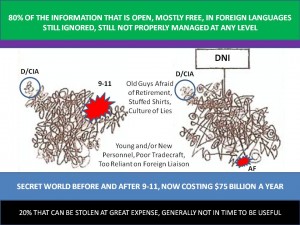
Phi Beta Iota:  These costs are severely understated and probably come closer to $15 billion a year than $10 billion.  However, taking $10 billion at face value, this means that the costs of secrecy completely apart from the sources and methods in being, are now at least 14% of the total budget for secret intelligence (itself moderately if not substantially understated since DoD concealed a great deal from the DNI in the last 2-3 years).  This is flat out NUTS.  It is unprofessional, irresponsible, and should at a minimum be grounds for Congressional refusal to fund the secret intelligence community until a 150-250 person GAO Special Intelligence Audit (SIA) unit is formed and given full access.

Journal: One Mobile Per Child

About the Idea, Civil Society, Collective Intelligence, Collective Intelligence, InfoOps (IO), IO Multinational, microfinancing, Mobile, Real Time, Reform, Tools

Phi Beta Iota: The idea of one mobile per person was originally devised by the Earth Intelligence Network, and is articulated in both brief form and in a full-length book.  Now the idea is emerging, spontaneously, from others.  Below is a link to a letter in the Journal of Health Informatics in Developing Countries.

Letter: One mobile per child: a tractable global health intervention

The authors, Prajesh Chhanabhai and Alec Hold, one working at the University of Otago in New Zeland, the other for the Department of Economic and Soical Affairs in the United Nations, make several important points, not least of which is the price point: mobile telephones are being offered in Venezuela for $15, which is half the price the World Bank negotiated with Motorola.

If and when the Chinese see the opportunity (free cell phone, no extra charge for listening in), we should see both free cell phones and eventually free airtime as well as free call centers to educate the poor “one cell call at a time” at the same time that we recoup the investment in elevated national productivity, now proven to be associated with the diffusion of cell phone access.

It merits observation that the cell phone is now the “gift of life” that any one of the one billion rich (80% of whom do not give to charity now) can endow, down to a specific person in a specific village.  The sooner we make cell phones ubiquitous, the sooner we can start exposing corruption at all levels (with web sites that make sense of text messages and expose corruption in near-real-time “by name,” and also creating infinite wealth among the four billion at the “bottom of the pyramid.”  The human brain is the one inexhaustible resource we have, giving every human a cell phone is the fastest way to harnessing the distributed intelligence of the Whole Earth.

Interesting Side Note: Carlos “slim” Helu (richest person in the world) has a major stake in Tracfone (some phones go for $10). He could be a major player in the one mobile per child campaign. Venezuela president Hugo Chavez has a Twitter account and the Earth Intelligence Network just posted >>  earthintelnet @chavezcandanga “the Vergatario” ($15 phone) + Carlos “Slim” Helu ? http://phibetaiota.net/?p=25785 #Vergatario #Venezuela #CarlosSlim

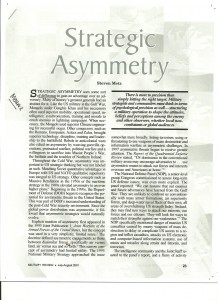
Reference: Strategic Asymmetry–with Comment

Analysis, Augmented Reality, Budgets & Funding, Collaboration Zones, Collective Intelligence, Computer/online security, Counter-Oppression/Counter-Dictatorship Practices, Ethics, Geospatial, History, info-graphics/data-visualization, InfoOps (IO), Intelligence (government), International Aid, Key Players, Policies, Policy, Reform, Research resources, Secrecy & Politics of Secrecy, Strategy, Technologies, Threats, Tools, True Cost
Full Source Online

Dr. Steve Metz was published on this topic by the Military Review in July-August 2001.  A great deal of original thinking came out of the U.S. Army Strategic Studies Institute (SSI) in the aftermath of the 1998 Army Strategy Conference, and sadly, none of it has gained any traction with any Secretary of Defense (or State) since then.  Should Senator Chuck Hagel (R-NE) actually be selected to be the new Director of National Intelligence (DNI), this is a concept he is going to have to integrate into his thinking.

Although Dr. Metz fully understands the asymmetry of will and touches on the asymmetry of morale, he does not address the core intelligence question of our century: the asymmetry of morality.  Will & Ariel Durant understood this and highlighted the strategic value of being “in the right” in their capstone work, The Lessons of History.  Others, including Buckminster Fuller in Critical Path and Dr. Robert Ackoff (see first link below), understood that context matters, and within context, morality and doing the right thing.

Morale is not the same as moral, and the “collateral advantage” that allows one to harness the distributed intelligence of the Whole Earth–to receive unsolicited warnings large and small, to receive unsolicited good ideas large and small–comes ONLY when one holds the moral high ground.  It merits stressing that CONSENSUS is most easily achieved when those striving to achieve consensus share a common faith in integrity–in morality.

America is in the wrong today, because the US Government is imposing on both the domestic public and on humanity at large the wrong policies, the wrong programs, and the wrong acquisitions–as well as the wrong distribution of US taxpayer funds in the service of dictators, cartel leaders, and predatory immoral banks and businesses not at all interested in earning legal ethical profit fully compliant with true cost economics also known as the triple bottom line.

If the next DNI is to be successful, they must:

Continue reading “Reference: Strategic Asymmetry–with Comment”

Journal: With No Successor In Sight, Intelligence Czar Departs

Analysis, Augmented Reality, Budgets & Funding, Collective Intelligence, Computer/online security, Counter-Oppression/Counter-Dictatorship Practices, Geospatial, Government, InfoOps (IO), Intelligence (government), Key Players, Maps, Methods & Process, microfinancing, Money, Banks & Concentrated Wealth, Open Government, Policies, Policy, Politics of Science & Science of Politics, Power Behind-the-Scenes/Special Interests, Reform, Research resources, Secrecy & Politics of Secrecy, Strategy, Technologies, Threats, Tools, True Cost

FULL STORY:  Declassified (newsweek.com/blogs)

May 28, 2010

By Mark Hosenball

On Dennis Blair’s last day in office as director of national intelligence, the Obama administration seems more stymied than ever in its efforts to replace him.

Following a torrent of criticism from Capitol Hill—apparently touched off by this Declassified interview with Rep. Pete Hoekstra, the House Intelligence Committee’s top Republican—the candidacy of James Clapper looks doubtful to say the least. On top of Hoekstra’s criticism of the retired three-star general, who currently serves as the Defense Department’s intelligence chief, the Senate Intelligence Committee’s leaders are now also publicly saying they think he’s the wrong man for the job.

. . . . . .

The latest boomlet in speculation on potential candidates is centered on Michael Vickers, a former Green Beret and CIA operative who has been the Defense Department’s top civilian in charge of counterterrorism and special-operations programs slnce late in the Bush administration. Vickers was one of 15 potential DNI candidates we identified when news of the job opening broke….

. . . . . . .

But other names keep coming up. Some, such as Homeland Security undersecretary Rand Beers, Joint Chiefs of Staff Deputy Chairman Gen. James Cartwright, and outgoing Sen. Evan Bayh, have surfaced before (one former official who worked in national security positions with Beers describes him as “indefatigable”). But others are new to this particular search, including Rep. Jane Harman, former Ambassador to Iraq Ryan Crocker, and former CIA deputy director John McLaughlin.
Phi Beta Iota:  Worth a complete read.  Here are the fifteen potential DNI's they identified earlier:, followed by our picks.

Political and bureaucratic heavyweights:
FBI Director Robert Mueller
CIA Director Leon Panetta
Deputy Secretary of State James Steinberg
Marine Gen. James Cartwright, deputy chair of the Joint Chiefs of Staff 

Intelligence and defense technocrats:
Lt. Gen. Jim Clapper, currently Defense Department intelligence supremo;
Michael Vickers, assistant defense secretary for special operations;
John Hamre, a former deputy defense secretary;
Harvard academic Joseph Nye, also a former senior Pentagon official; and
John McHugh, a former GOP congressman whom Obama named as secretary of the Army.
 
High-profile intelligence politicos:
John Brennan, the White House counterterrorism and Homeland Security supremo; or
Rand Beers, a former career intelligence official who left his job as a senior counterterrorism adviser in the George W. Bush White House to become national security adviser to Democratic presidential candidate John Kerry, and now serves as undersecretary of Homeland Security

High-profile politicos:
former Sen. Chuck Hagel, a Republican close to Obama; former congressman and
intelligence-reform campaigner Lee Hamilton;
former Indiana senator Evan Bayh; and
former representative Tim Roemer (another intel-reform campaigner who is now U.S. ambassador in India)
Phi Beta Iota:  Everyone in the above lists is a ridiculous untenable suggestion with one exception: Senator Chuck Hagel.  His combination of integrity, substantive experience, standing on the Hill, and general non-partisan common sense, is ideal.  What he lacks is a kick-ass deputy who actually understands all the crap that the agencies–and their den mother Jim Clapper–put forward.  Leon Panetta would actually be very good as the Deputy, responsible for turning off all funds to all agencies at 20% a year (10% a year restored for new initiatives; savings to education and national research under DNI oversight as provided for in the Smart Nation-Safe Nation Act) but Hagel is going to need a kitchen cabinet of truth-tellers and we are pretty sure he is not even aware of who they might be.  That is his sucking chest wound–if he solves that he will not only earn Obama a second term, he will transcend politics and impact directly on the totality of all budgets–US, state & local, other nations, corporations, NGOs.  Jack Devine is in the wings in New York, the Trilateral Commission's choice for either DNI or Director of Central Intelligence, he has our vote for the latter position.

The problem President Obama has is in the White House is that no one working for him actually “gets it” with respect to 21st Century governance–between his pogomist and his pollster and his talented but oblivious others, he is running on fumes, will not get a second term, and is simply counting the days to when he can follow Bill Bradley, Al Gore, and Bill Clinton in Goldman Sachs honey-land–and screw the American public, they were never the intended beneficiaries of all this in the first place.

References for any future DNI:

Human Intelligence (HUMINT): All Humans, All Minds, All the Time (SSI, 2010)
The Smart Nation Act: Public Intelligence in the Public Interest (OSS, 2006)
Information Operations: All Information, All Languages, All the Time (OSS, 2006)
The New Craft of Intelligence: Personal, Public, & Political (OSS, 2002)
On Intelligence: Spies and Secrecy in an Open World (AFCEA, 2000; OSS, 2001)

and for the really big picture:

Intelligence for Earth: Clarity, Diversity, Integrity, & Sustainability (EIN, 2010)
Collective Intelligence: Crating a Prosperous World at Peace (EIN, 2008)
Peacekeeping Intelligence:  Emerging Concepts for the Future (OSS, 2003)

noble gold