Review: National Defense

5 Star, Force Structure (Military), Military & Pentagon Power

Amazon Page
Amazon Page

5.0 out of 5 stars Still Relevant Because NOTHING HAS CHANGED,

January 19, 2003
James Fallows
I bought this book, used, after it was recommended as a key source to a just-published book by Robert Coram, “BOYD: The Fighter Pilot Who Changed the Art of War,” which I recommend very strongly, together with this book for historical perspective.Although there may be a few inaccuracies (I did not notice anything substantial) what really matters about this book are two things: the author is a very serious critic with both Public Citizen and Atlantic Monthly credits, and the taxpayer's best interests in mind; and NOTHING HAS CHANGED since this book was published in 1981. If anything, it has gotten worse. One page (43) really jumped out at me, as it contains a chart showing how many planes can be bought for the same amount of money (1000 F-5s, 500 F-4s, 250 F-15s) and then now many sorties per day they can do because of complex logistics and other constraints (2.5/day for F-5's, 1.5 per day for F-4s, 1 per day for F-15s), finally concluding on the “real force” numbers: 2,500 for the F-5, 750 for the F-4, and 250 for the F-15.

As General Wes Clark noted in his book of lessons learned as NATO Commander during the Kosovo crisis (“Waging Modern War”), he found the new USAF airplanes so unresponsive that they needed a full 24 hours notice to shift from one pre-planned task to another.

The author is equally effective in criticizing the Navy for its obsession with carriers and other big ships; and the Army for complex helicopter systems that–as General Clark documents in his book–they are loath to actually use in combat because they might not work as advertised or might be blown out of the sky.

In this book, the author gets the “constants” right, and they are still with us. First, he focuses on the rapidly changing nature of external threats, and the importance of having a military–we do not–that is agile and able to surge in varied directions. The Cold War “one size fits all” military simply will not do….yet the current Administration continues to spend in that direction, with $7 billion for a lunatic anti-missile defense (we would be better off detecting cargo containers with nuclear bombs in them), and another $72 billion for ultra-modern (code for ultra-expensive) weapons systems that a) have not been defined, b) do not provide for the intelligence support needed to make them effective and c) have no connection to the real world of sub-state violence and instability.

The second thing he gets right is the importance of both oil, and instability, as the twin threats to American prosperity–with our over-dependence on cheap oil being a form of Achilles' heel, and our ignorance and tolerance of Arab and other instability and repression being the other side of that same coin.

The third thing he gets right is the need for an independent test authority, because the US military services have proven over and over again that they are corrupt when it comes to weapon acquisition. Whether it is the Navy or the Air Force or the Army is irrelevant–they all fail to do proper requirements analysis and concept development before jumping into bigger more expensive weapons systems that are both not needed for the kinds of threats we have today (America spends as much on national security as the next *twenty* countries, including Russia and China, *combined*), and that do not work as advertised. The taxpayer needs and must demand an Independent Test Authority for all military as well as intelligence systems.

I found this book, and one other, by Paul Seabury and Angelo Codevilla, “WAR: Ends and Means,” to be very helpful starting points in thinking about whether the taxpayer's $500 billion a year that is spent on national defense, is spent wisely. The other two, mentioned above, are the four book beginning to a 100+ book list on making America safe that I will be reviewing here on Amazon over the next 18 months.

Vote on Review
Vote on Review

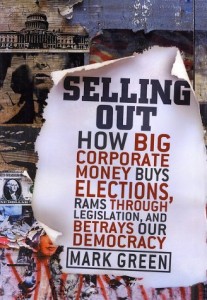
Review: Selling Out

5 Star, Congress (Failure, Reform), Crime (Corporate), Crime (Government), Culture, Research, Democracy, Impeachment & Treason, Misinformation & Propaganda, Politics, Power (Pathologies & Utilization)
Amazon Page
Amazon Page

5.0 out of 5 stars Nitty Gritty, Worth Every Penny to Any Voter,

January 19, 2003

Mark Green

I've chosen this book, together with Michael Moore's “Stupid White Men” and Greg Palast's “The Best Democracy Money Can Buy” to end a lecture I give on the top 50 books every American should read in order to understand why America is not safe today and will not become safe anytime soon, unless the people take back the power and restore common sense to how we spend the $500 billion a year that is now *mis-spent* on the military-industrial complex instead of real capabilities for a real world threat.Mark Green knows as much as anyone could know about the intricate ways in which the existing system provides for *legally* buying elected representatives away from the citizens' best interests. The details he provides in this book–as well as the moderate success stories where reforms have worked–are necessary.The bottom line is clear: until the 60% of America that is eligible to vote but does not vote, comes back into the democracy as active participants who question candidates, vote for candidates, and hold elected representatives accountable *in detail and day to day,* then corporate corruption will continue to rule the roost and will continue to concentrate wealth in the hands of an unreasonably wealthy few at the expense of the general public.

Although I found the book inspiring, I also found it depressing. Absent another 9-11 (or two–or suicidal shooters in an elementary school in every state of the union, or cataclysmic failure in Iraq and North Korea) I see no immediate prospects for America's dropped-out citizens “awakening” and taking back the power. There is still time for corporate money to get smart, pump a little more down to the poor, and avoid a revolution at the polls.

Vote on Review
Vote on Review

Review: Tomorrow Now–Envisioning the Next Fifty Years

5 Star, Future

Amazon Page
Amazon Page

5.0 out of 5 stars Some Real Gems,

January 19, 2003
Bruce Sterling
I know and admire the author, whose other non-fiction book, “Hacker Crackdown” was an extraordinary contribution to social understanding, of both the abuse of uninformed government power, and the potential enlightenment that could be achieved by hackers (who are like astronauts, pushing the envelope in cyberspace).This book is uneven. There are some truly brilliant gems, but there is also a lot of rambling, and I fear that the author's brilliance as a science fiction writer may have intimidated the publisher and editor into settling for what they got, instead of what the author is truly capable of producing when diligently managed. However, after thoroughly reviewing the book to write the review, I ended up going for 5 instead of 4 stars because this kind of writing is uncommon and provocative and my lack of patience may be the external limiting factor.

There are a number of gifted turns of phrase and ideas, and so I do recommend this book for purchase, for reading, and for recurring review. The author focuses on generic engineering, imagining an order of magnitude of achievement beyond what is now conceptualized; he properly redefines education in the future as being disconnected from the schools that today are socializing institutions, beating creativity out of children and doing nothing for adults that need to learn, unlearn, and relearn across their lifetimes; he is brilliant in conceptualizing both crime as necessary and exported instability as tacitly deliberate–Africa as the whorehouse and Skid Row of the world; he recognizes oil as the primary source of instability and inequality, sees all politicians as devoid of grand vision (and we would surmise, character as well); he is hugely successful in talking about the mythical “American people” that do not exist, about moral panics after Enron or 9-11 that achieve no true reform; and his focus on the information age basics that make it cheaper to migrate business than people, that make it essential for the Germans to see through Microsoft's insecure code and thus to opt for LINUX or open source code for their military as well as their government systems in general.

He ends brilliantly in conceptualizing a new world order within a new world disorder, in which very rich individuals combine with very poor recruits from a nationless diaspora, a new network that looks like Al Qaeda but has opposite objectives.

In the larger scheme of things, as the author concludes, Earth is debris and the humans are on their way to being the Sixth Extinction. Party while you can.

Vote on Review
Vote on Review

Review: Understanding International Conflicts–An Introduction to Theory and History

5 Star, Atlases & State of the World, Country/Regional, Diplomacy, Games, Models, & Simulations, Intelligence (Public), Peace, Poverty, & Middle Class, Terrorism & Jihad, Threats (Emerging & Perennial)

Amazon Page
Amazon Page

5.0 out of 5 stars Superb, Post 9-11 Update, Excellent Adult Foundation,

January 10, 2003
Joseph S. Nye
First, it is vital for prospective buyers to understand that the existing reviews are three years out of date–this is a five-star tutorial on international relations that has been most recently updated after 9-11. If I were to recommend only two books on international relations, for any adult including nominally sophisticated world travelers, this would be the first book; the second would be Shultz, Godson, & Quester's wonderful edited work, “Security Studies for the 21st Century.”I really want to stress the utility of this work to adults, including those like myself who earned a couple of graduate degrees in the last century (smile). I was surprised to find no mention of the author's stellar service as Chairman of the National Intelligence Council–not only has he had full access to everything that can be known by secret as well as non-secret means, but he has kept current, and this undergraduate and affordable paperback was a great way for me–despite the 400+ books I've read (most of them reviewed on Amazon.com) in the past four plus years–to come up to speed on the rigorous methodical scholarly understanding of both historical and current theories and practices in international relations. This book is worth anyone's time, no matter how experienced or educated.

Each chapter has a very satisfactory mix of figures, maps, chronologies, and photos–a special value is a block chart showing the causes for major wars or periods of conflict at the three levels of analysis–international system, national, and key individual personalities, and I found these quite original and helpful.

Excellent reference and orientation work. Took five hours to read, with annotation–this is not a mind-glazer, it's a mind-exerciser.

Vote on Review
Vote on Review

Review: Boyd–The Fighter Pilot Who Changed the Art of War

5 Star, Biography & Memoirs, Complexity & Resilience, Decision-Making & Decision-Support, Games, Models, & Simulations, Information Operations, Military & Pentagon Power, War & Face of Battle

Amazon Page
Amazon Page

5.0 out of 5 stars Brilliant Theory, Ugly Corruption, Sad Personal Decay,

December 15, 2002
Robert Coram
In forty years of adult reading, thousands of books, hundreds of biographies, I have not in my lifetime found a better integration of subject, sources, and scholarship. This book will make anyone laugh, cry, and think. There is a deep spirit in this book, and knowing a little about all of this, I was quite simply stunned by the labor of love this book represents. The author's skill and devotion to “getting it right” is breathtakingly evident across the book. His sources, both those close to the subject and those more distant, have been exhaustively interviewed and the quality of this book is a direct reflection of some of the most serious “homework” I have ever been privileged to read.On the theory of war, on the original contributions of John Boyd, the book renders a huge service to all military professionals by dramatically expanding what can be known and understood about the Energy-Maneuverability Theory and the nuances of the OODA Loop (Observe-Orient-Decide-Act–for the real Tigers, Observe-od-Act–a faster loop). Two things stuck out, apart from the heroic manner in which Boyd pursued the intellectual side of combat aviation: first, Boyd consistently had his priorities right: people first, ideas second, hardware last–this is the opposite of the existing Pentagon priorities; and second, truth matters–the book has some extraordinary examples of how both the Air Force and the Army falsified numbers, with disastrous results, while also selecting numbers (e.g. choosing to list an aircraft's weight without fuel or missiles, rather than fully loaded, a distortion that will kill aviators later when the aircraft fails under stress).

On the practical side, the insights into Pentagon (and specifically Air Force) careerism and corruption, as well as contractor corruption and cheating of the government, are detailed and disturbing. There have been other books on this topic, but in the context of Boyd's heroic endeavors as an individual, this book can be regarded as an excellent case study of the pathology of bureaucracy–the Air Force regarding the Navy, for example, as a greater threat to its survival than the Russians. Especially troubling–but clearly truthful and vital to an understanding of why the taxpayer is being cheated by the government bureaucracy, were all the details on the mediocrity and mendacity of Wright-Patterson laboratories and organizations nominally responsible for designing the best possible aircraft. The same thing happens in other bureaucracies (e.g. the Navy architects refusing to endorse the landing craft ideas of Andrew Higgins, who ultimately helped win World War II), but in this instance, the author excels at documenting the horrible–really really horrible–manner in which the Pentagon's obsession with building monstrous systems that increase budgets has in fact resulted in fewer less capable aircraft. The book is a case study in corrupt and ill-considered (mindless) gold-plating and mission betrayal.

As a tiny but extremely interesting sidenote, the book provides helpful insights into the failure of the $2.5 billion “McNamara Line,” a whiz-kid lay-down of sensors in Viet-Nam that Boyd finally ended up terminating.

On a personal level, the author treats Boyd's family life, and his neglect of his family, in objective but considerate terms; the author is also quite effective in identifying and addressing those instances in Boyd's professional life when his fighter-pilot embellishments might be construed by lesser mortals to be falsehoods. There are three sets of heroes in this book, apart from the subject: the ranking officers, including a number of generals, who protected Boyd against the corrupt careerists–there *are* good officers at the top; the enlisted and officer personnel that carried on in the face of poor leadership, mediocre aircraft, and daunting external challenges; and finally, the “Acolytes,” the six specific individuals (Tom Christie, Pierre Sprey, Ray Leopold, Chuck Spinney, Jim Burton, and Mike Wyly), each of whom endured what they call “the pain” to nurture John Boyd and his ideas. I found the author's dissection and articulation of the personal relationships and sacrifices to be quite good and a most important part of the larger story.

Finally, a few tributes en passant. The author does a great job of showing how Boyd ultimately was adopted by the U.S. Marine Corps rather than the U.S. Air Force, and how his ideas have spawned the 4th Generation and Asymmetric Warfare theories, for which the Pentagon does not yet have an adequate appreciation. The mentions in passing of two of my own personal heroes, Mr. Bill Lind and Col G. I. Wilson of the U.S. Marine Corps, and the due regard to the roles played by Dr. Grant Hammond of the Air War College and Mr. James Fallows of the Atlantic Monthly, add grace and completion to the story.

This book is moving–if you care about America, the military, and keeping our children safe into the future, it *will* move you to tears of both laughter and pain.

Vote on Review
Vote on Review

Review: The Fool’s Run

5 Star, Capitalism (Good & Bad), Empire, Sorrows, Hubris, Blowback

Amazon Page
Amazon Page

5.0 out of 5 stars

Integrates Several Plots in an Enjoyable Manner,

December 13, 2002
John Sandford
I do not share the disappointment expressed by some of the earlier reviewers, perhaps because I do not read many novels and this was my first exposure to John Sandford. In any event, I found this “airplane book” so interesting that I made time to finish it once I got home.The integration of several sub-plots, the detailed portrait painted of the primary character, the ins and outs of planning the destruction of a corporation, and the final surprise ending, very much an “out of the box” solution for an impossible situation, gave me great satisfaction, to the point that this author joins Robin Cook, Dick Francis, and Michael Creichton as a trusted provider of light entertainment.

Vote on Review
Vote on Review

Review: COMA (Fiction)

5 Star, Disease & Health

Amazon Page
Amazon Page

5.0 out of 5 stars The Original Medical Thriller, Still Going Strong,

December 13, 2002
Robin Cook
This book, the original novel that propelled the author to the top of the medical thriller genre a quarter-century ago, is a gem. I buy and read Cook's novels anytime I finish my pre-planned books on a trip, and was truly delighted to have a chance to pick up the anniversary edition, which I had not read previously.Among the aspects of Cook's “formula” that I especially appreciate are 1) his provision of non-fiction background references that frame the novel in the real world; 2) his orchestration of vignettes so that one obtains real insights into the backroom operations and otherwise invisible nuances of hospitals and medicine; 3) his engaging characters; and, most importantly, 4) his dramatization of major threats that are not well-articulated to the public by any other means.

Vote on Review
Vote on Review
noble gold