
Review (Retired Reader): Solving the People Puzzle — Cultural Intelligence and Special Operations Forces

4 Star, Asymmetric, Cyber, Hacking, Odd War, Best Practices in Management, Culture, Research, Force Structure (Military), Information Operations, Intelligence (Government/Secret)
Amazon Page

Dr. Emily Spencer (Author)

4.0 out of 5 stars Intelligence Support for Speical Operations Forces,August 15, 2011

This book provides an excellent description of the personal, organization and mission of what are called Special Operations Forces (SOF) and their relationship to conventional forces. More importantly it introduces the concept of `cultural intelligence' as the precise type of intelligence information that SOF unit need to successfully execute their missions.

Cultural Intelligence which Spencer refers to as “CQ” (to avoid confusion with Counter Intelligence (CI)) is a combination of ethnography, sociology, and psychology. As Spencer makes clear successful counter-insurgency operations (COIN) and counter-terrorism (CT) programs depend on understanding the cultural environment in which they are conducted. That is it is necessary to understand the underlying social structures, beliefs, and motivations of the populations constitute what she refers to as the Contemporary Operating Environment within which SOF missions are conducted. This important insight is one of those concepts which appear obvious, but only have somebody has developed it.

Continue reading “Review (Retired Reader): Solving the People Puzzle — Cultural Intelligence and Special Operations Forces”

Review: International Intelligence Cooperation and Accountability

4 Star, Intelligence (Government/Secret)
Amazon Page

Hans Born (Editor), Ian Leigh (Editor), Aidan Wills (Editor)

4.0 out of 5 stars Four for Content, Zero for Price,August 16, 2011

There are some good contributions in this book, and it is certainly recommended for institutional purchase, but the price is utterly outrageous and completely unacceptable for the individual professional, scholar, or practitioner interest in learning from these authors. The book should be offered immediately at no more than $35.00.

The book is focused on governments. Worse, it is focused on governments exchanging secret or sensitive information with one another.  While there is one extraordinary chapter on intelligence in international operations, the book as a whole is government centric a decade (or two) after the rest of us began routing around government. The new meme is M4IS2: Multinational, Multiagency, Multidisciplinary, Multidomain Information-Sharing and Sense-Making, and the eight tribes that do M4IS2 (when properly led, which is almost never) are academic, civil society, commerce, government, law enforcement, media, military, and non-government/non-profit.

The general concept of the book, that a frame of reference for accountability is needed, is a good one, but overlooks the obvious fact that 80-90% of information sharing must be multinational, multiagency, and not secret–unclassified open sources and methods are the vast majority of what needs to be shared.  In that context, I would suggest that all governments fail the most basic accountability test: they persist in spending taxpayer money on secret intelligence that provides, “at best” 4-10% of what the full range of government needs for decision-support are.  It's time we start holding secret intelligence accountable for being largely worthless in the overall scheme of human affairs, and in relation to the ten high-level threats identified and prioritized by the United Nations High Level Panel on Threats, Challenges, and Change.

See Also: [Amazon insert a link remains broken for books]

Continue reading “Review: International Intelligence Cooperation and Accountability”

Review: Keeping Watch – Monitoring Technology and Innovation in UN Peace Operations

5 Star, Information Operations, Information Technology, Intelligence (Government/Secret), Intelligence (Public), Peace, Poverty, & Middle Class, Stabilization & Reconstruction, United Nations & NGOs, War & Face of Battle
Amazon Page

Walter Dorn

5.0 out of 5 stars Phenomenal Contribution to UN and to Literature,August 13, 2011

Professor Walter Dorn is the de facto dean of the small number of scholars who study the specific topic of peacekeeping intelligence, or intelligence support to United Nations (UN) operations. Since his pioneering early studies of UN successes in the Congo in the 1960's to his more recent articles on the introduction of the Joint Military Analysis Centre (JMAC) in Haiti, he is both the closest academic observer, and the most well-written in this area.

I read this book with great interest. It is the first comprehensive look at technologies that are directly applicable to the fulfillment of UN mandates, the design and security of multinational forces, the effective management of tactical campaigns, and of course being technical, it is the first and last word on surveillance technologies vital to peacekeeping and peace enforcement across vast regions.

Pending the “Inside the Book” feature being available for this just published book, here is the table of contents from my own copy.

1 Introduction
2 The Evolution of Peacekeeping
3 Monitoring: The Constant Need
4 Survey of Technologies
5 Aerial Surveillance: Eye in the Sky
6 Traditional Peacekeeping: Cases
7 Modern Multidimensional Peacekeeping: Cases
8 Current UN Standards: Starting from Near Zero
9 Challenges and Problems
10 Recommendations
11 Conclusions

I recently attending a conference on the history and future of UN Air Power, and in both my own presentations and those of others, “Peace from Above” was a recurring theme. The importance of assuring that UN elements have the best possible human and technical surveillance technologies cannot be understated–for modest investments–including Unmanned Aerial Vehicles–the UN can save lives, money, and time–on the latter point, Colin Gray, in Modern Strategy, observes that time is the one strategic variable that can neither be purchased nor replaced.

A word on pricing: as those who follow my reviews know, I will occasionally single out extraordinary books that are so grotesquely priced as to dishonor the entire publishing world. This book is perfectly priced, close to my standard of page count with one decimal. I salute the UN Press for bringing this book into the world. It should become a standard volume, not only for UN training classes, but for all war colleges as well as for commercial security training and operations.

See Also:

Peacekeeping Intelligence: Emerging Concepts for the Future

Vote on Review

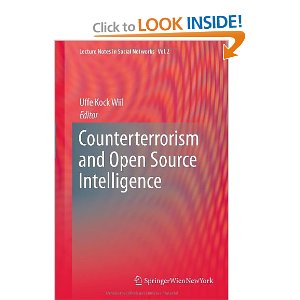
Review: Counterterrorism and Open Source Intelligence

5 Star, Asymmetric, Cyber, Hacking, Odd War, Games, Models, & Simulations, Information Operations, Intelligence (Commercial), Intelligence (Government/Secret), Terrorism & Jihad
Amazon Page

Uffe Kock Wiil (ed)

5.0 out of 5 stars , Innovative, Technical, Leverages Open Sources to the Fullest July 27, 2011

Springer needs to make it clear to Amazon that the book ships from a US-based warehouse. I have urged the lead editor and conference organizer to ask Springer to correct the error. The book is available within the US and should be delivered within the week once Springer corrects the way the book has been registered on Amazon. I anticipate that a paperback version will be offered at a more affordable price for individuals–this is the library or institutional “trade” price.

I am very glad to see the publisher make use of Look Inside the Book, and encourage all interested parties to use that feature and study the table of contents. I have to articulate my profound respect for the conference organizer and senior book editor and for those contributing to this book, all of whom I met at the conference for which this content was created.

I have never seen a better collection of scientific and mathematical approaches to leveraging open sources of information to identify precursors and patterns of terrorism. This is an original book, and the first major effort of the new counterterrorism center at the University of Southern Denmark.

Including my alternative perspective, as one other senior participant put it, “makes our job harder.” One reason I particularly like Nordic professionals is because of their integrity. There is a great deal of intelligence and total integrity in this book; it is an honor for me to have been included. I am not competent in the way the other authors are, and my regard for their pioneering is unlimited.

Also just published, very US centric but a really original study, is No More Secrets: Open Source Information and the Reshaping of U.S. Intelligence (Praeger Security International). I have provided a lengthy review at the Amazon page for that book.

Vote and/or Comment on Review

Review: Intelligence Analysis – Behavioral and Social Scientific Foundations

5 Star, Decision-Making & Decision-Support, Information Operations, Intelligence (Government/Secret)
Amazon Page

Baruch Fischhoff and Cherie Chauvin (eds.)

5.0 out of 5 stars Insider/Academic/Psychology Overview, Avoids the Negatives,July 25, 2011

First off, this book is not being offered by Amazon but rather by third party sellers seeking to leverage public ignorance. The book is available for $70 instead of $130 at National Academies Press, where it is also available for free by the chapter–every chapter–which gladens my heart. That is how it should be, and earns the book a fifth star despite the rather narrow view offered by the insider/academic authors in the aggregate, all focusing on the psychology of intelligence analysis.

Continue reading “Review: Intelligence Analysis – Behavioral and Social Scientific Foundations”

Review: No More Secrets – Open Source Information and the Reshaping of U.S. Intelligence

5 Star, America (Founders, Current Situation), Best Practices in Management, Budget Process & Politics, Change & Innovation, Communications, Congress (Failure, Reform), Corruption, Country/Regional, Culture, Research, Decision-Making & Decision-Support, Executive (Partisan Failure, Reform), Information Operations, Intelligence (Government/Secret), Intelligence (Public), Nature, Diet, Memetics, Design, Politics, Power (Pathologies & Utilization), Public Administration, Security (Including Immigration)

Hamilton Bean

5.0 out of 5 stars Spectacular Integrative and Pioneering Work, July 27, 2011

This is a pioneering work that not only explains the true worth of open source intelligence, but also illuminates the institutional bias against it and the pathologies of a culture of secrecy. The use of primary data from interviews makes this an original work in every possible sense of the word. I strongly recommend the book to both professionals and to faculty seeking a provocative book for students.

The book opens with a Foreword from Senator Gary Hart, who cites Senator Daniel Patrick Moynihan's point that secrecy is used against the US public more often than it is used to withhold information from the alleged enemy. He also makes the observation that the collapse of the Soviet Union and the emergence of the web occurred almost simultaneously (1990-1991). See Senator Hart's three most recent books, The Thunder and the Sunshine: Four Seasons in a Burnished Life; The Shield and the Cloak: The Security of the Commons, and my favorite The Minuteman: Returning to an Army of the People. The concept of an “intelligence minuteman” is at the foundation of the Open Source Intelligence movement, and highly relevant to this book by Dr. Hamilton Bean.

In his Preface Dr. Bean makes the point that his book is about institutional change and resistance, and the open source intelligence story is simply a vehicle for examining both the utility of his methods with respect to the study of communications and discourse, and the ebbs and flows of institutional change.

Continue reading “Review: No More Secrets – Open Source Information and the Reshaping of U.S. Intelligence”

Review: Global Public Policy – Governing Without Government?

5 Star, Best Practices in Management, Capitalism (Good & Bad), Change & Innovation, Complexity & Resilience, Congress (Failure, Reform), Corruption, Decision-Making & Decision-Support, Environment (Solutions), Executive (Partisan Failure, Reform), Future, Intelligence (Commercial), Intelligence (Government/Secret), Intelligence (Public), Nature, Diet, Memetics, Design, Peace, Poverty, & Middle Class, Politics, Power (Pathologies & Utilization), Priorities, Stabilization & Reconstruction, Values, Ethics, Sustainable Evolution, Water, Energy, Oil, Scarcity
Amazon Page

Wolfgang Reinicke

5.0 out of 5 stars Pioneering Work, Missing Some Pieces,July 7, 2011

This is a pioneering work, easily a decade ahead of other world-class efforts, my favorite being that of (then) World Bank Vice President for Europe, J. F. Rischard, High Noon 20 Global Problems, 20 Years to Solve Them. It has been largely over-looked, but should gain additional importance, along with the author's additional book, Critical Choices. The United Nations, Networks, and the Future of Global Governance, now that George Soros is sponsoring the Central European University (CEU), and within that university, the author Wolfgang Reinicke has been appointed the inaugural dean of CEU's School of Public Policy and International Affairs. In the context of the essay by George Soros, the first 57 pages of The Philanthropy of George Soros: Building Open Societies, and the now hardened disenchantment with the nation-state system for being ignorant, biased, and non-agile (these and other deficiencies are marvelously articulated by Professor Philip Allot of Cambridge in The Health of Nations: Society and Law beyond the State, one can surmise that Dean Peinicke will seek to focus on integrationist endeavors that demand transparency and accountability for multiple stakeholders in return for stability and mutual gain.

Continue reading “Review: Global Public Policy – Governing Without Government?”