My Head Hurts–Time for a Black Caucus on Black Power
October 7, 2009
Houston A. Baker
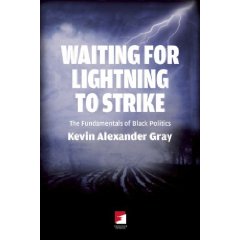
My head hurts. After enjoying and reviewing Waiting for Lightning to Strike: The Fundamentals of Black Politics yesterday evening, I was not anticipating the firestorm of erudite adjective-laden brow-beating that this author delivers. Minus one star for beating several (black) horses to death, and as Reviewer Carter notes, not without meriting some of the same himself.
First off, this is a book that had to be written and must be read. There are, amidst the “wordier than thou” broad brush critiques, some real gems, some really engaging turns of phrase. It is unfortunate that the nature of the inquiry demands fairly personal explicit attacks on avowedly great black intellectuals, but there is some meat here.
Page 104: “Centrist territory is a rhetorical demilitarized zone where honest, committed, and historically informed proclamations on cause and effect regarding race, culture, morality, and gender in the United States can be studiously avoided, fudged, or simply made to suit the audience on hand.”
Although the essays date back to 1994 this book (and the one above) are both published in 2008 and I will first testify that this is a fresh book, very ably strung together, and it does indeed address the fundamentals.
I totally share the author's conviction that the war on drugs is a fraud that is in fact both a war on blacks and a means of populating the prison-slavery complex. I appeared in the DVD American Drug War: The Last White Hope testifying against the CIA for precisely this reason–the author does not discuss, but I am aware of, the close relation between laundered drug money and Wall Street liquidity, and I absolutely one hundred percent support both the legalization of drugs beginning with marijuana, and the eradication of SWAT teams and other forms of excessive militarization across America.
The more I read, the less I know and the more frustrated I grow with the insanity of academic, government, corporate, and non-governmental stovepipes of knowledge in isolation.
Opening quote on page 5: “Fedor Dostoevsky once said, `A man who lies to himself, and believes his own lies, becomes unable to recognize truth, either in himself or in anyone else.” What an epitaph for partisan governance based on lies.
Before I lay out my fly-leaf notes, a comment spanning all the books I have read:
As a recovering spy who has published and agitated for intelligence reform over the years, I generally have little patience for spy novels less the George Smiley series by John Le Carre. Been there, done that. This book is nothing short of sensational, and at $9 a huge value.
This book is so very good that I am making it one of THREE books I recommend to future spies and those who wish to understand the human side of the spy world today (or course there are many others but this one is special). The other two are still:
I liked this book on multiple levels. It does for the clandestine service, where we were obscenely proud of having the highest alcoholism, adultery, divorce, and suicide rates in the US Government, what James Webb did for the abuse of military forces by craven politicians in Fields of Fire.
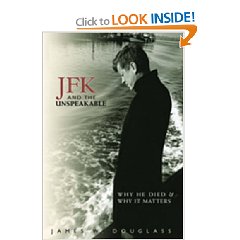
The premise is that JFK went against the national security establishment, notably the CIA, the Joint Chiefs of Staff, and the military-industrial complex, and was assassinated by deliberate plan of the CIA, with Richard Helms, David Atlee Philips, David Sanchez Morales, and Desmond Fitzgerald specifically culpable for high crimes of treason.
As with 9/11 and the documented culpability of Dick Cheney, Donald Rumsfeld, Larry Silverstein, and Rudy Gulliani, there is insufficient proof in this book for conviction, but it is more than ample to demand a very intrusive and comprehensive investigation of the CIA, the Secret Service, and the FBI. I *want* to believe Helms when he says CIA did nothing not ordered by a President. However, if the premise of this book is proven, CIA should be abolished, its HQS demolished, and salt plowed into the earth at Langley.
The book's most positive account is of the back-channel dialog JFK developed with Khrushchev, Castro, and the Pope, dialog that not only defused the confrontations of the time, but also ended the Cold War. The theology of peace, the role of Monk Thomas Merton, the role of Norman Cousins (author of The Pathology of Power – A Challenge to Human Freedom and Safety), the role of the Pope and Pacem in Terris, and the strength JFK drew from a single meeting with Quakers are moving. This is in many ways a resurrection of JFK and both an epitaph worthy of his unsung accomplishments, and a call to arms for achieving closure–truth and reconciliation–with respect to his assassination by US Government personnel committing treason.
5.0 out of 5 starsPhenomenal Reference with a Priceless CD,
September 25, 2009
Jerome Glenn, Theodore Gordon, and Elizabeth Florescu
This book, which includes a CD with a ton of additional information and visualization, is worth every penny of the asking price. It brings together global statistics, illustrations, and expert depictions of alternative scenarios.
Although it focuses primarily on Energy & Economies, it is closely tied in with achieving all of the Millenium Goals set by the Member Nations of the United Nations, and cacn easily be scaled up and out as more resources are applied.
This book is a “beyond five stars” book and will be so rated at Phi Beta Iota, the Public Intelligence Blog where I can do things Amazon does not provide for, including reader access to my 1400+ non-fiction reviews via any of 100 different categories.
This single man, this author, has lifted 17 million people out of poverty by focusing on the needs of the one-acre and below subsistence farmer living on $1 a day. I get goose-bumps just thinking about the magnitude of both the accomplishment, and the implications of the accomplishment.