This review is from: Classified Woman-The Sibel Edmonds Story: A Memoir (Paperback)
Sibel Edmonds' new book, “Classified Woman,” is like an FBI file on the FBI, only without the incompetence.
The experiences she recounts resemble K.'s trip to the castle, as told by Franz Kafka, only without the pleasantness and humanity.
I've read a million reviews of nonfiction books about our government that referred to them as “page-turners” and “gripping dramas,” but I had never read a book that actually fit that description until now.
The F.B.I., the Justice Department, the White House, the Congress, the courts, the media, and the nonprofit industrial complex put Sibel Edmonds through hell. This book is her triumph over it all, and part of her contribution toward fixing the problems she uncovered and lived through.
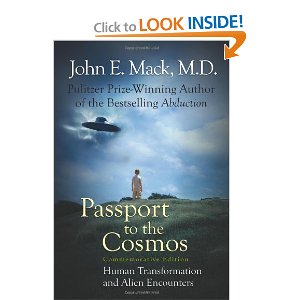
As Professor of Psychiatry at Harvard University Medical School, John Mack had the highest possible academic credentials. He was also a Pulitzer Prize-winning author for his biography of T. E. Lawrence, ‘A Prince of our Disorder.'
‘Passport to the Cosmos' (PTTC) was Mack's second and final book on the alien abduction issue, before his death in September 2004. It's a thoughtful, coherent and readable essay; a more absorbing narrative than his earlier 1994 book “Abductions: Human Encounters with Aliens”. Whereas the earlier book episodically recounted the experiences of 13 different abductees in their own words but seemed reluctant to draw conclusions – beyond the obvious fact that the phenomenon was not psychiatric but (in some way) external to the experiencer and physically real – “PTTC” explores what it all might mean in terms of human consciousness and why our accepted “ontological notions of consensus reality” need to be expanded to accommodate this subversive intrusion into our world.
The author writes in Chapter One:
“…marshalling evidence that might conceivably satisfy the physical sciences `on their own turf' has proved to be an elusive task. I will document experiencers' reports with physical evidence where applicable, but my principal interest is in their pattern, meaning and potential implications for our understanding of reality and knowledge of ourselves in the universe.”
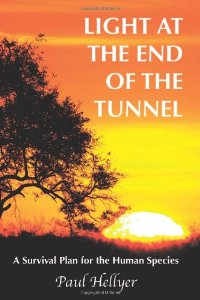
Unlike our Asian counterparts, the West often fails to accord our wise elders the honor they deserve – the status they have earned by devoting their lives to love of, and service to humankind. Paul Hellyer of Canada is one such man. Born in 1923, he is very much a hero of the 20th century; yet he continues his vigorous momentum into the new century, preparing youth for the hopes and challenges that lie ahead.
As former Minister of Defense for Canada and cabinet member during both the Pearson and Trudeau administrations, Hellyer is certain that technology currently exists to replace the ecologically-destructive world oil economy. He argues that, while difficult and financially threatening to “big oil,” a gradual transition can, and must be implemented post haste, warning that ten years is just about all the time we have left before the ecological damage to our planet becomes irreversible.
“Failure to disclose a clean energy alternative to fossil fuels,” he writes, “is worse than a crime against humanity. It's a crime against creation and the Creator.”
His book speaks volumes about crimes against planet Earth. He investigates them from many perspectives, laying out charges against perpetrators, and in his wisdom, offers rehabilitation plans to assure today's youth that they will inherit a world redeemed from near destruction.
Minister Hellyer reminds his American readers of the long-standing economic dirty tricks, the incessant meddling in the internal affairs of other nations and myriads of injustices carried out by the United States government under the banner of democracy, freedom and, ironically, peace – also that, because of U.S. news media collusion, such outrages rarely reach the eyes and ears of the average Yankee.
My summoned review of this book: “the most interesting one of the MH saga”.
In this book you can find the most revealing information about this human race. While I was reading this book, a long sleeping memory re-ignited in my head: I ALSO met these people !! No joke I swear, this fisonomy matches exactly to that of 4 people that came across my hometown about 35 years ago:
On july 1975 (perhaps 1976) my family spent vacations in a little village named “Chera”, here in Spain located some 70 km inland from East coast (Valencia).
My uncle startled stood up during the street-laid supper and voiced: “what the heck is that thing”, spotting what he said “looked like a flying bus”.
Effectively all of us could see about 3000 feet high and 3 miles away, an strange object cruising from east to west in utter silence. This sighting was at roughly 11 pm and lasted for no more than 30 secongs. This place is sorrounded by mountains and the object soon hid behind a ridge.
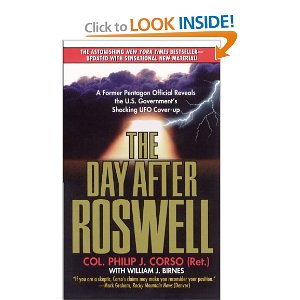
Before I begin my review, let me clarify that I have only a moderate curiosity in UFO's and such. I'm not a skeptic or a believer, but someone who sees a field of study that's intriguing, impossible to flat-out dismiss, and at the very least entertaining. Nevertheless I did pick up this book and read it. Here are my thoughts:
Many skeptics ask, “If the government DOES know something about aliens and UFOs, why, and how, do they keep it secret from everyone else?”
Col. Corso's book gives a sober and convincing explanation for this. Rather than giving a broad overview, however, he wisely sticks to a specific description of his own hands-on experience and how he did the job he was asked to do. Specifically, as head of the Army's Foreign Technology Desk in the Pentagon, Corso alleges he was in charge of “getting something useful” out of alien artifacts collected from the Roswell UFO crash in 1947.
Corso was faced with a challenge: How do you gather funding and personnel (many of whom are low-ranking) for a US Army R&D project on the Roswell UFO artifacts, while using “normal,” visible administrative channels, and keep it a secret from other branches of the government and even many of the individuals directly involved?
Surveillance or Security?: The Risks Posed by New Wiretapping Technologies is a hard book to categorize. It is not about security, but it deals extensively with it. It is not a law book, but legal topics are pervasive throughout the book. It is not a telecommunications book, but extensively details telco issues. Ultimately, the book is a most important overview of security and privacy and the nature of surveillance in current times.
Surveillance or Security? is one of the most pragmatic books on the topic is that the author never once uses the term Big Brother. Far too many books on privacy and surveillance are filled with hysteria and hyperbole and the threat of an Orwellian society. This book sticks to the raw facts and details the current state, that of insecure and porous networks around a surveillance society.
In this densely packed work, Susan Landau, a fellow at the Radcliffe Institute for Advanced Study at Harvard University details the myriad layers around surveillance, national security, information security and privacy. Landau writes that her concern is not about legally authorized law enforcement and nationally security wiretapping; rather about the security risks of building surveillance into communications infrastructures.