Dr. Edna Reid, intelligence analyst (IA) in the federal government, and Aileen Marshall will present an interactive session about emerging roles for librarians/information professionals as intelligence analysts (IAs), open source specialists, and cyber intelligence analysts. The workshop will involve dissecting job descriptions for IAs, comparing competencies of librarians and IAs, and exploring training opportunities such as the open source specialist certificate. Reforms in the intelligence community (IC) and enhanced recognition of the value of open source/unclassified information (OSINT) can provide new opportunities for you!
Objectives:
• Discover how librarians can make the transition to IAs in the intelligence community (IC).
• Analyze IA job announcements, outline differences between LIS and an IA resumes, and discuss analytical tradecraft associated with IAs. Tradecraft is a skill acquired through experience in a trade.
• Highlight opportunities for librarians/information professionals and the SLA.
5.0 out of 5 stars We NEED Deep History to Counter-Act Criminal Insanity Within Our Elite, February 17, 2013
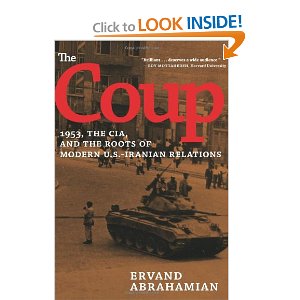
This book could not have come out at a better time, as the neo-conservatives continue to try to inspire confrontation with Iran, using the same methods that Dick Cheney used — in his case 935 now documented lies — to invade Iraq.
I was drawn to this book by Leon Hadar's review (he is the author of Sandstorm: Policy Failure in the Middle East in Reason.com, “Our Man in Iran: How the CIA and MI6 installed the Shad.” I am a former CIA clandestine case officer, and today an arch-critic of expensive ignorant secret sources and methods, while also being a champion for open source everything and multinational information-sharing and sense-making — the anti-thesis of all that CIA represents.
Please do look up the Hadar review online, he writes from a geopolitical perspective. As an intelligence professional myself, and as someone who cares deeply about achieving intelligence with integrity in the public interest, my own comments focus on how vital this book is as a means of exposing information pathologies — below are a few books about such pathologies, all of which are illiminated by this book on UK-US perfidy and CIA “success” that is actually an ignominious denial of history, reality, and morality.
We are at a turning point in modern human history — the Earth will survive us, but if we are to survive and prosper, we must confront the stark reality that with a few exceptions (Iceland, Nordics, BENELUX) all Western governments are corrupt to the bone. In the USA, the two-party tyranny whores itself to Wall Street, and there is no difference between the high crimes and misdemeanors of the Cheney Regime (Bush Senior led the CIA team that assassinated JFK, see for example Dark Legacy, Bush Junior was nothing more than a well-intentioned idiot whose Dad and assorted criminal allies bought him the Presidency (and Al Gore's playing dead)) and the Obama Regime with its drones and special forces teams doing extrajudicial killings all over the world, and the Department of Justice making torture and rendition and execution of US citizens “OK” while telling the Court they have a right to lie to the Court in case of national security. America gone mad, indeed.
Both the critics and the admirers of the Central Intelligence Agency have tended to portray it as an all-knowing, all-powerful, invulnerable entity and to exaggerate the ability of America's spies to determine the outcome of developments around the world. An American reporter interviewing an ordinary citizen—or an official—in Cairo, Buenos Aires, or Seoul may hear that “everyone knows” that the CIA was behind the latest rise in the price of vegetables or the recent outbreak of flu among high-school kids. It’s like you Americans aren't aware of what's obvious (wink, wink).
New histories of the agency, drawing on recently released classified information and memoirs by retired spies, provide a more complex picture of the CIA, its effectiveness, and its overall power, suggesting that at times Langley was manned not by James Bond clones but by a bunch of keystone cops. My favorite clandestine CIA operation, recounted in Tim Weiner's Legacy of Ashes, involves its 1994 surveillance of the newly appointed American ambassador to Guatemala, Marilyn McAfee. When the agency bugged her bedroom, it picked up sounds that led agents to conclude that the ambassador was having a lesbian love affair with her secretary. Actually, she was petting her two-year-old black standard poodle.
I’ve identified 16 of these game-over situations facing America today, situations from which there is the possibility of no recovery — not the certainty, but the possibility. As I was working on that article though, looking especially what it would take to reverse each trend, I realized it’s really only one story writ 16 times on 16 separate canvasses.
It’s the story, in other words, of worldwide billionaires and the one thing they’re doing — monomaniacly making money while telling each other tales of their Randian goodness.
America’s 16 deadlines
As I said, I see 16 individual, though interlinked, processes in the country today that have potential game-over, irreversible end-points. You may think there are more, or you may think some could be merged, but I think that’s tweakage, “in the noise,” not a useful distinction. For our purposes, this list is good enough.
Here they are, numbered in no particular order, but grouped:
‘The damage we're doing to the Defense Department is enormous'
By Charlie Rose
Someone said to me that, since you received your heart transplant last year, you’re a new man. That you’re mellow, less strident. Is this true?
My family’s accused me of being downright chatty on occasion. I don’t sense that I’m a different personality. A lot of people want to know, “Did your new heart change your political views?” I went from end-stage heart failure, near death, to a new heart. I wake up every morning with a smile on my face in anticipation of a day I never expected to see.
You were in Wyoming last weekend, and you talked about Obama’s new team being “second-rate.” What issues stand out for you?
I’m very concerned about what I see happening in the national security arena. I think the administration’s policies are terribly flawed. I think the damage we’re doing to the Defense Department is enormous with the sequester. I think the president’s performance in the international arena, the Middle East and so forth, is worse than many of my friends and colleagues deem his domestic policies. I see him headed for the exits in the Middle East. We’re getting out of Iraq … getting out of Afghanistan as quickly as he can. We’re jawboning the Iranians on their nuclear program, but at the same time we withdraw one of our carriers from the Persian Gulf.
So you’ve got problems with Obama’s policies—and his nominations of Chuck Hagel and John Brennan.
With respect to Hagel and Brennan, just in the last week their performances in front of the committees that have to confirm them have been pretty poor. And that’s not my judgment. That’s the judgment of senators on both sides of the aisle. When I think of a secretary of defense for a Democratic administration … Sam Nunn. He’s a tremendous talent, enormous experience. Chuck doesn’t have those credentials. He doesn’t have that stature. I think [Obama] wants a Republican to be the foil, if you will, for what he wants to do to the Defense Department, which is to do serious damage to our military capabilities.
We are delighted to share with you our 2013 list of the 100 Most Spiritually Influential Living People.This marks the third year that we are publishing our 100 list. We’ve done our best to consider as many people as possible and our spiritual database includes the names of over six hundred candidates from which we selected the list of the top 100, highlighting the most proactive individuals – ranging from political and religious leaders to spiritual writers, filmmakers and visionary artists.
Issue 33, Spring 2013 Order Here UK 4.95
This list is meant to serve as a positive guide to some of the leading modern teachers that are alive today, and we hope that you are as inspired as we are by their impact. We hope it helps our readers discover new authors and inspirational ideas.
This year’s list is more global and diverse than ever before. The youngest person on the list is Jeff Foster (32 years old) and the oldest person is Kyozan Joshu Sasaki (105 years old). We are also sad to report that Stephen Covey who was on last year’s list, passed away in July, 2012. There are several factors that were taken into account when compiling the list. The main three criteria are:
1) The person has to be alive
2) The person has to have made a unique and spiritual contribution on a global scale
3) The person is frequently googled, and is actively talked about on the internet; for writers, the book sales via Nielsen Data are also considered.
[VatiLeaks] showed how Benedict, a weak manager who may most be remembered for the way in which he left office, was no match for a culture that rejected even a modicum of transparency and preferred a damage-control campaign that diverted attention from the institution’s fundamental problems. Interviews in Rome with dozens of church officials, Vatican insiders and foreign government officials close to the church, many of whom spoke on the condition of anonymity for fear of retribution, mapped out that hermetic universe.
. . . . . . . . .
Click on Image to Enlarge
“Seeing evil and corruption everywhere in the church, I finally reached a point of degeneration, a point of no return, and could no longer control myself,” Gabriele explained to Vatican investigators. A shock, “perhaps through the media,” Gabriele continued, could “bring the church back on the right track.”
. . . . . . . . .
But Bertone worked diligently to consolidate power. His allies control the church’s main financial institutions, prompting one official to write in a leaked document that traditional checks and balances had been ignored. “They say that our principal point of reference is the Secretary of State,” the letter read, “yet in many cases he’s precisely the problem.” Bertone’s position also meant he presided over the Vatican Bank, a post he appeared to use to impede Benedict’s financial reforms.
. . . . . . . . . .
The Vatican’s reaction to the leak scandal was not to address its inner flaws but to burnish its outer image.