NIGHTWATCH: Afghanistan Lost, Syria Holding

Cultural Intelligence, Government, Military
0Shares

Afghanistan: Comment: On the 16th, US and NATO officials praised the Afghan commandos for leading the counterattack against the small group of anti-government fighters who assaulted Kabul on Sunday. However, some seemed to undermine the significance of the Afghan achievement by minimizing the significance of the assault itself, calling it the last gasp of the anti-government forces. Evidently, the Afghans fought well against a weak force and the sensational set of attacks actually signifies an improving security situation. Hmmm.

Thus, Readers might be confused on the 17th by multiple press services reports that the NATO command plans a large offensive to improve security in Kabul in May.

NightWatch has written that violent instability is centripetal. It moves from the border marches and other peripheries to the center of power, the capital. Victory for the anti-government forces means seizing and holding the capital. Victory for the government forces means holding a secure center and expanding a secure perimeter outward to the national borders.

A government that cannot maintain a secure center of power, the capital, cannot survive. It does not matter whether it falls to the Taliban or the Haqqanis. It will fall. Thus, attacks in the capital are always signs of weakness at the center. The only question is how weak.

For example, the Syrian government understands this phenomenology, which is why there have been less than a handful of attacks in Damascus during a year of violent instability. Damascus has experienced no 18-hour battles. The occasional attacks do not signify significant weakness. The Syrian center is holding.

Syria is not Afghanistan and the two fights are quite different, but the importance of security at the center is the same. This week's outbreak of fighting in Kabul means one thing: Kabul is not secure even with NATO forces. If the center is not secure, nowhere else matters.


NIGHTWATCH KGS Home

Chuck Spinney: Hardware Über Alles in the Spendagon — Paneta Pumps Corporate Profits While Veterans Commit Suicide + Meta-RECAP

07 Other Atrocities, 10 Security, 11 Society, Corruption, DoD, Government, Military, Officers Call
0Shares
Chuck Spinney

Hardware Über Alles in the Spendagon

(Note to Readers, the following essay is a revised version of one that appeared in Time Magazine's Battleland blog found at this link.)

For a good example of the Military-Industrial-Congressional Complex’s (MICC’s) value system — which is hardware before ideas and people — read this New York Times column by Nicholas Kristof.

Note his opening paragraph:

Here’s a window into a tragedy within the American military: For every soldier killed on the battlefield this year, about 25 veterans are dying by their own hands.

And here is Kristof’s penultimate paragraph:

We refurbish tanks after time in combat, but don’t much help men and women exorcise the demons of war. Presidents commit troops to distant battlefields, but don’t commit enough dollars to veterans’ services afterward. We enlist soldiers to protect us, but when they come home we don’t protect them.

In between, Kristof supports these statements with horrific detail.

Continue reading “Chuck Spinney: Hardware Über Alles in the Spendagon — Paneta Pumps Corporate Profits While Veterans Commit Suicide + Meta-RECAP”

Patrick Meier: The Digital Operations Center of the American Red Cross

IO Impotency
0Shares
Patrick Meier

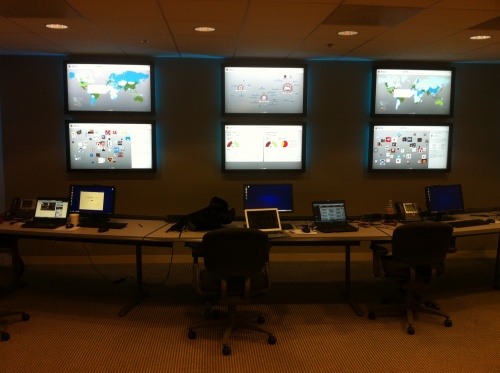
The Digital Operations Center at the American Red Cross is an important and exciting development. I recently sat down with Wendy Harman to learn more about the initiative and to exchange some lessons learned in this new world of digital  humanitarians. One common challenge in emergency response is scaling. The American Red Cross cannot be everywhere at the same time—and that includes being on social media. More than 4,000 tweets reference the Red Cross on an average day, a figure that skyrockets during disasters. And when crises strike, so does Big Data. The Digital Operations Center is one response to this scaling challenge.

Sponsored by Dell, the Center uses customized software produced by Radian 6 to monitor and analyze social media in real-time. The Center itself sits three people who have access to six customized screens that relate relevant information drawn from various social media channels. The first screen below depicts some of key topical areas that the Red Cross monitors, e.g., references to the American Red Cross, Storms in 2012, and Delivery Services.

REDACTED:  Multiple Screen Shots and Related Commentary

Click on Image to Enlarge

As  argued in this previous blog post, the launch of this Digital Operations Center is further evidence that the humanitarian space is ready for innovation and that some technology companies are starting to think about how their solutions might be applied for humanitarian purposes. Indeed, it was Dell that first approached the Red Cross with an expressed interest in contributing to the organization’s efforts in disaster response. The initiative also demonstrates that combining automated natural language processing solutions with a digital volunteer net-work seems to be a winning strategy, at least for now.

After listening to Wendy describe the various tools she and her colleagues use as part of the Operations Center, I began to wonder whether these types of tools will eventually become free and easy enough for one person to be her very own operations center. I suppose only time will tell. Until then, I look forward to following the Center’s progress and hope it inspires other emergency response organizations to adopt similar solutions.

Phi Beta Iota:   This is not real — it is what the beltway bandits can vaporware, or viewgraph engineering.  It appears to be a local initiative that is completely removed from the Geneva operations center that follows 30+ wars at a time.  It is the germ of a good idea that is heavily reliant on non-existent volunteers, and disconnected from all other information outside the social sphere.  It also appears to have overlooked the value of Twitter in identifying specific individuals at specific locations who can be queried via Twitter for an eyes-on answer.

See Also:

2012 PREPRINT FOR COMMENT: The Craft of Intelligence

1989 Webb (US) CATALYST: Computer-Aided Tools for the Analysis of Science & Technology

Open Source Agency: Executive Access Point

THE OPEN SOURCE EVERYTHING MANIFESTO: Transparency, Truth & Trust

World Brain & Global Game 101-104

Review (Guest): Gandhi and the Unspeakable

5 Star, Biography & Memoirs, Culture, Research, Justice (Failure, Reform), Nature, Diet, Memetics, Design, Peace, Poverty, & Middle Class, Philosophy, Politics, Power (Pathologies & Utilization), Religion & Politics of Religion, Threats (Emerging & Perennial), Truth & Reconciliation, Values, Ethics, Sustainable Evolution
0Shares
Amazon Page

James W. Douglass

Reviewed by Christian Newswire

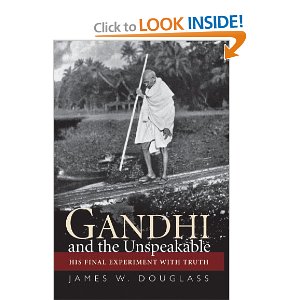
Ghandhi and the Unspeakable looks upon the father of the Indian independence movement and examines why a prophet of nonviolence was assassinated by Hindu nationalists during a prayer meeting in New Delhi.

From James W. Douglass, the bestselling author of JFK and the Unspeakable (Orbis 2010), Ghandhi and the Unspeakable shines new light on the untimely death of Mohandas Gandhi. Following the theme of his study about the assassination of President John F. Kennedy, Mr. Douglass shows how the people who conspired to kill Gandhi hoped to destroy a compelling vision of peace, nonviolence and reconciliation.

By tracing the story of Gandhi's early “experiments with truth” in South Africa, Mr. Douglass shows how Gandhi confronted and overcame the fear of death. He also explains why, as with the case of JFK's death, this story matters today and what can be learned from Gandhi's truth and its opposition to the powers of his time.

Mr. Douglass is a scholar and peace activist. His book about the JFK assassination is widely acclaimed by historians and political scientists as one of the most important books written about the subject. Gandhi and the Unspeakable, according to Publisher's Weekly, “provides readers with a slim, elegant volume containing explosive insight into who conspired to assassinate the father of modern nonviolence and why.”

See Also:

JFK and the Unspeakable: Why He Died and Why It Matters

Theophillis Goodyear: Ethics, Psychology, and the Volunteer Army

Ethics, Military
0Shares
Theophillis Goodyear

During World War II, most men joined the service out of a sense of duty and a sense of right and wrong. During the Vietnam war, many men, but not all, were drafted and really didn't want to be there. But they didn't want to go to prison. But men tend to join today's volunteer army so they'll have a job. These are all generalizations of course, but only for the purpose of discussion.

Ethics is a deep and complex subject. Right and wrong may seem easy to determine on most occasions, but what's not easy, at all, is to give reasonable and rational arguments for what's right and wrong on all occasions. That's why ethics is an imprecise branch of philosophy that often asks more questions than it can ever hope to answer. Some moral dilemmas are impossible to resolve.

If a man goes to war and kills out of a sense of duty, then that sense of duty may protect him from some of the psychological consequences of committing violence. He can tell himself that his heart was in the right place and his intentions were good—-and they probably were. But in the heat of battle, things happen.

Continue reading “Theophillis Goodyear: Ethics, Psychology, and the Volunteer Army”

DefDog: UK Guardian Does a Series on the Internet

IO Impotency
0Shares

Continue reading “DefDog: UK Guardian Does a Series on the Internet”

Review (Guest): TRAITOR: The Whistleblower and the “American Taliban”

5 Star, America (Founders, Current Situation), Asymmetric, Cyber, Hacking, Odd War, Atrocities & Genocide, Consciousness & Social IQ, Corruption, Crime (Government), Culture, Research, Democracy, Empire, Sorrows, Hubris, Blowback, Executive (Partisan Failure, Reform), Impeachment & Treason, Power (Pathologies & Utilization), Public Administration, Secrecy & Politics of Secrecy, Threats (Emerging & Perennial), True Cost & Toxicity, Values, Ethics, Sustainable Evolution
0Shares
Amazon Page

Jesselyn Radack

5.0 out of 5 stars Extremely Important,February 8, 2012

David C N Swanson (Charlottesville VA United States) – See all my reviews
(REAL NAME)

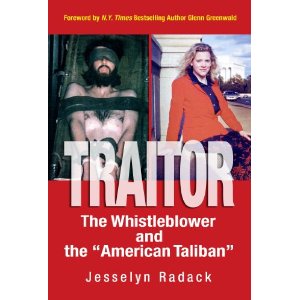
It began with that monstrous young man so evil we needed to blindfold him and strap him to a board, that confusing young man who looked like Christ but cast us in the role of crucifiers, that treasonous young man who brought dark and heathen evils across linguistic and cultural borders and brought torture onto the list of accepted government actions.

When you hear the phrase “American Taliban” you probably think of a young American who betrayed his country, aided its enemies, and – like Saddam Hussein – was behind the attacks of 9-11. John Walker Lindh was an American. That part is accurate. He converted to Islam at age 16 and traveled to Yemen to study classical Arabic and Islamic theology. In 2001 he went to Afghanistan to join an ongoing battle between a political group funded by Russia and another group funded by the United States. Lindh joined the group that was backed and funded by the Bush Administration. It was called the Taliban. Lindh trained to fight the Northern Alliance, not civilians, and not the United States. But, after 9-11, the United States attacked the Taliban, and Lindh attempted to escape and return to America.

Instead he and other soldiers were captured by the Northern Alliance and beaten senseless in the presence of two CIA officers, Johnny “Mike” Spann and Dave Tyson, who interrogated Lindh and threatened him with death on the spot. When some of the other prisoners rebelled (Lindh was not involved), Northern Alliance troops shot and killed scores of prisoners, many with their arms tied behind their backs. Lindh was shot in the leg. Spann was killed. (Though he was not involved, Lindh was later charged with conspiracy to murder Spann.)

Continue reading “Review (Guest): TRAITOR: The Whistleblower and the “American Taliban””