

Sepp Hasslberger: Open Source Tricorder
Advanced Cyber/IO, Autonomous Internet, Collective Intelligence
This is about a great project to make an open source, universal sensing instrument. The name was popularized in a science fiction series – Star Trek I believe it was – where they were never without one when visiting a new planet or some unfamiliar environment.
While this one starts out very modestly, it has the potential to become a real powerhouse of personal sensor, better than anything we have today.
“The Tricorder X-Prize aims to bring a diverse array of inexpensive sensors together in an accessible, easy to use, handheld design. On Jan 12, 2012, the contest was officially opened at the 2012 Consumer Electronics Show in Las Vegas.”
“Dr. Jansen’s Mark 2 runs on Linux. The hardware includes an ARM Atmel microcontroller squeezed into a clam-shell with two OLED touchscreens. Schematics, board layouts, and the firmware is all available free and includes the initial proof-of-concept device.”
There is also a blog about how it's made, by the guy behind the project…
http://www.tricorderproject.org/
Phi Beta Iota: Open Source Everything. This is an imperative not subject to negotiation. It begins now.
See Also:
THE OPEN SOURCE EVERYTHING MANIFESTO: Transparency, Truth, & Trust
Howard Rheingold: Media Literacy and the Challenge of New Information and Communication Technologies (ICT)
Advanced Cyber/IO, IO Impotency
Media Literacy and the Challenge of New Information and Communication Technologies
The Communication Review
“The article begins with a definition: media literacy is the ability to access, analyse, evaluate and create messages across a variety of contexts. This four-component model is then examined for its applicability to the internet. Having advocated this skills-based approach to media literacy in relation to the internet, the article identifies some outstanding issues for new media literacy crucial to any policy of promoting media literacy among the population. The outcome is to extend our understanding of media literacy so as to encompass the historically and culturally conditioned relationship among three processes: (i) the symbolic and material representation of knowledge, culture and values; (ii) the diffusion of interpretative skills and abilities across a (stratified) population; and (iii) the institutional, especially, the state management of the power that access to and skilled use of knowledge brings to those who are ‘literate’.”
Phi Beta Iota: There are TWO new media / ICT literacies. This deals with the second, access. The first, Open Data Access, is still in a very retarded state for lack of standards, compliance, and commitment to actually making all information in all languages accessible via direct digital pathways or via human-enabled call centers. Media literacy among the five billion poor (whose annual aggregate income is four time that of the one billion rich) will be of little relevance in the absence of media literacy among the eight communities of information and intelligence (academy, civil society, commerce, government, law enforcement, media, military, non-governmental / non-profit).
Graphic: Smart Nation Through Open Everything – Intel21 “Stack”
Balance, Capabilities-Force Structure, Citizen-Centered, Earth Orientation, ICT-IT, Innovation, Leadership-Integrity, Multinational Plus, Policies-Harmonization, Political, Processing, Reform, Resilience, Strategy-Holistic Coherence, Threats, Tribes, True Cost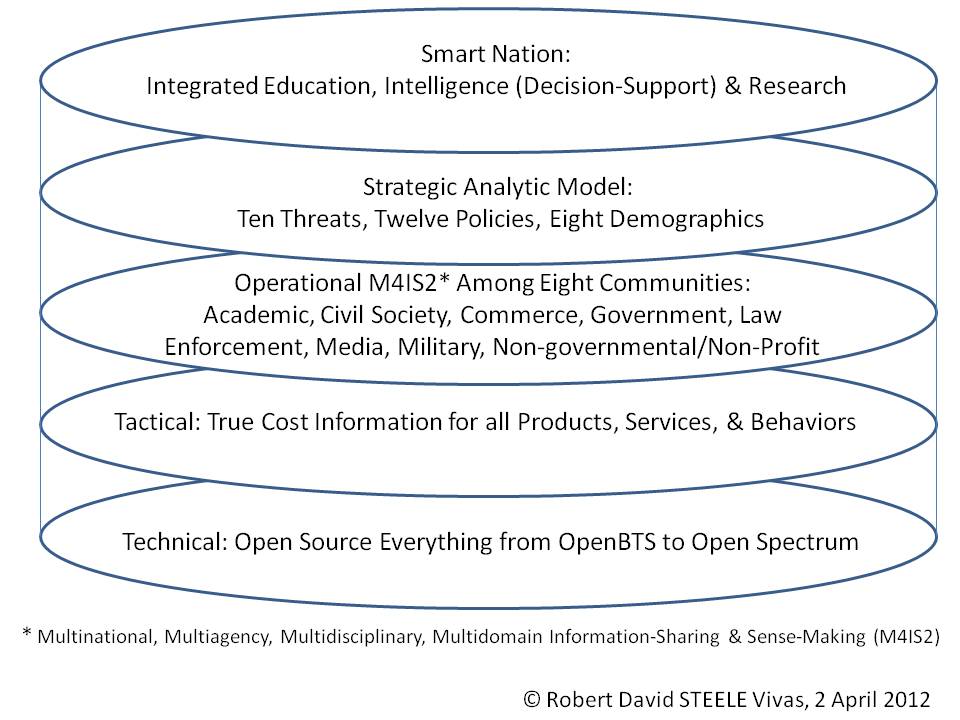
Mini-Me: Empire Flames on the Edges, Loses the Backyard
Counter-Oppression/Counter-Dictatorship Practices, IO Impotency, Key Players, Policies, Threats
Huh?
Latin America to be Innovative in Rio+20
Prensa Latina, 2 April 2012
Quito, Apr 2 (Prensa Latina) Latin America is the only region with capacity to propose innovative initiatives at the World Conference on Sustainable Development Río+20 in the context of today's global crisis, said Mario Ruales, advisor for Environmental Affairs.
Ruales told Prensa Latina they are taking to the event the agreements of the Ministerial Meeting in Quito.
He added there has been consensus on basic environmental issues at the heart of the Bolivarian Alliance for the Peoples of Our Americas (ALBA) and from the Community of Latin American and Caribbean Community (CELAC).
Among them he mentioned regional support to Ecuador's initiative to promote a Universal Declaration on the Rights of Nature, matching human rights'.
 “The foundations needs to be removed, noted the expert, since Ecuador and the subcontinent agree that the economy is part of a bigger natural system.Exceeding its limits may bring irreversible damage on the planet”, he added.
“We need to warn on this situation and achieve a global pact to revert the process,” notes Ruales, but that demands renewed efforts to further build common platforms to hold successful global negotiations, “but individual initiatives will hardly be enforced.”
Negotiations are complicated, he adds, but they have proven it is possible to advance towards what should become the future of humanity relaying on savvy proposals.
Phi Beta Iota: A great deal appears to be happening south of the US border, the most obvious attribute of which is the absence of the US — and one supposes — the obliviousness of the US. Hybrid governance is emergent, and it is routing around the US Government. Others doing the same thing include the African Union (behind the scenes, while they play Africa Command as a “useful idiot”), the Paris-Berlin-Moscow axis, the rapidly evolving Iran-Turkey-Pakistan axis, and of course the continuing global — and highly nuanced as well as xtremely well-informed — Chinese advances across all domains. For the many who are unaware of CELAC, it is OAS without the US and Canada.
Reference: New BRIC Bank First Step in Crushing Dollar-Based Fraud
UncategorizedReview: GLOBAL PREDATOR – U.S. Wars for Empire
6 Star Top 10%, 9-11 Truth Books & DVDs, Atrocities & Genocide, Congress (Failure, Reform), Corruption, Crime (Corporate), Crime (Government), Culture, Research, Empire, Sorrows, Hubris, Blowback, Executive (Partisan Failure, Reform), History, Military & Pentagon Power, Misinformation & Propaganda, Politics, Power (Pathologies & Utilization), Threats (Emerging & Perennial), True Cost & Toxicity, Values, Ethics, Sustainable Evolution, Voices Lost (Indigenous, Gender, Poor, Marginalized), War & Face of Battle
Stewart Halsey Ross
5.0 out of 5 stars 6 Stars for Coherence, Simplicity, & Morality,April 1, 2012
I read a lot — over 1800 books (including some DVDs) here at Amazon, in 98 categories, all but one non-fiction. This book is by a self-taught historian and self-described contrarian revisionist, and I will observe with the utmost respect that this author writes in the same vein, with the same quality, as Howard Zinn in A People's History of the United States: 1492 to Present, Chalmers Johnson in The Sorrows of Empire: Militarism, Secrecy, and the End of the Republic (The American Empire Project), and even Carroll Quiqley's Tragedy & Hope: A History of the World in Our Time.
What makes this book spectacular–and strongly recommended for anyone–student or adult–who desires to understand the history of the United States of America with intelligence and integrity–is the elegantly straight-forward but devastatingly disturbing blend of facts–with superb notes at the end of each chapter.
I am very disappointed that the publisher has not taken advantage of Amazon's absolutely priceless “Look Inside the Book” feature, so I will take the time here to list chapters and appendices.
Continue reading “Review: GLOBAL PREDATOR – U.S. Wars for Empire”
