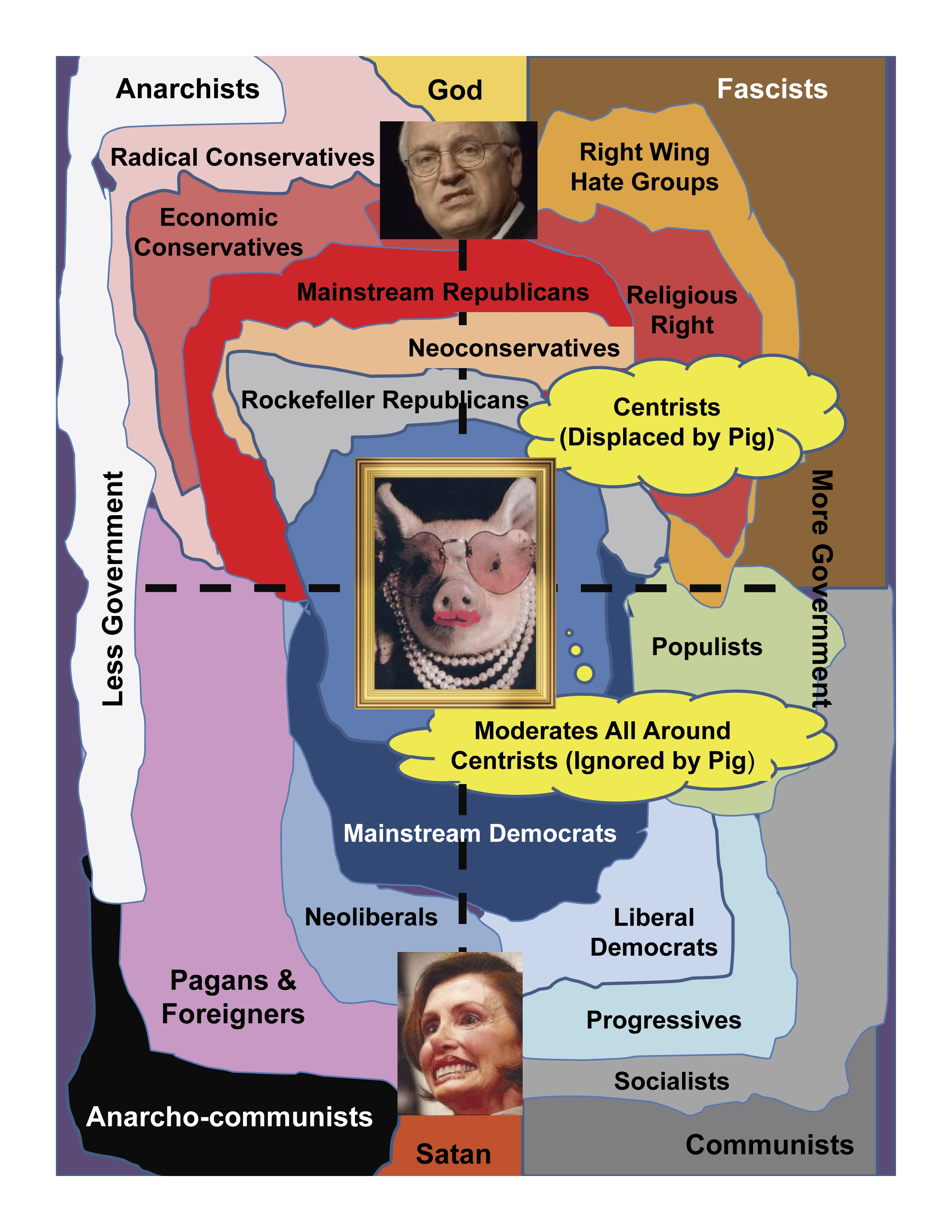
Inside front cover of Robert Steele, ELECTION 2008: Lipstick on the Pig (EIN, 2008).

The truth at any cost lowers all other costs — curated by former US spy Robert David Steele.
Inside front cover of Robert Steele, ELECTION 2008: Lipstick on the Pig (EIN, 2008).

The project aims to improve the response to ICT crime and the transnational organised crime groups that may be involved in it, by outlining the criminal profiles of the different types of hackers, with particular emphasis on their possible involvement in transnational organised crime activities and cyber-terrorism. Through a better understanding of hackers, HPP will facilitate the prevention and countering of ICT crimes and will improve the operational methods that may lead to the identification of computer intruders.
||

This book is an attempt to apply the behavioural science of Criminal Profiling to the hacking realm. Its main objective is to provide a new means of investigation in order to deal with issues related to cybercrime. But there is a lot more to discover…
Computer networks are commonly thought of as unfathomable and invisible, beyond our grasp; a hacker is someone who can still see the joins and this is what makes him interesting though remaining a complex, original and controversial personality.
Aware of the lack of information, which prevents people from adequately understanding the phenomenon of hacking and its many related aspects, the authors' desire is to provide more insight into this realm by telling interesting anecdotes as well as describing bizarre characters that practice hacking and cracking as an art, following different but established ethical models. Providing an in-depth exploration of the hacking realm, focusing on the relation between technology and crime, the authors reveal hidden aspects and many interesting details answering questions like: Who are real hackers? What life does a hacker lead when not on line? Is it possible to determine a hacker's profile on the basis of his behaviour or types of intrusion?

 Excellent Primer Lacking in Some Substantive Respects
1. Needs to add understanding and summary of “secret war” and covert action dimensions underlying each revolution and its counter-revolution. Although there are some references, the reality about the CIA and others that comes out in books such as Legacy of Ashes: The History of the CIA or None So Blind: A Personal Account of the Intelligence Failure in Vietnam is simply not there. In this vein, the author focuses too much on world “permissiveness” for revolution as a factor, and not enough on the grave sorrows inflicted on humanity by US sponsorship of dictatorships (see Ambassador Mark Palmer's utterly sensational Breaking the Real Axis of Evil: How to Oust the World's Last Dictators by 2025. While the author does address CIA's role in subverting both Guatemala and Iran (and in Guatemala, of Che Guevara's being there to witness the illegal over-throw), generally this book lacks a system of systems approach to the raw disconnect between government and people across political-legal, socio-economic, ideo-cultural, techno-demographic, and natural-geographic factors.
2. Needs to add understanding and summary of the role of multinational corporations in both sponsoring and suppressing revolutions. From Global Reach: The Power of the Multinational Corporations to War is a Racket: The Antiwar Classic by America's Most Decorated Soldier to The Global Class War: How America's Bipartisan Elite Lost Our Future – and What It Will Take to Win It Back, the role of elite corruption sponsored by the USA or USSR or China or Iran is simply not adequately integrated.
3. Needs to add understanding and summary of the role of criminal networks as substantive players in any and all revolutionary movements, not just whatever poster child the US Government wants to emphasize that day. Criminals, terrorists, revolutionaries, and white collar criminals all share the same smuggling and money-laundering spectrum of networks. See Illicit: How Smugglers, Traffickers, and Copycats are Hijacking the Global Economy.
Continue reading “Review: Revolutions and Revolutionary Movements”

+ Host: London-based International Centre for the Study of Radicalization and Political Violence
+ Partners, Affiliates, Financial Support: National Defense Univ, Rena & Sami David, The Rockefeller Foundation, Public Safety Canada, Center on Global Counterterrorism Cooperation, Centre for Policy Research, New Dehli, Dept of War Studies , King's College London, Inst for Strategic Threat Analysis & Response, Univ of Penn, International Inst for Counter-Terrorism, Interdisciplinary Center Herzliya, Pakistan Inst for Peace Studies, Regional Centre on Conflict Prevention, Jordan Inst of Diplomacy
> Overall, disappointing but reviewing these notes shows there are some good nuggets to take + connect.
BIGGEST SURPRISE = NOT ONE MENTION ABOUT FINANCING OF TERRORISM
Continue reading “Event Report: 30 Jun-1 July, NYC – ICSR Peace and Security Summit”

Where We Are Winning – Where We Are Losing:
Futurologists Publish Annual Report on Major World Problems and Opportunities
Berlin 7th July 2010 – Can civilization implement solutions fast enough to keep ahead of the looming challenges? The Millennium Project, a global independent think tank of futurologists, and thought leaders, today published its 14th report on global perspectives in Germany and around the world. Until two years ago the report showed a positive trend in the so-called “State of the Future Index” (SOFI). Triggered by the financial and economic crises and the failure of the climate conference in Copenhagen, the current SOFI shows that the prospects of success in solving some major global challenges have become somewhat clouded.
What the authors see as lacking the most, according to Jerome Glenn,
Director of the Millennium Project, are a serried of serious global
strategies to be implemented by governments, companies, NGOs, UN
institutions and other international bodies.” The world is in a race between
implementing ever-increasing ways to improve the human condition and the
seemingly ever-increasing complexity and scale of global problems. After 14
years of research into the future within the framework of the Millennium
Project it is increasingly clear that the world has the necessary capacity
to cope with its problems. However, it remains unclear whether humankind
will make the right decisions on the scale necessary to meet the global
challenges appropriately”, said Glenn.
Among the regular sections in the ninety page ‘State of the Future' report
are the annually updated analyses of the fifteen key global challenges, as
well as the publication of the State of the Future Index (SOFI). The index
identifies areas in which there has been either an improvement or
deterioration during the past 20 years and creates projections for these
scenarios over the coming decade. All relevant and recognised studies by the
UN or World Bank are distilled as part of these projections.
On individual results of the State of the Future Index:
Where We Are Winning
Continue reading “Where We Are Winning – Where We Are Losing: Futurologists Publish Annual Report on Major World Problems and Opportunities”
Afghanistan-Pakistan: Afghanistan's Tolo TV cited Pakistani media stating that Taliban chief Mullah Mohammad Omar was arrested in Pakistan, Xinhua reported 6 July. Taliban spokesman Qari Yusuf Ahmadi almost immediately rejected the report as “mere Western propaganda,” stating that the Taliban chief is free, enjoys sound health and is in full command of his fighters.
The Nation reported that Taliban spokesperson Zabeeh Ullah said the United States is employing propaganda tactics to save face. He stated that Mullah Omar is still in Afghanistan. Pakistani intelligence and police sources also denied the arrest of Mullah Omar.
Comment: This is one of the best psychological warfare anecdotes of the nine-year war. In its effort to refute the claim, Pakistani sources divulged that Pakistan arrested around 100 second rank leaders of Taliban in the past two years. Unnamed sources said the intelligence agencies arrested 64 Taliban leaders in 2009 and 35 in 2010, but not Omar.
Several Taliban leaders were arrested in various cities as the result of joint operations by Pakistani and US intelligence agencies, the sources said.
In the urgency to set the record straight about Omar without looking completely incompetent, Pakistani official sources divulged more details about the numbers arrested than previously. The numbers raise a question how many second rank leaders were killed by drones in the same periods.
Under similar pressure, the Taliban spokesman also provided information about Omar that is damning to Pakistani law enforcement. Omar is most likely in Karachi, not in Afghanistan.

 Concise, Relevant, Documents New Knowledge, Respects Work of Others
George Akerlof and Rachel Kranton
This book is a solid five, and one of those instances when brevity adds value. While I was concerned to see no discussion of “true cost” economics and the book is overly fawning on Goldman Sachs (written before Goldman Sachs was exposed for its multiple fiscal crimes against both investors and governments), the superior References, Notes, and Acknowledgements balanced this out. This work began in 1995.
This is an engrossing book and it immediately overcame my general disdain for economists, most of whom have only recently discovered information asymmetries and most of whom refuse to recognize that corruption in the US government and cheating across the US economy is fully the equivalent of transnational organized crime in cost to society.
Overall I consider this book very useful as both an overview (with most impressive “by name” citation of prior art on every page) and as a critique of conventional economics. This book is an excellent complement to the book I just reviewed, The Hidden Wealth of Nations and will be complemented by the book I will review next week, Building Social Business: The New Kind of Capitalism That Serves Humanity's Most Pressing Needs. See also my review of Nobel-worthy The Fortune at the Bottom of the Pyramid, Revised and Updated 5th Anniversary Edition: Eradicating Poverty Through Profits.
Core concept: IDENTITY is actualized psychological norms within a social context.
QUOTE (page 8): Identity economics restores human passions and social institutions into economics.”
