Snapshots of the US Government–Really…

10 Security, 11 Society, Corruption, Cultural Intelligence, Government, IO Impotency, Law Enforcement
Who, Me?

TSA diaper screening of 95-year-old draws angry reader reactions: ‘Home of the free?'

Texas lawmakers revive TSA anti-groping measure

TSA's Diaper Grope Sparks More Criticism of Feds

A Florida group is calling on state lawmakers to enact a law “against state-sponsored perversion and oppression” in the wake of an aggressive TSA patdown of a diapered 95-year-old woman at Northwest Florida Regional Airport.

Phi Beta Iota: This is real simple.  State by state, nullify the TSA and administer security as a state function.  If the federal government does not like that, secede from the Union.   TSA is not blocking flights from Europe or anywhere else that are fortunate in not having to put up with what passes for security in the USA.

Among The Costs Of War: $20B In Air Conditioning

June 25, 2011

The amount the U.S. military spends annually on air conditioning in Iraq and Afghanistan: $20.2 billion.

That's more than NASA's budget. It's more than BP has paid so far for damage during the Gulf oil spill. It's what the G-8 has pledged to help foster new democracies in Egypt and Tunisia.

Phi Beta Iota: It is always helpful to remember Medard Gabel's graphic on the cost of peace versus war.  For what we have spent on the military-industrial-intelligence complex these past ten years, never mind the legalized fraud of Wall Street, we could have eradicated the ten high-level threats to humanity.  The US Government lacks both intelligence and integrity.  Good people trapped in a very bad system–we need to set them free.  An nation's best defense is an educated citizenry that pursues a foreign policy of peace and commerce with truth and trust as core value and core outcome.

Network Learning to Team/Autonomous Learning

04 Education, 11 Society, Advanced Cyber/IO, Blog Wisdom, Collective Intelligence, Commercial Intelligence, Ethics, InfoOps (IO), Methods & Process, Strategy
Howard Rheingold

Harold Jarche » Network Learning: Working Smarter

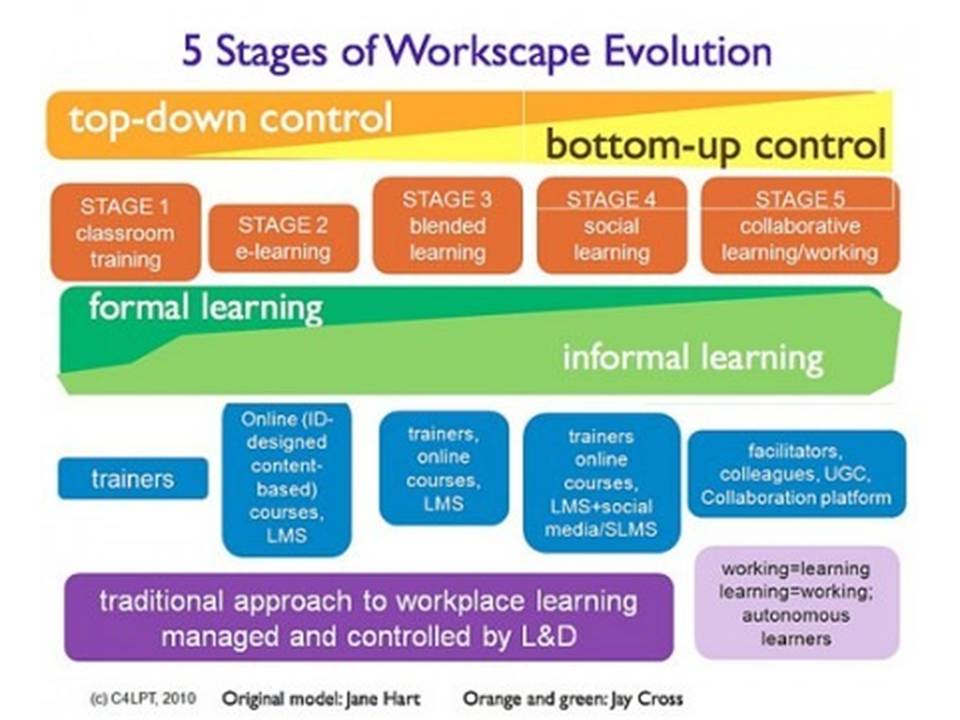
At its core, network learning is a way to deal with an ever-increasing amount of digital information. It requires an open attitude toward learning and finding new things. Each worker needs to develop individualized processes of filing, classifying and annotating information for later retrieval.

Source: www.jarche.com

Network Learning: Working Smarter

Posted on October 22nd, 2010 by Harold Jarche

Click on Image to Enlarge

“In the period ahead of us, more important than advances in computer design will be the advances we can make in our understanding of human information processing – of thinking, problem solving, and decision making…” ~ Herbert Simon, Economics Nobel-prize winner (1968)

The World Wide Web is changing how many of us do our work as we become more connected to information and each other. In California, Ray Prock, Jr. (2010) uses a Web-based note system to store messages, manage his financial risk and stay on top of the multiple factors necessary to run a successful dairy farm. He is constantly learning as he works and has found a method to keep up, thanks to the Internet.

Continue reading “Network Learning to Team/Autonomous Learning”

Trending: Torture and Toxic Army Leaders

04 Inter-State Conflict, 07 Other Atrocities, 09 Justice, 09 Terrorism, Advanced Cyber/IO, Civil Society, Corruption, Cultural Intelligence, Ethics, Government, Intelligence (government), Law Enforcement, Methods & Process, Military, Officers Call, Peace Intelligence
Marcus Aurelius Recommends

General Patraeus, one of the four generals featured in the book, The Fourth Star: Four Generals and the Epic Struggle for the Future of the United States Army is easily one of the best and brightest of our generation.  I was surprised to read about his opening the door to torture.

Worst-case scenario

NY Daily News, Saturday, June 25th 2011

And on the other end–concerns rising within the US Army about “toxic leaders.”  Too many of them, perhaps greater in proportion at higher ranks.

Army Survey Raises Worries Over Damage Caused By ‘Toxic' Leaders

Washington Post, June 26, 2011

Phi Beta Iota: We asked Col Stu Herrington, USA (Ret), Army counterintelligence officer/interrogator with successful interrogation experience in three wars, what he thought of the matter of General Patraeus opening the door on torture, and here is what he thinks–we have to concur.

Continue reading “Trending: Torture and Toxic Army Leaders”

Van Jones Ascendant: Rebuild the Dream

Advanced Cyber/IO, Civil Society, Collective Intelligence, Counter-Oppression/Counter-Dictatorship Practices, Cultural Intelligence, Ethics, Methods & Process, Policies, Strategy, Waste (materials, food, etc)
John Steiner

VAN JONES:

We are not broke.

Taxing the super-rich will not kill the economy.

Most patriotic thing we can do is NOT taking down the US Government.

All three of those are big lies.

Let's rebuild the dream.

Van Jones

In the coming weeks, people all across the country will come together for American Dream house meetings. Let's talk about what a new American Dream looks like and commit to stand together to make it happen.

Find an American Dream house meeting near you. We want YOU to be part of this movement, from the very beginning.

Rebuild the Dream

See Also:

Van Jones and The Roots To Launch “Rebuild the Dream” Calling For Investment in Middle Class

A Case for NOT Reducing Federal Debt?

03 Economy, 07 Other Atrocities, 11 Society, Civil Society, Commerce, Cultural Intelligence, Government, Money, Banks & Concentrated Wealth, Power Behind-the-Scenes/Special Interests, Secrecy & Politics of Secrecy, True Cost
Chuck Spinney Recommends...

Can the US Have an Expansionary Fiscal Contraction?

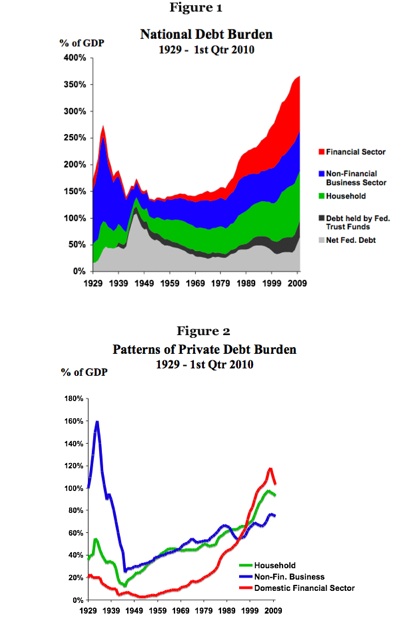
All  … the attached essay was written by Simon Johnson, Ronald Kurtz Professor of Entrepreneurship, MIT Sloan School of Management; Senior Fellow, Peterson Institute for International Economics; and co-founder of Baseline ScenarioJohnson used to be Chief Economist of IMF and is, IMO, one of the sanest voices in economics. It summarizes his recent testimony to the Joint Economic Commitee of Congress.  The question is — Should we reduce federal debt to slow the build up of private debt?  He lays out 4 reasons why such a contractionary fiscal policy will create even worse problems.

Click on Image to Enlarge

His penultimate paragraph places the real issue — who is going to pay for the liquidation of the private bubble (see chart below, which I compiled from Fed. Reserve data) into context (the red typing is mine to clarify the ambiguity in his double use of debt).  Also, I urge you to read his testimony (you can download it from the link indicated below) — it is more detailed and he has a brief discussion about how the cost of the financial meltdown (looming private debt liquidations — particularly the bubbles of debt in the financial and household sectors — which Fig 2 shows has not really begun to bite) are being shifted to the middle class.  Note, the rise in the light gray area in Figure 1 is the spike in federal debt that has taken place since the meltdown.

Chuck

The Baseline Scenario

What happened to the global economy and what we can do about it

Could The US Have An “Expansionary Fiscal Contraction”?

By Simon Johnson.  My full written testimony to Tuesday’s hearing of the Joint Economic Committee of Congress is available here.

The US has a large budget deficit and a debt-to-GDP ratio that, in most projections, continues to rise over time.  Some House and Senate Republicans are arguing strongly that this situation calls for large and immediate cuts to government spending, for example as part of any agreement to increase the federal government’s debt ceiling.

The Joint Economic Committee of Congress held a hearing on Tuesday to discuss whether such spending cuts would be “contractionary” or “expansionary” for the economy in the short-run.  My assessment, after participating as a witness at the hearing, is that large immediate spending cuts would tend to slow the economy (a webcast of the hearing is here).

Read full posting….

Digital Currency for Environmental Sustainability

03 Economy, 11 Society, Advanced Cyber/IO, Civil Society, Commerce, Commercial Intelligence, Counter-Oppression/Counter-Dictatorship Practices, Cultural Intelligence, Ethics, Gift Intelligence, Money, Banks & Concentrated Wealth
Venessa Miemis

Ven: A Digital Currency Designed for Environmental Sustainability

Hub Culture is a global collaboration network with over 25,000+ members distributed across 110 countries. Their stated mission to expand collective consciousness is driven by the blend of online workspaces for knowledge sharing with offline Pavilions for meeting and connecting – all powered by their digital currency, Ven. Below is an interview with Hub Culture’s Founding Director, Stan Stalnaker.

What compelled you to create Ven?

For us it was a matter of practicality – with a global, diverse community, we found that no single currency could offer a single pricing structure for global inventory in Hub Culture.  Our members needed a global wallet – as simple to use in Rio as Shanghai. As a social network, we thought linking this system to the social profile of our users would help them share and create value.  We needed a simple, transparent way for our members to exchange value and favors, and the answer was Ven.  It has been a learning experience for us. The currency has evolved and grown since its debut in the summer of 2007, and we have discovered ways to make it more useful for our members and the planet at large.

You’ve said Ven can be thought of as ‘green money’? Why?

Today Ven is the only digital currency to be priced from a basket of currencies, commodities and carbon futures.  These components give the Ven advantages of other currencies: the basket encourages price stability on a forward basis, and the link to commodities grounds value in hard assets.  The introduction of carbon to the basket is helping us think about how money can serve better social purposes – in this case to support and stimulate demand for carbon credits and social impact development, driving offsets for every transaction used with Ven.  This is how the idea of ‘green money’ developed with Ven – because its carbon linkages are able to play a role in this area.  I really like the idea that Ven is green, social and efficient, with a mission to improve the lives of its users and the communities that use it.

Read full interview….

Libyan Rebels Genociding Black Libyans

04 Inter-State Conflict, 05 Civil War, 06 Genocide, 07 Other Atrocities, 08 Wild Cards, 10 Security, 11 Society, Corruption, Government, Military, Peace Intelligence
Cynthia McKinney

Ethnic Cleansing of Black Libyans

Black Star News Editorial, 06-21-11

Rebels, with the help of NATO bombs and missiles, drove out Misrata's Black population

The “rebels” in Misrata in Libya have driven out the entire Black population of the city, according to a chilling story in The Wall Street Journal today under the headline Libya City Torn by Tribal Feud.”

The “rebels” now eye the city of Tawergha, 25 miles away, and vow to cleanse it of all Black people once they seize the city. Isn't this the perfect definition of the term “genocide”?

According to The Journal's article, the “rebels” refer to themselves as “the brigade for purging slaves, black skin.” The Journal quotes a rebel commander Ibrahim al-Halbous saying, of Black Libyans, “They should pack up,” and that “Tawergha no longer exists, only Mistrata.”

You won't read this kind of article in The New York Times, which has become as journalistically corrupt and as compromised as the old PRAVDA, during the Soviet era. This editorial page has been insisting since the beginning of the Libya conflict that the “rebels” embraced racism and used the allegation that Muammar al-Quathafi had employed mercenaries from other African countries as a pretext to massacre Black Libyans.

Read rest of editorial….

Phi Beta Iota: Congress has no clue–pontificating politicals divorced from reality.  Cynthia McKinney, Green Party candidate for President in 2008, has taken a personal interest in this, and personally visited Libya to confirm that NATO is committing war crimes in its indiscriminate attacks against Tripoli, far removed from the “no fly zone” as originally envisioned.  What the US Government is doing “in our name” in Libya, and in many countries around the world, is neither Constitutional nor affordable.  Congress is lacking in intelligence and integrity.  The lunacy continues….

noble gold