GUINEA: Rio Tinto’s friends talk Conde around
GUINEA: How Soros is backing new leader
IVORY COAST: Sponsors give generously
NIGERIA: Soros to the Rescue?
CONGO-K: Soros Targets Katanga Operators
SAO TOME AND PRINCIPE: Conflict of Interest for Soros?
AFRICA/UNITED STATES: Soros Ups Investment
SOUTH AFRICA: Soros initiative in South Africa
Robyn shares her personal story and how it inspired her current path as a “Real Food” evangelist. Grounded in a successful Wall Street career that was more interested in food as good business than good-for-you, this mother of four was shaken awake by the dangerous allergic reaction of one of her children to a “typical” breakfast. Her mission to unearth the cause revealed more about the food industry than she could stomach, and impelled her to share her findings with others. Informative and inspiring.
Amazon Page
Robyn authored The Unhealthy Truth: How Our Food Is Making Us Sick and What We Can Do About It. A former Wall Street food industry analyst, Robyn brings insight, compassion and detailed analysis to her research into the impact that the global food system is having on the health of our children. She founded allergykidsfoundation.org and was named by Forbes as one of “20 Inspiring Women to Follow on Twitter.” The New York Times has passionately
described her as “Food's Erin Brockovich.”
Phi Beta Iota: Across all twelve “policy” domains from agriculture to water, with food cutting across all domains ans especially Family, Health, and Society, we are seeing the emergence of public intelligence in the public interest. What we are not seeing (yet), is the integration of “true cost” information as a core element that must be available to the public; and the integration of all that we can know about each domain in isolation, into a larger “360 degree” strategic analytic model for getting a grip on how we live and how we spend.
For the U.S., democracy's fate in the region matters much less than the struggle between the Saudis and Iran
Robert D. Kaplan
Wall Street Journal, March 26, 2011
Despite the military drama unfolding in Libya, the Middle East is only beginning to unravel. American policy-makers have been spoiled by events in Tunisia and Egypt, both of which boast relatively sturdy institutions, civil society associations and middle classes, as well as being age-old clusters of civilization where states of one form or another have existed since antiquity. Darker terrain awaits us elsewhere in the region, where states will substantially weaken once the carapace of tyranny crumbles. The crucial tests lie ahead, beyond the distraction of Libya.
The United States may be a democracy, but it is also a status quo power, whose position in the world depends on the world staying as it is. In the Middle East, the status quo is unsustainable because populations are no longer afraid of their rulers. Every country is now in play.
Phi Beta Iota: Perhaps his meeting with Barack Obama served kool-aid, and he drank it. This article, which can certainly be considered to be an authoritative depiction of the prevailing views in Washington, is disappointing at multiple levels. The author lacks a strategic analytic model, an ethical model, and a process model, as well as an appreciation for how the tortilla has flipped. Epoch B was born in the 1970's coincident with Peak Empire when the US was thrown out of Viet-Nam by indigenous people's with stronger ethics, a stronger culture, and an unconquerable will. Today Epoch B is a young teen-ager, just beginning to flex its muscles. “Dad” can no longer win a physical contest with this young teen-ager, nor can “Dad” understand the nuances of the digital age the way this teen-ager–the first generation not to be a “mini-me” of “Dad”–does. Most of us never imagined that Wall Street and the two-party “front” for corporations would last as long as it did after the 1980's meltdown. We all under-estimated the placidity of the American public. Now the American public's perceptions are secondary. The five billion poor are on the march, and Washington has absolutely no clue what to do next.
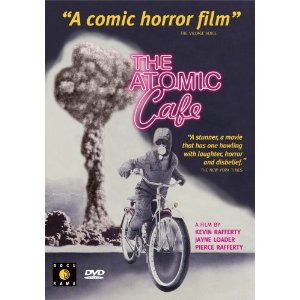
What vintage bomb survival suits have to do with Dr. Stragelove and Richard Nixon.
The recent tragedy in Japan has triggered a tsunami of terror, founded and unfounded, about the potential risks of nuclear reactors.
While there are people better equipped than us to explain the precise implications of the situation, we thought we’d put things in perspective by examining the flipside of these dystopian fears: The exuberant optimism about nuclear power in mid-century America.
The issue is heating up in America as well, and will soon be heard in court.
On April 5th, 2011, at 11 a.m., at the Federal Courthouse at 141 Church Street in New Haven, Connecticut, the case of Gallop v. Cheney, Rumsfeld, and Myers will be heard by the United States Court of Appeals for the 2nd Circuit.
Phi Beta Iota: There is not a sufficiency of evidence to convict, but there is assuredly a sufficiency of evidence to indict, and we are equally certain that the 911 Commission was at best a mediocre and incomplete endeavor and at worst a complete cover-up. As Penguin notes, the truth will come out.
EXTRACT: A lot has happened over the past 30 years, but if you're looking for a single political sea change that's had the biggest impact on middle class wages—more important than union decline, more important than NAFTA, more important than the end of Glass-Steagall—it's the political consensus that underlies the Fed's reluctance to allow labor markets to stay tight enough to generate wage increases in the real economy. And it's something we're seeing all over again right now, as the DC chattering classes have almost unanimously decided that inflation is our real enemy right now, even though core inflation is running around 1% and unemployment is still near 9%.
This is a policy beloved of the business community, which prefers loose labor markets that keep wages low and executive compensation high, but it hasn't always been the Fed's policy and it's not written in stone that it has to be now. Tight labor markets and rising middle-class wages are, to a large extent, a choice we make. Politics took them away 30 years ago, and politics can return them to us if we want.


 The five principles driving war propaganda are in play in Libya



 Who Screwed the Middle Class?