 Open Source Intelligence Requires an Open Source Agency
Continue reading “Reference: Open Source Agency Synopsis (Full Text Online for Google Translate)”

The truth at any cost lowers all other costs — curated by former US spy Robert David Steele.
Open Source Intelligence Requires an Open Source Agency
Continue reading “Reference: Open Source Agency Synopsis (Full Text Online for Google Translate)”

The following four publications by Michael Vlahos were overlooked when they first came out. They continue his brilliant track record of deep cultural analysis of both the home front and the real world.
Colonial Britain, Neocolonial America?
Why America Is Like Imperial Spain (Part I)

Three new potent Occupy Together resources
Three new exciting resources have just showed up.
1. OccupyCafe.org – a linked phone and online forum space for conversations among everyone “who cares about what is happening on Wall Street and around the world.” Its phone mode uses the advanced MaestroConferencing system that enables activities like breakout groups and hand-raising. Topic conversations begun on the phone can be continued in the online forum, and vice versa. The first phone call is Monday morning. See details below.
2. Organizational consultants study grassroots activist communities – This article didn't exist online, so I got a blurry scanned copy from one of the co-authors and typed it up over a couple of days so I could post it and send it to you. The next day the other co-author posted a clear pdf online, so that's what you get below. I think it is applicable and potentially useful to the Occupy movement.
3. Some very clear advice from nonviolent activist Sharif Abdullah of Commonway in Portland Oregon. Sharif's the fellow who spread the phrase “create a world that works for all” into movement circles. Taking lessons from Gandhi, King, Argentinian activists, and his own work in Sri Lanka, he offers guidelines to help the folks in the Occupy Together movement sustain their transformational impact.
Bit by bit, action by action, conversation by conversation, we develop the collective knowledge we need to make a world that works for all…
Coheartedly,
Tom
Read full post with more detail about each and additional links.

This is very old news, but thought it interesting to highlight lag time between FBI and the original reports.
The FBI Announces Gangs Have Infiltrated Every Branch Of The Military
The FBI has released a new gang assessment announcing that there are 1.4 million gang members in the US, a 40 percent increase since 2009, and that many of these members are getting inside the military (via Stars and Stripes).
The report says the military has seen members from 53 gangs and 100 regions in the U.S. enlist in every branch of the armed forces. Members of every major street gang, some prison gangs, and outlaw motorcycle gangs (OMGs) have been reported on both U.S. and international military installations.
Read full story with link to report.
Phi Beta Iota: One can only marvel at the ability of the US Government (both political leaders and senior civil servants) to carry on without intelligence or integrity for decades. The USA remains the top proliferator of nuclear, biological, chemical, radiological, and small arms as well as cyber-weaponry. The USA remains locked into elective wars that have nothing to do with national interests and everything to do with special interests. And now we learn again (DHS published first, in 2007) that we are also training tens of thousands of gang members who are at the same time gaining access to weapons and munitions that we cannot account for…
See Also:
2007 Reference: Gangs in the US Military

My friend Andrew Cockburn is on a roll. One week after his brilliant article on IEDs in Harpers, he has produced another hard-hitting tubesteak, this time in Counterpunch. Andrew's targets are the Banksters, whose looting continues to push the middle class into poverty and the lower income classes into a kind of debt servitude that is reminiscent of that imposed by company stores in the West Virginia coal towns in what we had hoped was a bygone era.
Andrew's essay is important, because the problem he is describing exists against the backdrop of the Great Recession, which now, three years after the banking system started to collapse, may be on the cusp of a full blown debt deflation, triggered by another, even more catastrophic banking collapse. My introductory comments are intended to help you understand that magnitude of that danger that Andrew is describing.
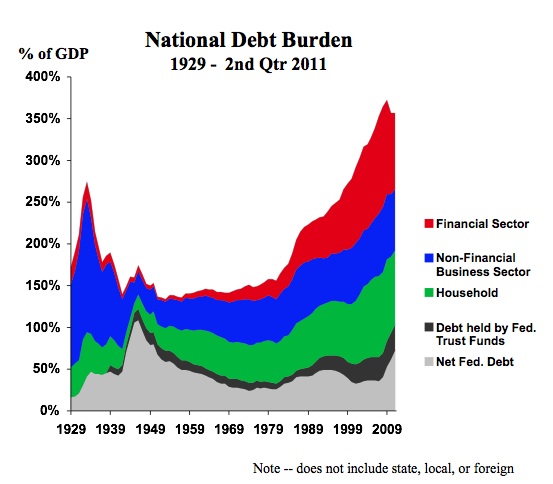
The following charts (Figures 1 & 2), based on the most recent data released by the Federal Reserve,
portray ratio of debt to gross domestic product over time. Figure 1 shows how the cumulative debt changed in the entire system, with debt expressed as a percentage of the GDP produced by the economy. The debt ratio for the entire economy should not be thought of as an absolute measure of debt burden but as an indexof that burden, and is an indicator of the comparative pressure of that debt regardless of the overall size of the economy.[1] Thus, one can compare
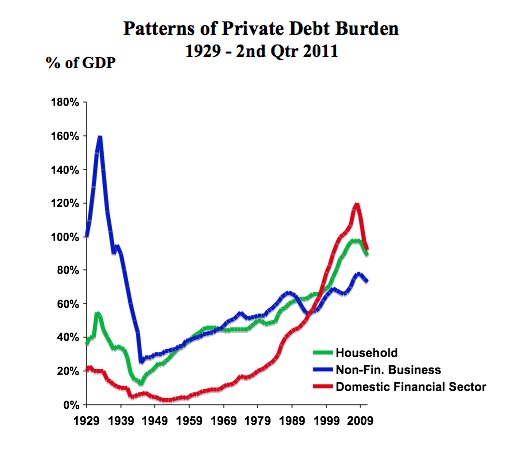
changes in earlier years to those in later years. Figure 2 plots the sector burdens separately for the components in the private sector (note: since Federal Debt is arranged in bottom position in Figure 1 it is also the same shape that would be plotted in Figure 2; other categories, like state and local debt have been ignored because over time their ratio changes have not been significant enough to the alter the pattern in the figures). What do these figures tell us?
“If the Occupiers start chanting ‘Mark to Market,’” an attorney highly conversant with the darker workings of the Wall Street-Washington complex told me, “we’ll know they’re serious.” Such a call would quickly presage the collapse of our “too big to fail” banks, for it would highlight the fact that a huge proportion of the assets of Bank of America, Wells Fargo, JP Morgan, and Citigroup consist of loans that will never be paid back and are therefore essentially worthless. The so called “recovery” of our leading financial institutions from the post-Lehman abyss has depended on a fraudulent valuation of these assets, but stripped of the fiction, the banks are insolvent.
Phi Beta Iota: The banks are on the brink–wildly fearful of a run on stocks and deposits–and the US Government knows they are on the brink–and is wildly fearful of nation-wide violence. Pissed off white people will make the Watts Riots looks like an effete tea party. There is good news. The close OccupyWallStreet gets to understanding the depth of the depravity of the government that enabled and enables Wall Street, the lack of intelligence and integrity within that government, the closer we get to being able to demand and secure the Electoral Reform Act of 2012, in our view the sole means by which a non-violent revolution might restore the integrity of the U.S. Government.

The more they say they have changed, the more they remain the same…..
Occupy Wall Street: Washington Still Doesn't Get It
Matt Taibbi
Rolling Stone, 21 October 2011
I'll have more coming out about this in a few days, but there have been two disgusting developments in the realm of plutocratic intervention on behalf of Wall Street that everyone protesting should take note of.
The fact that both of the following things took place in the middle of the full fever of OWS, when everyone is supposedly trying to placate anti-banker sentiment and Obama and the DCCC are supposedly pledging support of the protesters, shows how completely bankrupt this system is and how necessary street-level protests have become. Popular uprising is probably the only move left to stop developments like the following:
Phi Beta Iota: This is why US Day of Rage and Phi Beta Iota both feel so strongly that Electoral Reform is the only immediately reasonable and achievable demand. Congress and the White House are under the delusion that they are going to be in power after 2012, and that #OWS is a light rain that will disappear over the winter. We do not agree. Politics has finally become very personal to the 99%. That is what's new. The lack of intelligence and integrity in the US Government is not new, but God willing, will be old news by 2012.
See Also:
 Post-Gadhafi: What’s Next for Libya’s Government?
(pieces from the article)
The World’s Ten Least Powerful Deliberative Bodies
1. People’s Assembly of Myanmar (.00)
2. Consultative Council of Saudi Arabia (.09)
3. People’s Council of Turkmenistan (.06)
4. General People’s Congress of Libya (.13)
4. Supreme People’s Assembly of North Korea (.13)
6. Council of Oman (.16)
7. National Assembly of Bahrain (.19)
8. National Assembly of Bhutan (.22)
8. National Assembly of Chad (.22)
8. National Assembly of Jordan (.22)
Also see:
23 Worst Tyrants/Dictators (Yes, there’s more than 23) and Oops, there’s Saudi Arabia..
Review: Breaking the Real Axis of Evil–How to Oust the World’s Last Dictators by 2025
