Reference: Our Choice–Changing the Game

About the Idea, Collaboration Zones, Communities of Practice, Ethics, IO Sense-Making, Officers Call, Policies, Real Time, Threats, Topics (All Other)

Today, with permission, I present Tom Atlee's newest vision, “Are We Ready to Change the Game Yet?,” and at the end, a link to his 2000 audio interview with Jim Rough, pioneer of Citizen Wisdom Councils and author of Society's Breakthrough.

ARE WE READY TO CHANGE THE GAME YET?

by Tom Atlee

2010-11-15-atlee.jpg

Some people say Gandhi was about nonviolence. And he was.

But he is significant for something else that I believe is far more important:

He changed the game.

With no one's permission, he reconfigured the playing field of colonialism to a higher Game in which everything the British did in their smaller, narrower game backfired on them. Prisons, guns, threats and bureaucracies of control not only ceased to work like they used to, but actually generated more power for Gandhi's world-changing Game.

Gandhi's Game involved, in his words, “experiments in Truth” — a search for Truth, a bigger Truth, a common inclusive Truth, a win-win Truth in every situation. The British — and even many of Gandhi's compatriots — were not aligned to that Truth. They wanted victory, control, and righteousness. These things trapped them in their smaller game until, one by one, and sometimes wholesale, Gandhi's commitment to Truth won their hearts and minds — and Shift happened.

Unfortunately he failed to create adequate social institutions that embodied, sustained, and empowered the Search for Truth by the whole of society. He depended on individuals seeing the light and being transformed. The miracle of his work is that so many people did transform — and continue to transform even to this day — inspired by his words, his life, his work. But in the end, what he left was an inspiring possibility, not an India or a world that was united, peaceful, just and sustainable.

Today's world calls us, with increasing intensity, not just to carry on Gandhi's work, but to carry it further. It isn't a matter of doing nonviolence as he and Martin Luther King, Jr., did it. It is a matter of changing the game.

Which brings me to the current state of U.S. politics and governance. These games are desperately in need of changing. Several recent innovations offer us the possibility to actually accomplish that and the timing is ripe.

Continue reading “Reference: Our Choice–Changing the Game”

Journal: US Keeps Spending in AF

07 Other Atrocities, 11 Society, Budgets & Funding, Cultural Intelligence, Government, Military, Officers Call, Power Behind-the-Scenes/Special Interests

Tom EngelhardtTom Engelhardt
Editor of TomDispatch.com

Posted: November 15, 2010 03:23 PM

The Stimulus Package in Kabul (I Was Delusional — I Thought One Monster ‘Embassy' Was the End of It)

You must have had a moment when you thought to yourself: It really isn’t going to end, is it?  Not ever.  Rationally, you know perfectly well that whatever your “it” might be will indeed end, because everything does, but your gut tells you something different.

Read rest of long, deep, important articulation….

Phi Beta Iota: Please take the time to link to the entire article at Huffington Post.  Tom Englehardt has produced one of the most gripping, detailed, insightful, and provactive snapshots of how three monstrous billion dollar “embassies” in Baghdad, Kabul, and now Islamabad, are the last clarion of the Empire.  His piece is a “must read,” both an epitaph on the Empire, and sadly, a preface to the next 20 years of death and debt as we wind down all that has been set in motion.

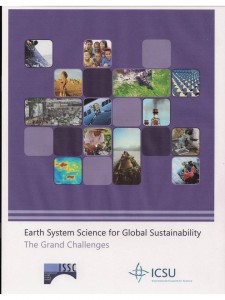
Reference: Earth System Science for Global Sustainability–Grand Challenges

Analysis, Augmented Reality, Budgets & Funding, Communities of Practice, Earth Intelligence, Ethics, Geospatial, History, info-graphics/data-visualization, InfoOps (IO), Intelligence (government), International Aid, IO Sense-Making, Key Players, Maps, Methods & Process, microfinancing, Mobile, Open Government, Policies, Politics of Science & Science of Politics, Power Behind-the-Scenes/Special Interests, Real Time, Secrecy & Politics of Secrecy, Standards, Strategy, Technologies, Threats, Tools, Waste (materials, food, etc)
Main Document (24 Page PDF)

The International Council for Science (ICSU) is spearheading a consultative Visioning Process, in cooperation with the International Social Science Council (ISSC), to explore options and propose implementation steps for a holistic strategy on Earth system research. Five Grand Challenges were identified during step 1 of the process. If addressed in the next decade, these Grand Challenges will deliver knowledge to enable sustainable development, poverty eradication, and environmental protection in the face of global change.

The details of the Grand Challenges are contained in the document ‘Earth System Science for Global Sustainability: The Grand Challenges’, representing input from many individuals and institutions.

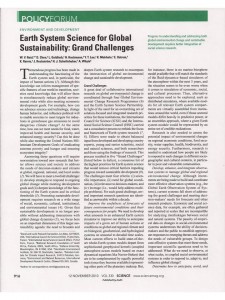
Science Article (2 Page PDF)

INTERNATIONAL COUNCIL FOR SCIENCE – PRESS RELEASE

Thursday 11 November 2010

Scientific Grand Challenges identified to address global sustainability

Paris, France—The international scientific community has identified five Grand Challenges that, if addressed in the next decade, will deliver knowledge to enable sustainable development, poverty eradication, and environmental protection in the face of global change. The Grand Challenges for Earth system science, published today, are the result of broad consultation as part of a visioning process spearheaded by the International Council for Science (ICSU) in cooperation with the International Social Science Council (ISSC).

The consultation highlighted the need for research that integrates our understanding of the functioning of the Earth system—and its critical thresholds—with global environmental change and socio-economic development.

The five Grand Challenges are:

  1. Forecasting—Improve the usefulness of forecasts of future environmental conditions and their consequences for people.
  2. Observing—Develop, enhance and integrate the observation systems needed to manage global and regional environmental change.
  3. Confining—Determine how to anticipate, recognize, avoid and manage disruptive global environmental change.
  4. Responding—Determine what institutional, economic and behavioural changes can enable effective steps toward global sustainability.
  5. Innovating—Encourage innovation (coupled with sound mechanisms for evaluation) in developing technological, policy and social responses to achieve global sustainability.

Continue reading “Reference: Earth System Science for Global Sustainability–Grand Challenges”

Journal: Pentagon Acquisition

03 Economy, 10 Security, Corruption, Military
DefDog Recommends...

Pentagon’s Favorite Jet Delayed as Costs Rise Yet Again

Add another several billion dollars and years in delays to the military’s most important new jet. Nearly a year after Defense Secretary Robert Gates fired the head of the F-35 Joint Strike Fighter program for failing to keep costs and performance under control, a new internal Pentagon review finds the $382 billion stealth plane might get pushed back as much as three years, with an added $5 billion price tag.

. . . . . . .

The delay is due to a host of problems central to the aircraft, including “software, engineering and flight difficulties,” according to Bloomberg. Fixing them will require jacking program costs up an estimated $5 billion. Worse, Venlet’s review is supposed to find that the Joint Strike Fighter will be “as much as 1 1/2 times more expensive to maintain” as the F-16, the F/A-18, the A-10 and the AV-8B — the planes the Joint Strike Fighter is supposed to replace.

Read rest of article….

Phi Beta Iota: The literature on complexity & catastrophe is quite clear–one cannot micro-manage complexity, and the Pentagon keeps trying to do precisely that: build more and more complex systems that fail in unanticipated cummulative ways.  The mind-set is broken, and no amount of money can fix that mind-set.  It is going to take a kick-ass Secretary of Defense willing to actually do a clean-sheet redesign of Whole of Government and M4IS2 operations, using information and intelligence to reconnect PPBS to reality, and to harmonize other people's money.  What we have now is flat out nuts, unaffordable, and ineffective.

See Also:

Continue reading “Journal: Pentagon Acquisition”

Journal: Afghanistan Winds Down

02 Diplomacy, 08 Wild Cards, Government, Military, Strategy
DefDog Recommends...

Its over: US NATO formally announcing ‘transition’ to Afghan withdrawal

Pakistan Patriot

Posted on 14 November 2010

The Obama administration and its NATO allies will declare late this week that the war in Afghanistan has made sufficient progress to begin turning security control over to its government by spring, months before the administration’s July deadline to start withdrawing U.S. troops, according to U.S. and European officials.

Even as it announces the “transition” process, which will not immediately include troop withdrawals, NATO will also state its intention to keep combat troops in Afghanistan until 2014, a date originally set by Afghan President Hamid Karzai.

The seemingly contradictory messages, in communiques and agreements to be released at NATO’s upcoming summit in Lisbon, are intended to reassure U.S. and European audiences that the process of ending the war has begun.

At the same time, the coalition wants to signal to the Taliban – along with Afghans and regional partners who fear a coalition withdrawal, and Republicans in Congress who oppose it – that they are not leaving anytime soon.

Read rest of entry…

Karzai wants U.S. to reduce military operations in Afghanistan

Washington Post

Sunday, November 14, 2010; 12:52 AM

KABUL- President Hamid Karzai said on Saturday that the United States must reduce the visibility and intensity of its military operations in Afghanistan and end the increased U.S. Special Operations forces night raids that aggravate Afghans and could exacerbate the Taliban insurgency.

Rest of article and also a photo gallery….

Phi Beta Iota: Deja vu…we have the uneasy feeling that Brzezinski and whoever is still whispering in Obama's ear is pulling a Kissinger–four more years will kill thousands more at a cost we cannot afford for a purpose we have never legitimately defined.

See Also:

Journal: Taliban Tet a Tet + Tet Offensive

Journal: AF BODY COUNT–$50 Million Per Body

Journal: US War Policy Enters the Rubber Room

Review: The Trial of Henry Kissinger

Review: Politics Lost–How American Democracy Was Trivialized By People Who Think You’re Stupid

Journal: Taliban’s grip is far stronger than the West will admit

04 Inter-State Conflict, 05 Civil War, 08 Wild Cards, 10 Security, Analysis, History, InfoOps (IO), Intelligence (government), Military, Misinformation & Propaganda, Officers Call, Power Behind-the-Scenes/Special Interests, Strategy
Chuck Spinney Recommends...

Afghanistan – behind enemy lines

James Fergusson returns after three years to Chak, just 40 miles from Kabul, to find the Taliban's grip is far stronger than the West will admit

Independent, 14 November 2010

The sound of a propeller engine is audible the moment my fixer and I climb out of the car, causing us new arrivals from Kabul to glance sharply upwards. I have never heard a military drone in action before, and it is entirely invisible in the cold night sky, yet there is no doubt what it is. My first visit to the Taliban since 2007 has only just begun and I am already regretting it. What if the drone is the Hellfire-missile-carrying kind?

Three years ago, the Taliban's control over this district, Chak, and the 112,000 Pashtun farmers who live here, was restricted to the hours of darkness – although the local commander, Abdullah, vowed to me that he would soon be in full control. As I am quickly to discover, this was no idle boast. In Chak, the Karzai government has in effect given up and handed over to the Taliban. Abdullah, still in charge, even collects taxes. His men issue receipts using stolen government stationery that is headed “Islamic Republic of Afghanistan”; with commendable parsimony they simply cross out the word “Republic” and insert “Emirate”, the emir in question being the Taliban's spiritual leader, Mullah Omar.

The most astonishing thing about this rebel district – and for Nato leaders meeting in Lisbon this week, a deeply troubling one – is that Chak is not in war-torn Helmand or Kandahar but in Wardak province, a scant 40 miles south-west of Kabul.

Read rest of this direct look at ground truth….

Phi Beta Iota: We are reminded by this piece of how the best CIA desk officers knew instantly, the day we announced going to war in Viet-Nam, that we had gotten it wrong, that Ho Chi Minh was a nationalist, and that we would lose.  By the time Afghanistan rolled around, intelligence had become both jejeune and unethical (silent in the face of treason), and politics had become even more ideologically psychopathic and corrupt than ever before.  James Fegusson has given us a very fine contribution–this is ground truth at its best.

See Also:

Worth a Look: Book Review Lists (Negative)

and most especially:

Review: War Without Windows

Review: None So Blind–A Personal Account of the Intelligence Failure in Vietnam

Review: Who the Hell Are We Fighting?–The Story of Sam Adams and the Vietnam Intelligence Wars

Journal: Cyber-Heist 2nd Generation

03 Economy, 04 Education, 10 Security, Civil Society, Collective Intelligence, Computer/online security, Cultural Intelligence, Cyberscams, malware, spam, InfoOps (IO), IO Mapping, Law Enforcement, Mobile, Standards
Marcus Aurelius Recommends

The Great Cyber-Heist

New York Times

By JAMES VERINI

November 10, 2010

Full Story Online

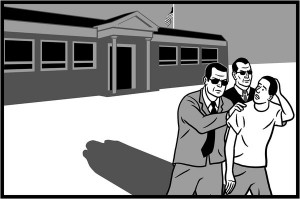
Mid-1990s: Gonzalez, 14, is visited by F.B.I. agents at his high school for hacking into NASA.

Gonzalez,  law-enforcement officials would discover, was more than just a casher. He was a moderator and rising star on Shadowcrew.com, an archetypal criminal cyberbazaar that sprang up during the Internet-commerce boom in the early 2000s. Its users trafficked in databases of stolen card accounts and devices like magnetic strip-encoders and card-embossers; they posted tips on vulnerable banks and stores and effective e-mail scams. Created by a part-time student in Arizona and a former mortgage broker in New Jersey, Shadowcrew had hundreds of members across the United States, Europe and Asia. It was, as one federal prosecutor put it to me, “an eBay, Monster.com and MySpace for cybercrime.”

Read rest of article….

Phi Beta Iota: We opened Hackers on Planet Earth (HOPE) in 1994, making the observation that when the Israeli's captured a hacker they gave him a job, while the US simply kicked them in the teeth and sent them to jail.  We tried to keep Phiber Optic out of jail, and we have for decades been on record comparing hackers to astronauts–full of the right stuff and pushing the edge of the envelope.  No one, including Marty Harris then in charge of the National Information Infrastructure (NII) wanted to listen.  Today the US Government is again ignoring the warnings on the urgency of getting a grip on all information in all languages all the time, and roughly 20 years behind in creating “root” cyber-security.  This article by James Verini is a phenomenal update on what we all knew in the mid-1990's that the US Government is still oblivious to–this is not a problem technology or wanton spending can solve–this is a problem that demands discipline, integrity, intelligence, and sharing.  It is neither possible nor desireable to secure government or military computers in isolation–this is an “all in” smart safe nation challenge.

See Also:

1994 Sounding the Alarm on Cyber-Security

Search: smart nation intelligence reform electoral reform national security reform

Continue reading “Journal: Cyber-Heist 2nd Generation”