My colleagues at Resolve and Invisible Children have just launched their very impressive Crisis Map of LRA Attacks in Central Africa. The LRA, or Lord’s Resistance Army, is a brutal rebel group responsible for widespread mass atrocities, most of which go completely unreported because the killings and kidnappings happen in remote areas. This crisis map has been a long time in the making so I want to sincerely congratulate Michael Poffenberger, Sean Poole, Adam Finck, Kenneth Transier and the entire team for the stellar job they’ve done with this project. The LRA Crisis Tracker is an important milestone for the fields of crisis mapping and early warning.
WHO PARTICIPATES IN “WHOLE SYSTEM” CONVERSATIONS? – PARTISANS, STAKEHOLDERS, DOMAINS, AND CITIZENS
by Tom Atlee
Consciously convened conversations have many functions. Many seek simply to get people talking with each other. Others try to bring together what they call “the whole system” to address that system's collective issues or dreams. Who is involved in these “whole system” conversations?
A “whole system”, in this case, involves all the parties who play – or could play – roles in some social unit or situation. The social unit could be a family or relationship, a group or organization, a community or a whole society. A situation might be, on the one hand, an issue, a problem, or a conflict – or, on the other hand, an inquiry, an opportunity, a shift, or simply a periodic reflection about what's happening. We can convene conversations around any of these things.
So how do we decide who the parties or players are? How do we “cut the pie” of the whole system? And, if we're ambitious, how do we elicit a “voice of the whole”?
I see four different approaches to defining who “a whole system” includes. Each approach has its own rationale and appropriate usages. They are not mutually exclusive, but are usually used more or less separately. Perhaps being aware of them and building synergies between them would enhance the power and wisdom of our conversations. These approaches include:
Phi Beta Iota: Tom Atlee is in our view the living founding father of Epoch B–there have been others before him, and there are other now, but for us, he is the spiritual center of gravity for doing the right thing now, here, in America. Please support his work on behalf of all of us.
Phi Beta Iota: On the one hand, NYPD's capabilities are vastly exaggerated. They're still feeling their way, wasting enormous human and financial resources, “because they can.” On the other hand, NYPD's efforts are precisely where the rest of the world needs to go, where Stephen Cambone said we need to go, down to the neighborhood level of granularity. One thing NYPD has going for it is the wicked combination of officers fluent in over one hundred key languages, and not having to deal with the idiocy of the federal classification and security clearance systems. What they do not have going for them is a complete loss of perspective–this is a force that spends $75 million a year putting mostly black people in jail for possession of marijuana….NYC is the marijuana arrest capital of the planet.
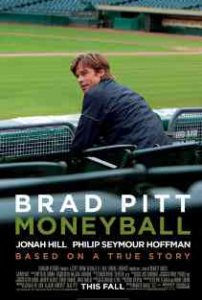
f you somehow missed it, they turned Michael Lewis’ book Moneyballinto a movie that premiered last weekend. Given how much coverage it got, I was stunned to see it come in third place at the box office, behind the re-released Lion King of all things.
I have been aware of the book and Billy Beane since Beane turned the baseball world on its ear by proving that the old school measure of talent, batting average, was necessary but not sufficient to make the best decisions about hiring, and talent is everything in baseball – or to put it in Yogi Berra-oid terms – 90% of baseball is 50% talent.
Beane showed that things lke on base percentage, slugging percentage, even the number of walks a player gets can have greater statistical impact on the outcome of games – and of course winning is what matters in the end. And for years, Beane was the only one managing a team this way, so he had the advantage and his team did better while spending less on their talent (because everyone was still so focused on batting averages). Now everyone follows this model so the playing field is once again relatively level (albeit a new higher level).
Friday I was listening to NPR and they were talking about the book and the movie and why the book was such a huge hit and the person they were interviewing said it really well – he said the reason Moneyball was such an “important” book was because it rattled an entire industry by showing it the set-in-stone metrics that industry was using were not enough, and that sent ripples into other industies suggesting that they rethink their metrics as well. In many respects, my book Rethink is a guide to helping organizations do just that.
After I heard that piece on NPR I saw two different articles in The New York Times talking about two very different companies who have followed the Moneyball/Rethink logic and offer some great examples of non-obvious changes.
Julie Dermansky – Julie Dermansky is a multimedia reporter and artist based in New Orleans. She is an affiliate scholar at Rutgers University's Center for the Study of Genocide and Human Rights. Visit her website at www.jsdart.com.
The Atlantic, 27 September 2011
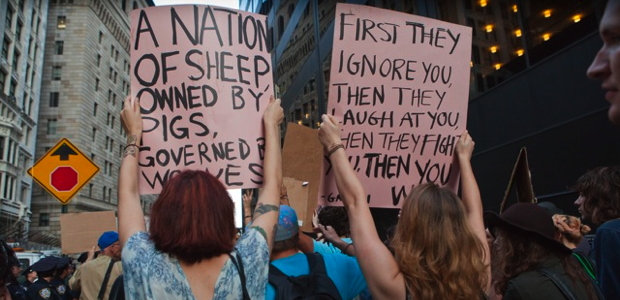
They're calling it America's answer to the Arab Spring. In July, the anti-capitalist magazine Adbusters urged readers to “flood into lower Manhattan, set up tents, kitchens, peaceful barricades and occupy Wall Street for a few months. Once there,” it continued, “we shall incessantly repeat our one simple demand until Barack Obama capitulates.”
Click on Image to Enlarge
As planned, thousands began gathering on September 17, but 10 days into their demonstration, it's not entirely clear what that “one simple demand” might be. Many of the hand-scrawled signs lash out against corporations. But as the days go by, new issues emerge. The execution of Georgia prisoner Troy Davis four days into the protest made the death penalty into a central theme. And the NYPD has become a major target for rage, especially after Saturday's reports that a police officer (improbably named Anthony Bologna) had aimed pepper spray at a protester's face.
Photographer Julie Dermansky, who covered the protests in Tahrir Square, headed to New York after seeing videos of the Wall Street demonstrations on Facebook. These photos capture some of the scenes she encountered yesterday.
One of our contributors passed this to me and asked me to comment in relation to the alarm that Winn Schwartau, Bill Caeli, Jim Anderson, and I sounded in 1994, in writing, to Marty Harris, then head of the National Information Infrastructure (NII).
Stuxnet, the cyberweapon that attacked and damaged an Iranian nuclear facility, has opened a Pandora's box of cyberwar, says the man who uncovered it. A Q&A about the potential threats.
EXTRACT:
CSM: How would you characterize the year since Stuxnet – the response by nations, industry and government?
LANGNER: Last year, after Stuxnet was identified as a weapon, we recommended to every asset owner in America – owners of power plants, chemical plants, refineries and others – to make it a top priority to protect their systems…. That wakeup call lasted only about a week. Thereafter, everybody fell back into coma. The most bizarre thing is that even the Department of Homeland Security (DHS) and Siemens [maker of the industrial control system targeted by Stuxnet] talked about Stuxnet being a wakeup call, but never got into the specifics of what needed to be done.
The Standby Volunteer Task Force (SBTF) was launched exactly a year ago tomorrow and what a ride it has been! It was on September 26, 2010, that I published the blog post below to begin rallying the first volunteers to the cause.
Phi Beta Iota: This is the most structured harnessing of distributed human intelligence that we know of, and it is especially empowering because of its strong geospatial roots. Now imagine similar forces in being to cover each of the ten high-level threats to humanity from local to global, each of the core policies, with citizen intelligence minutemen tallying true costs for every good and service, and sticking like leeches to every organization, illuminating corruption at every turn.