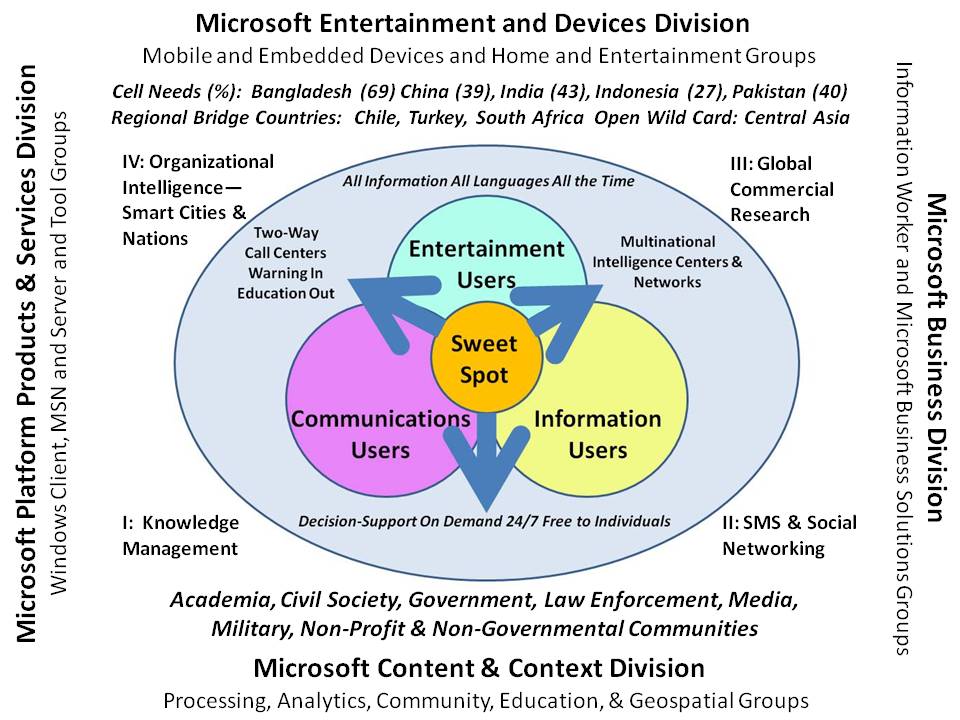
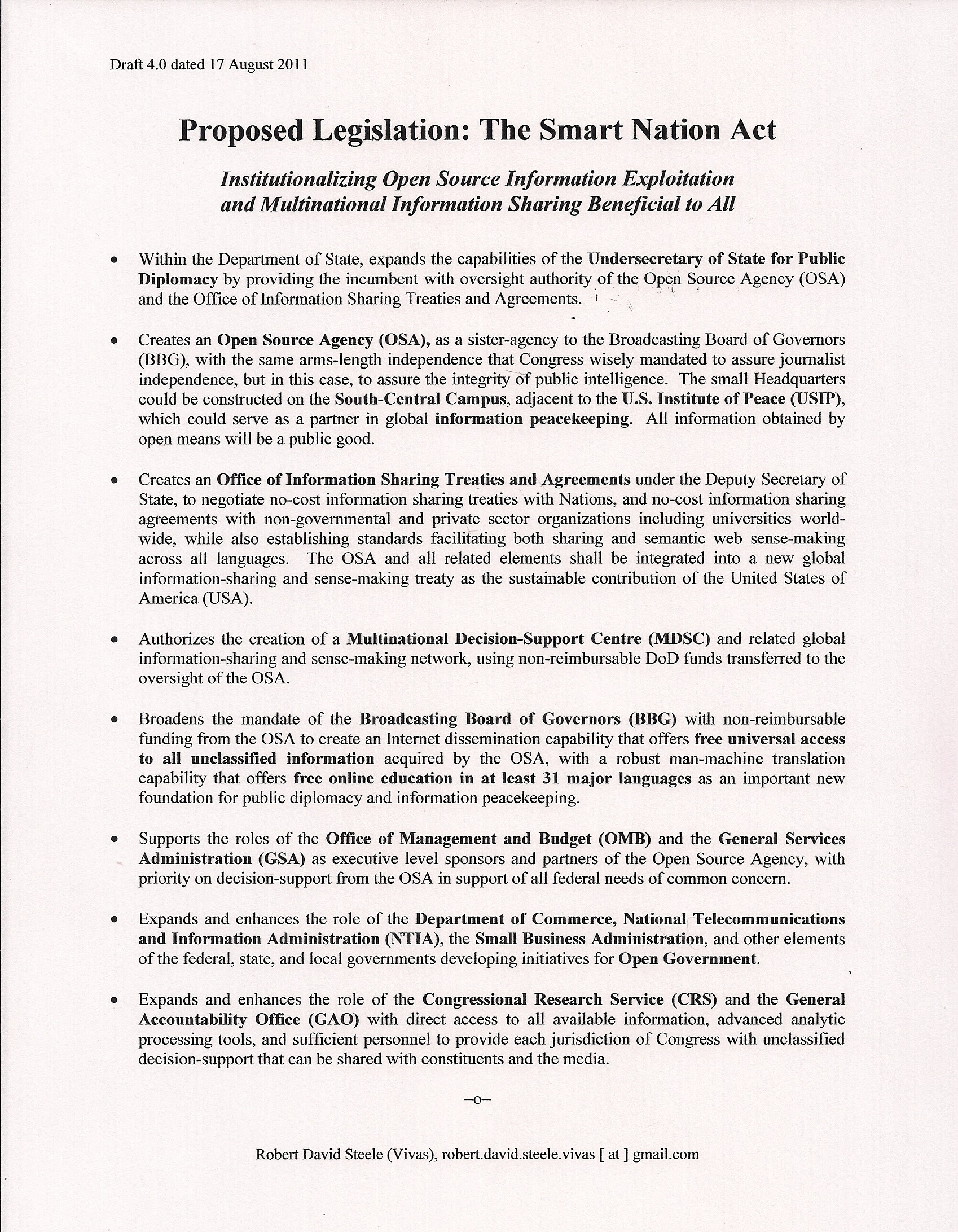
After some effort, the below memorandum on Operation Cloudburst was delivered to and read by Reed Hastings and Norm Judah (the latter Chief Technical Officer for Microsoft). Microsoft as a culture evidently cannot make the intellectual leap from legacy kludge to Open Everything, monetizing the aggregate instead of the instance. This memorandum is the intellectual property of Robert Steele and is now in the public domain under Creative Commons license, with the observation: this is what we need to build based entirely on Open Source software, Open Source hardware, and networks of hybrid paid and volunteer human minds.
Beginning last October and continuing through May I wrote a book part 1 and part 2 in which I have tried to examine Research and Education networks globally but with the primary emphasis on The Netherlands, Europe and the US as exemplified by Internet2. These networks are morphing into a platform for the conduct of collaborative science and present a potentially compelling alternative to commercial internet. These are taking shape into what could be a powerful alternative network based economy.
This January, when I saw US UCAN described in the abstract I became very enthusiastic about it a potential morphing into a national public internet for supporting John Robbsian Resilliant Communities. While Internet 2 finally got a much needed dose of new leadership i found that its Washington DC grant oriented minimum risk taking culture has not changed significantly.
At 140,000 words I realized in May I needed and introduction and summary for my book. I wrote one a a contribution to the Peer to Peer Foundation Wiki. That may be read here.
Unfortunately given the austerity kick under way there is no support for outreach and i am beginning in frustration to go back to the the run of the mill commercial internet. However Michell Bauwens did present my summaries on the P2P foundation blog.
I will post updates of those as follow ups to this.
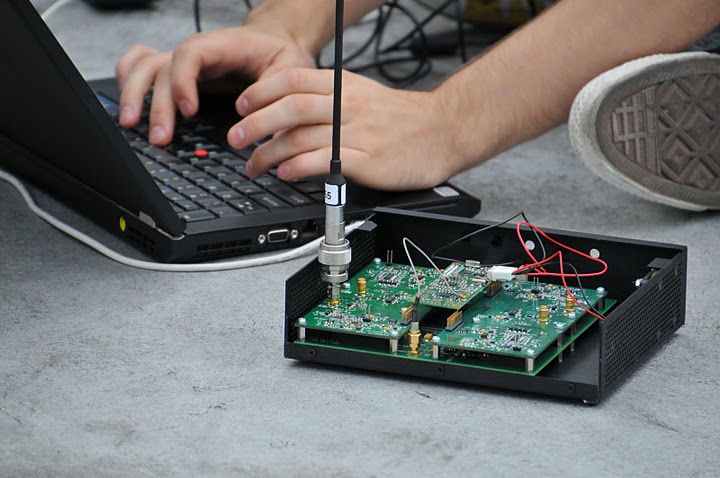
MoblleActive.org recently had the opportunity to test an off-the-grid GSM base station. Kurtis Heimerl presented The Village Base Station (VBTS), (link is a PDF) a low-power means of providing mobile network service without grid power or network infrastructure.
Phi Beta Iota: As best we can tell, OpenBTS is central–vital–to the achievement of Open Society as well as Open Government, and is the only way that we can reasonably scale free to very low cost Internet access to the five billion poor.
Deliberative public engagement is a distinctive approach to involving people in decision-making. It is different from other forms of engagement in that it is about giving participants time to consider and discuss an issue in depth before they come to a considered view. The aim of this 18-page background paper (2008) from Involve and the National Consumer Council is to encourage and support deliberative public engagement in public policy.
Deliberation itself – where a range of people learn, discuss and work out solutions together – is not new. Forums, advisory groups, partnerships and some forms of consultation have done this for years and are becoming increasingly sophisticated. More recently, citizens’ juries and large-scale citizens’ summits have found favour with government and public service providers at both local and national levels.
Involve and the National Consumer Council (NCC) believe that deliberative public engagement can be valuable in helping to create better public services, promote social cohesion and foster a thriving democracy. There is already good practice throughout the UK, and the full potential contribution of deliberation to improving the quality of decisions and policy solutions, and to enhancing representative democracy is becoming clearer as experience grows.
The government and other public bodies are currently developing general guidelines on public and stakeholder engagement – making it timely for Involve and NCC to draw on the growing body of learning and evidence to contribute a set of specific principles on deliberative public engagement from outside government.
This is far from being the last word. Over the next year Involve and NCC will continue to monitor the field, listen to feedback on the value and relevance of these principles, and consider the potential need for more detailed guidance. In the mean time, we hope our work will contribute to the already-flourishing debate on the role of deliberative public engagement in Britain today.
Phi Beta Iota: The 18 page document is available in English, French, and Turkish. The nine principles of public engagement discussed in the document are:
The process makes a difference.
The process is transparent.
The process has integrity.
The process is tailored to circumstances.
The process involves the right number and types of people.
The process treats participants with respect.
The process gives priority to participants' discussions.
The process is reviewed and evaluated to improve practice.
Here’s the plan. He talks to UNOSAT and Google about acquiring high-resolution satellite imagery for those geographic areas for which they need more information on. A colleague of mine in San Diego just launched his own company to develop mechanical turk & micro tasking solutions for disaster response. He takes this satellite imagery and cuts it into say 50×50 kilometers square images for micro-tasking purposes.
We then develop a web-based interface where volunteers from the Standby Volunteer Task Force (SBTF) sign in and get one high resolution 50×50 km image displayed to them at a time. For each image, they answer the question: “Are there any human shelters discernible in this picture? [Yes/No].” If yes, what would you approximate the population of that shelter to be? [1-20; 21-50; 50-100; 100+].” Additional questions could be added. Note that we’d provide them with guidelines on how to identify human shelters and estimate population figures.
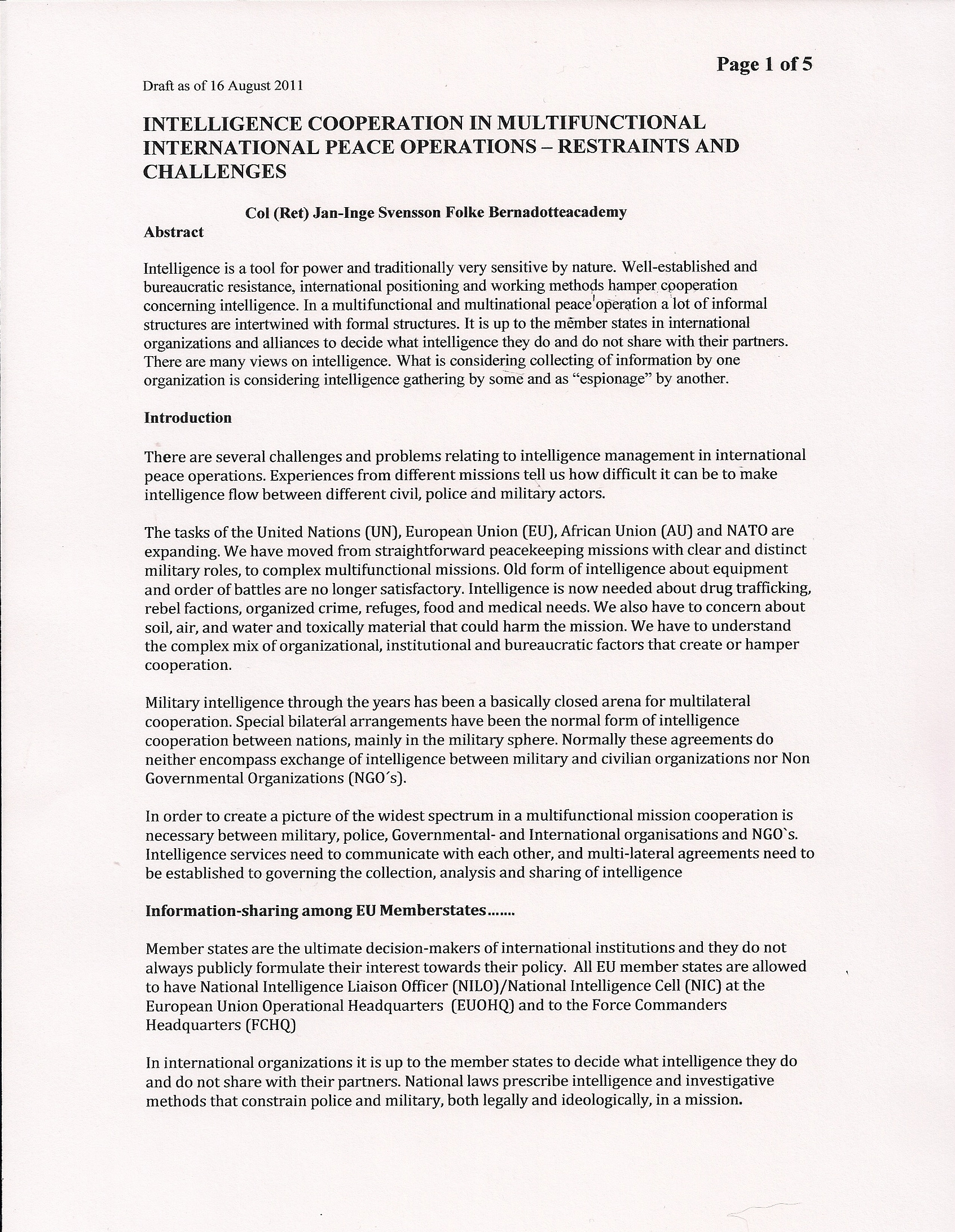
Intelligence is a tool for power and traditionally very sensitive by nature. Well-established and bureaucratic resistance, international positioning and working methods hamper cooperation concerning intelligence. In a multifunctional and multinational peace operation a lot of informal structures are intertwined with formal structures.
EXTRACT
In order to create a picture of the widest spectrum in a multifunctional mission cooperation is necessary among military, police, Governmental- and International organisations and NGO`s. Intelligence services need to communicate with each other, and multi-lateral agreements need to be established to governing the collection, analysis and sharing of intelligence.