Marcus Aurelius: Private Manning Public Context

04 Inter-State Conflict, 07 Other Atrocities, 09 Justice, 10 Security, 11 Society, Corruption, Cultural Intelligence, Director of National Intelligence et al (IC), DoD, Government, IO Impotency, Military, Officers Call
Marcus Aurelius

Article  below, based on views of three or so retired senior military officers, two of them former Service TJAGs, takes an unfortunate tack on Manning's treachery.  Their contention is that command and systemic failures set conditions for Manning to compromise documents.  They assert that since he was  “juniorest guy in the office,” everybody but him was responsible for what he did.  I disagree.  Responsibility for security is absolutely an individual one.  Individuals sign general nondisclosure agreement SF-312 and other program-specific non-disclosure agreements as a priori conditions of access.   Rules are stated up front.  Personnel security clearances, training, and indoctrination are approaches used for our side.  Gates, guards, guns, and all technical computer stuff are oriented against adversaries.  Manning should have been able to work in a totally open storage area with hardcopy and softcopy documents of all classifications immediately at hand without anyone having to worry about him.  Further, as we know, decision to commit treason is a profoundly individual one, often facilitated and rationalized by adversaries through considerations of sex, money, ideology, compromise, ego, excitement, etc. Individuals are supposed to individually withstand and deflect such adversary facilitations and inducements.  So, in my mind, Manning is party at fault here.  If justice system cannot generate a capital conviction for him, then he should go way of Jonathan Pollard, Israeli agent within NIS — life in prison, throw away key,  No compassion on my part for either.

Private First Class Bradley E. Manning

Bradley Manning's WikiLeaks case: The larger issue

Josh Gerstein

POLITICO, 12/23/11

After 19 months in military prisons — much of the time in solitary confinement — Pfc. Bradley Manning finally emerged over the past week from the netherworld to which he has been confined since his arrest in the largest breach of classified information in U.S. history.

Seven days of hearings at Fort Meade, Md., produced what the prosecution called “overwhelming” evidence that the low-ranking Army intelligence analyst was the one who sent hundreds of thousands of military reports and diplomatic cables to the transparency website WikiLeaks.

But the hearing also produced equally compelling evidence of the larger issue that is often overlooked in discussions of Manning’s alleged misdeeds: the systematic breakdown in security that enabled a low-ranking enlisted man to abscond with a staggering quantity of classified Pentagonand State Department documents.

Josh Kilbourn: Endgame – 2012 Forecast [W.E. Pollock]

01 Agriculture, 03 Economy, 07 Health, 09 Justice, 10 Security, 11 Society, 12 Water, Analysis, Budgets & Funding, Civil Society, Commerce, Corporations, Corruption, Cultural Intelligence, General Accountability Office, Government, IO Deeds of War, Money, Banks & Concentrated Wealth, Office of Management and Budget, Power Behind-the-Scenes/Special Interests, Threats, Waste (materials, food, etc)

We are going to move from denial to realization.  Physical world events will drive the process of realization. The primary trend is between stability and instability. We are moving from a multi-class system running from Super Elite to Unperson into a model of have's and have-nots, the unpersons. Labor has become a problem because less than 500 million are involved in life support activities thereby leaving more than 7 billion people very vulnerable to dependency (and treated as expendable containers). We are watching a redistribution process bound towards divestiture as more people become unpersons. Destruction of paper assets, debt collapse, bank failure, and war are all part of the redistribution process. With more unpeople, it becomes easier to reduce population through death and abuse. Our current economic structure has at least six trajectories of support; the physical world, human capital, transportation, technology, rule of law,and money.

Fukishima, Katrina, Gulf of Mexico oil spill — all examples of entire populations treated as “unpersons.”

See Also:

VIDEO: Fukushima – Total Cost (33)

W. E. Pollock Web Site

John Robb: Digital Empowerment of Resilient Communities

Advanced Cyber/IO, Blog Wisdom
John Robb

The Digital Roll-Out of Resilient Communities

Many of us believe that networked resilient communities are the key to the future.  These communities are not only a way to survive the current global collapse, they are something more:  The next step in social/economic organization.  For those of us that are successful (by hook or crook) in building a resilient community, it will be a way of life so productive, vibrant and life affirming that will make our current lives look stagnant, backward, and feudal in comparison.

Currently, our big challenge is to find ways to acclerate the shift to resilient communities as quickly as possible.  Why?  The ongoing and rapid delcine in the global economic and political environment I've been describing here for the last five years, will make it increasingly more difficult to make a successful shift despite a greater willingness to do so (as in:  finally seeing how truly screwed we all are).  So, how can we outrun the current collapse into economic depression and political chaos?

One of the fastest ways to a) change behaviors, b) deploy tools, and c) route around bariers (political/economic corruption) is to do it digitally.  Digital deployment is the way to get the “networked” portion of “networked resilient communities” rolled out. Let me show you how fast it can be.  Here's the rate of deployment and adoption for new technologies over the last Century.  The chart from Peter Brimelow that I found on Rob Carlson's site:

Click on Image to Enlarge

Note that with each new product, particularly those with strong network effects, we can see two things:

  1. the lag between discovery and deployment is dropping over time.
  2. the rate of adoption has accelerated over time.

Now that nearly everyone has a computer (either on a desk or in a smart phone), the rate of adoption for new tech has dropped from years to quarters.  There's almost no lag between development and deployment, and applications that represent major innovations can roll out to globally significant levels in months.  Here's a chart from Asymco that uses the most recent Android data.

Click on Image to Enlarge

Wow.  Applications that run on these phones deploy even faster. Given how fast things move now, it's not hard to imagine that a new economic system (better design), decentralized financial wire service, or P2P manufacturing system could sweep the world in months, drawing in tens of millions of people into a ways of creating, trading, and sharing wealth.  In short, new digital systems that make the transition to local production within networked resilient communities easier and faster since they can help generate the wealth required to do it without starving/freezing and the vision of the future that motivates people to persist despite setbacks.

Phi Beta Iota:  To our great surprise, Brother John does not mention OpenBTS in relation to cell phones, or the Autonomous Internet Roadmap.  The forthcoming book from Random House / Evolver Editions, THE OPEN SOURCE EVERYTHING MANIFESTO: Transparency, Truth, & Trust, make one core point over and over again: making anything “open” at “root” creates log of log adoption rates–in other words, if cell phone adoption or smart phone adoption is logrithmic now, making the pieces  open will make today's adoption rates logrithmic again–meta-logrithmic.  This is why there is a power-shift going on–bottom up common sense is being powered by both digital technology, and the access to one another and to information that digital technology brings to the public.

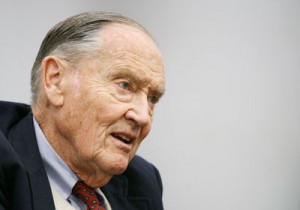
John Bogle: ENOUGH – Speculation Bad Investment Good

03 Economy, 07 Other Atrocities, 09 Justice, 10 Transnational Crime, Civil Society, Commerce, Commercial Intelligence, Corporations, Corruption, Government, Money, Banks & Concentrated Wealth, Power Behind-the-Scenes/Special Interests

MARK JEWELL

Associated Press, 22 December 2011

EXTRACTS:

Bogle says he's paying close attention to tax policies he considers unfair, including one that's favorable to the fund industry and investors with taxable accounts. The top rate for dividends and long-term capital gains is historically low at 15 percent, as a result of the extension of Bush era tax cuts that Congress and President Barack Obama agreed to a year ago. In contrast, top earners pay 35 percent on regular income. He doesn't like that disparity.

. . . . . . .

As for capital gains, there ought to be some distinction between capital made by people who start businesses, and contribute value to society, and capital made by gamblers on Wall Street, some of whom win. Earned capital income should carry the regular dividend rate, but capital income gains by trading, and particularly short-term trading, should pay a higher tax, even than the present ordinary income rate.

. . . . . . .

Q: What's your take on the Occupy movement?

A: I'm happy to say that my current income puts me in the 99 percent group. So maybe I'm not so happy, I don't know.

This movement has brought to the surface some very serious problems in our country about disparities in opportunity and income. So many young people are having a terrible time getting a job.

Young people have great idealism, and the Occupy movement has been a bit unrealistic at times. So what? I can't imagine a worse America if our younger generation didn't have great idealism. I salute them for their enthusiasm, and their mission.

The negative side is that they just pushed too hard for too long. It's very difficult for any movement without any seeming leadership — other than a good idea — to have any sense of taste or judgment. Who's to say, ‘This is going too far'? In some places, it's just gone on too long, and it's been too disruptive. So I think it's good that we've been cleaning up the plazas where the Occupy movement set up.

Read full interview.

See Also (Steele Reviews in Each Case):

John Bogle, The Battle for the Soul of Capitalism

William Greider, The Soul of Capitalism: Opening Paths to a Moral Economy

Matt Taibbi, Griftopia: A Story of Bankers, Politicians, and the Most Audacious Power Grab in American History

Chuck Spinney: Europe in Crisis Rule by Troika Spain and Hungary Next

03 Economy, 06 Russia, 08 Wild Cards, 11 Society, Commerce, Commercial Intelligence, Corruption, Government
Chuck Spinney

Rule by troika

by Serge Halimi
Le Monde Diplomatique, December 2011

Former bankers Lucas Papademos and Mario Monti have taken over in Athens and Rome, exploiting the threat of bankruptcy and the fear of chaos. They are not apolitical technicians but men of the right, members of the Trilateral Commission that blamed western societies for being too democratic.

In November, the Franco-German directorate of the European Union, the European Central Bank and the International Monetary Fund — the “troika” — were furious when the Greek prime minister, George Papandreou, announced plans to hold a referendum. This, they said, would call into question an agreement reached in October to strengthen the economic policy that had brought the country to its knees. Summoned to Cannes for an interview during a summit that his country was too small to attend, kept waiting, and publicly upbraided by Angela Merkel and Nicolas Sarkozy (who were responsible for exacerbating the crisis), Papandreou was forced to abandon the plan for a referendum and resign. His successor, a former vice-president of the ECB, promptly decided to include in the Athens government a far-right organisation banned since the Greek colonels lost power in 1974. (The troika expressed no views on this.)

The European project was supposed to secure prosperity, strengthen democracy in states formerly ruled by juntas (Greece, Spain, Portugal), and defuse “nationalism as a source of war”. But it is having the opposite effect, with drastic cuts, puppet governments at the call of the brokers, and renewed strife between nations. A young Spaniard voiced his anger at having to go to Berlin or Hamburg to find work: “We can’t go on being Germany’s slaves.” The Italians find the French president’s high and mighty attitude offensive and wonder, rightly, what exceptional talents might justify this.  Some Greeks are complaining about the “occupation” of Greece, with cartoons depicting the German chancellor in Nazi uniform.

For people in countries suffering under austerity measures, the history of Europe provides some outstanding examples. In some ways, recent events in Athens recall Czechoslovakia in 1968: the crushing of the Prague Spring and the removal of the Communist leader Alexander Dubcek. The troika has played the same part in reducing Greece to a protectorate as the Warsaw Pact did in Czechoslovakia, with Papandreou in the role of Dubcek, but a Dubcek who would never have dared to resist. The doctrine of limited sovereignty has been applied, though admittedly it is preferable and less immediately lethal to have its parameters set by rating agencies rather than by Russian tanks rolling over the borders.

Having crushed Greece and Italy, the EU and the IMF have now set their sights on Hungary and Spain.

See Also:

Mini-Me: Iceland Breaks the Back of Western Banking

Mini-Me: European-US Banking–Tangled Web — Tell Me Again, Why Shouldn’t We Default and Let the Banks Fry? + Financial Terrorism RECAP

Chuck Spinney: War Drums Beat within Versailles on the Potomac — War with Iran Promoted — More Lies and Miscalculation

04 Inter-State Conflict, 05 Iran, 10 Security, 11 Society, Articles & Chapters, Blog Wisdom, Corruption, Director of National Intelligence et al (IC), DoD, Government, IO Deeds of War, Media, Military, Misinformation & Propaganda, Officers Call, Peace Intelligence, Power Behind-the-Scenes/Special Interests
Chuck Spinney

On 12 December, I described a concatenation of warmongering pressures that were shaping the popular psyche in favor of bombing Iran.  Now, in a 21 December essay [also attached below], Steven Walt describes a further escalation of these pressures — in this case, via the profoundly flawed pro-bombing analysis, Time to Attack Iran: Why a Strike is the Least Bad Option, penned by Matthew Kroenig in January/February 2012 issue of the influential journal Foreign Affairs.

One would think that our recent experiences in Iraq and Afghanistan and our growing strategic problems in Pakistan, not to mention our economic problems and political paralysis at home, would temper our enthusiasm for launching yet another so-called preventative war.  But that is not the case, as Kroenig's analysis and the growing anti-Iran hysteria in the debates among the the Republican running for president show (Ron Paul excepted) show.  Moreover, President Obama’s Clintonesque efforts to triangulate the pro-war political pressures of the Republicans, while appeasing the Israelis, may be smart domestic politics in the short term, but they add fuel to the pro-war fires shaping the popular psyche. Finally, as I wrote last January, lurking beneath the fiery anti-Iran rhetoric are more deeply rooted domestic political-economic reasons for promoting perpetual war — reasons that have more to do with sustaining the money flowing into the Military – Industrial – Congressional Complex in the post-Cold War era than in shaping a foreign policy based on national interests.

While it is easy to whip up popular enthusiasm for launching a new war, our misadventures in Iraq and Afghanistan have shown that successfully prosecuting wars of choice are quite another matter.  Nevertheless, as my good friend Mike Lofgren explains in his recent essay, Propagandizing for Perpetual War, devastating rebuttals like Walt's are likely to have little effect on the course of events.

One final point … a surprise attack on Iran would trigger a far tougher war to prosecute successfully that either Iraq or Afghanistan.  If you  doubt this, I suggest you study Anthony Cordesman’s 2009 analysis of the operational problems confronting Israel, should it decide to launch a surprise attack on Iran’s nuclear facilities.

Yet, the beat goes on.

Chuck Spinney
The Blaster

The worst case for war with Iran

Stephen M. Walt

Foreign Policy, 22 December 2011

If you'd like to read a textbook example of war-mongering disguised as “analysis,” I recommend Matthew Kroenig's forthcoming article in Foreign Affairs, titled “Time to Attack Iran: Why a Strike Is the Least Bad Option.” It is a remarkably poor piece of advocacy, all the more surprising because Kroenig is a smart scholar who has done some good work in the past. It makes one wonder if there's something peculiar in the D.C. water supply.

There is a simple and time-honored formula for making the case for war, especially preventive war. First, you portray the supposed threat as dire and growing, and then try to convince people that if we don't act now, horrible things will happen down the road. (Remember Condi Rice's infamous warnings about Saddam's “mushroom cloud”?) All this step requires is a bit of imagination and a willingness to assume the worst. Second, you have to persuade readers that the costs and risks of going to war aren't that great. If you want to sound sophisticated and balanced, you acknowledge that there are counterarguments and risks involved. But then you do your best to shoot down the objections and emphasize all the ways that those risks can be minimized. In short: In Step 1 you adopt a relentlessly gloomy view of the consequences of inaction; in Step 2 you switch to bulletproof optimism about how the war will play out.

Kroenig's piece follows this blueprint perfectly.

Read full article.

Worth a Look: Occupy Matures into Inter-Occupy

Worth A Look

InterOccupy.org provides channels of communications between GAs, Work Groups and Occupiers across the Occupy movement.

http://www.interoccupy.org

They use MAESTRO as a conference call tool, have Facilitators, and are in every respect professional.

Maestro website offers/says:

Start your 30 DAY FREE TRIAL now. No software to download.

No other company enables real-time remote audience interaction like Maestro Conference.

Phi Beta Iota:  What is really impressive is if you call in with Google Voice and have access  to the conference dashboard at the same time.  FreeConferenceCall is also recommended by Inter-Occupy.

noble gold