FBI Intelligence Violations from 2001 – 2008

09 Justice, Corruption, Counter-Oppression/Counter-Dictatorship Practices, Government, Law Enforcement, Open Government, Secrecy & Politics of Secrecy
EFF report source in full

Executive Summary

In a review of nearly 2,500 pages of documents released by the Federal Bureau of Investigation as a result of litigation under the Freedom of Information Act, EFF uncovered alarming trends in the Bureau’s intelligence investigation practices. The documents consist of reports made by the FBI to the Intelligence Oversight Board of violations committed during intelligence investigations from 2001 to 2008. The documents suggest that FBI intelligence investigations have compromised the civil liberties of American citizens far more frequently, and to a greater extent, than was previously assumed. In particular, EFF’s analysis provides new insight into:

Number of Violations Committed by the FBI

  • From 2001 to 2008, the FBI reported to the IOB approximately 800 violations of laws, Executive Orders, or other regulations governing intelligence investigations, although this number likely significantly under-represents the number of violations that actually occurred.
  • From 2001 to 2008, the FBI investigated, at minimum, 7000 potential violations of laws, Executive Orders, or other regulations governing intelligence investigations.
  • Based on the proportion of violations reported to the IOB and the FBI’s own statements regarding the number of NSL violations that occurred, the actual number of violations that may have occurred from 2001 to 2008 could approach 40,000 possible violations of law, Executive Order, or other regulations governing intelligence investigations.1

Continue reading “FBI Intelligence Violations from 2001 – 2008”

Americans Admire Military Personnel While Being Unaware & Uninterested in What They Do “In Our Name”

02 Diplomacy, 04 Education, 04 Inter-State Conflict, 06 Family, 07 Health, 07 Other Atrocities, 09 Justice, 10 Security, Civil Society, Corruption, Ethics, Government, Media, Military, Policy, Waste (materials, food, etc)

Troops Die Because of Their Country, Not For It

US admiration for its soldiers may be deep and widespread, but interest in what they are doing is shallow and fleeting

article

by Gary Younge
Published on Monday, January 31, 2011 by The Guardian

Most of the stories told about Benjamin Moore, 23, at his funeral started in a bar and ended in a laugh. Invited to testify about his life from the pews, friend, relative, colleague and neighbour alike described a boisterous, gregarious, energetic young man they'd known in the small New Jersey town of Bordentown since he was born. “I'll love him 'til I go,” his granny said. “If I could go today and bring him back, I would.”

Grown men choked on their memories, under the gaze of swollen, reddened eyes, as they remembered a “snot-nosed kid” and a fidget who'd become a volunteer firefighter before enlisting in the military. Shortly before Benjamin left for Afghanistan, he sent a message to his cousin that began: “I'm about to go into another country where they hate me for everything I stand for.” Now he was back in a flag-draped box, killed by roadside bomb with two other soldiers in Ghazni province.

Continue reading “Americans Admire Military Personnel While Being Unaware & Uninterested in What They Do “In Our Name””

Highlights on the Democracy Front

07 Other Atrocities, 09 Justice, 11 Society, Civil Society, Collective Intelligence, Counter-Oppression/Counter-Dictatorship Practices, Cultural Intelligence, Ethics, Government, Officers Call
Tom Atlee

Dear friends,

There is need for bright news on the democracy front — and, luckily, there is some.  (I'm also working to create some in the background, but I've got nothing to announce yet.  Cross your fingers.)  So I thought I'd share a bit of it the good stuff I've seen.

The first article is an announcement that the Vermont legislature is planning to become the first state to ban corporate personhood statewide.  This is a move in the right direction to balance social power — a topic specifically addressed by the most popular article on the Co-Intelligence Institute website, “Democracy: A Social Power Analysis“, written by my father, John Atlee.  (Perhaps you'll get a sense of how my upbringing influenced my choice of career when you read it.)

Vermont Is Gearing Up to Strike a Major Blow to Corporate Personhood, Ban It Statewide

AlterNet by Christopher KetchamJanuary 22, 2011

The second article below is an interview with Frances Moore Lappé, one of my early mentors (see “Living Democracy“) exploring themes in her new book GET A GRIP 2.  She invites us to both work wholeheartedly on the issues that concern us AND to work on changing the systems (such as money's influence in politics) that create the problems we are trying to solve.

Continue reading “Highlights on the Democracy Front”

BLOWBACK, Legitimate Grievances, & Integrity Lost

08 Wild Cards, Collaboration Zones, Communities of Practice, Corruption, Counter-Oppression/Counter-Dictatorship Practices, Officers Call, Policies, Real Time, Threats

Phi Beta Iota: The announcement of the Egyptian Army that it recognizes the “legitimate grievances” of the public and that it will not use force is in fact a recognition of both the substance of the public grievances, and the fact that force would backfire–there are not enough guns on the planet to repress the public, that cat is out of the bag forever.  Morality is a priceless strategic asset–individual integrity is a priceless enabler of a government's legitimacy.  From Hawaii to Vermont, the USA is facing domestic demands for secession that reflect the lack of legitimacy of the financial crime families that “own” the two-party system to the detriment of the public interest.  It's time to get right with God and our own Humanity.  There is much that is right with America–none of it to be found on Wall Street or in Washington, D.C.

Amazon Page

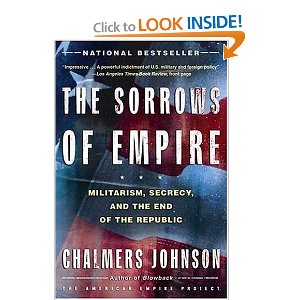
In Sorrows of Empire, Johnson discusses the roots of American militarism, the rise and extent of the military-industrial complex, and the close ties between arms industry executives and high-level politicians. He also looks closely at how the military has extended the boundaries of what constitutes national security in order to centralize intelligence agencies under their control and how statesmen have been replaced by career soldiers on the front lines of foreign policy–a shift that naturally increases the frequency with which we go to war.

Three More Covers & See Also Below the Line…

Continue reading “BLOWBACK, Legitimate Grievances, & Integrity Lost”

Video: Jesse Ventura Rips Wall St & Goldman Sachs

01 Poverty, 03 Economy, 07 Other Atrocities, Civil Society, Commerce, Corruption, Ethics, Government, Money, Banks & Concentrated Wealth, Power Behind-the-Scenes/Special Interests, Secrecy & Politics of Secrecy, Videos/Movies/Documentaries

Related:

Review: Griftopia–Bubble Machines, Vampire Squids, and the Long Con That Is Breaking America

See also:
Come Home, America: The Rise and Fall (and Redeeming Promise) of Our Country

The Battle for the Soul of Capitalism
Continue reading “Video: Jesse Ventura Rips Wall St & Goldman Sachs”

On Order for Review

Advanced Cyber/IO
Amazon Page

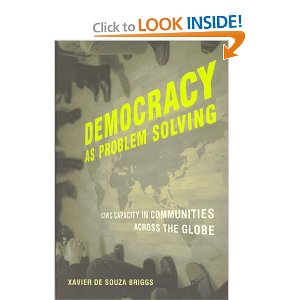
In his new book, Democracy as Problem Solving: Civic Capacity in Communities Across the Globe (2008: MIT Press), Xavier de Souza Briggs shows how civic capacity—the capacity to create and sustain smart collective action—is crucial for strengthening governance and changing the state of the world in the process.

Amazon Page

Analyzing emerging practices of collaboration in planning and public policy to overcome the challenges complexity, fragmentation and uncertainty, the authors present a new theory of collaborative rationality, to help make sense of the new practices. They enquire in detail into how collaborative rationality works, the theories that inform it, and the potential and pitfalls for democracy in the twenty-first century. Representing the authors’ collective experience based upon over thirty years of research and practice, this is insightful reading for students, educators, scholars, and reflective practitioners in the fields of urban planning, public policy, political science and public administration.

Amazon Page

Some blame the violence and unrest in the Muslim world on Islam itself, arguing that the religion and its history is inherently bloody. Others blame the United States, arguing that American attempts to spread democracy by force have destabilized the region, and that these efforts are somehow radical or unique. Challenging these views, The Clash of Ideas in World Politics: Transnational Networks, States, and Regime Change, 1510-2010 reveals how the Muslim world is in the throes of an ideological struggle that extends far beyond the Middle East, and how struggles like it have been a recurring feature of international relations since the dawn of the modern European state. John Owen examines more than two hundred cases of forcible regime promotion over the past five centuries, offering the first systematic study of this common state practice. He looks at conflicts between Catholicism and Protestantism between 1520 and the 1680s; republicanism and monarchy between 1770 and 1850; and communism, fascism, and liberal democracy from 1917 until the late 1980s. He shows how regime promotion can follow regime unrest in the eventual target state or a war involving a great power, and how this can provoke elites across states to polarize according to ideology. Owen traces how conflicts arise and ultimately fade as one ideology wins favor with more elites in more countries, and he demonstrates how the struggle between secularism and Islamism in Muslim countries today reflects broader transnational trends in world history.

Food speculation: ‘People die from hunger while banks make a killing on food’

01 Agriculture, 01 Poverty, 03 Economy, 07 Health, Civil Society, Commerce, Ethics, Money, Banks & Concentrated Wealth, True Cost

It's not just bad harvests and climate change – it's also speculators that are behind record prices. And it's the planet's poorest who pay
John Vidal Sunday 23 January 2011

article

Just under three years ago, people in the village of Gumbi in western Malawi went unexpectedly hungry. Not like Europeans do if they miss a meal or two, but that deep, gnawing hunger that prevents sleep and dulls the senses when there has been no food for weeks.

Oddly, there had been no drought, the usual cause of malnutrition and hunger in southern Africa, and there was plenty of food in the markets. For no obvious reason the price of staple foods such as maize and rice nearly doubled in a few months. Unusually, too, there was no evidence that the local merchants were hoarding food. It was the same story in 100 other developing countries. There were food riots in more than 20 countries and governments had to ban food exports and subsidise staples heavily.

The explanation offered by the UN and food experts was that a “perfect storm” of natural and human factors had combined to hyper-inflate prices. US farmers, UN agencies said, had taken millions of acres of land out of production to grow biofuels for vehicles, oil and fertiliser prices had risen steeply, the Chinese were shifting to meat-eating from a vegetarian diet, and climate-change linked droughts were affecting major crop-growing areas. The UN said that an extra 75m people became malnourished because of the price rises.

Continue reading “Food speculation: ‘People die from hunger while banks make a killing on food'”

noble gold