REMINDER: Environmental Degradation, not Climate Change, is High-Level Threat #3. Climate Change is less than 10% of that, and within Climate Change, mercury and sulfer are more important than carbon. Furthermore, it is not possible to address any one threat without addressing the other nine (e.g. #1 Poverty) with harmonized policies from Agriculture to Water, so the bottom line is that these talks are isolated and worthless. The world needs a serious global strategy with serious analytics, a commitment to understanding true costs of every product and service, and a commitment to bringing the five billion poor into a prosperous world at peace. Anything less is a betrayal of the public trust.
Mexico said Thursday that more than 30,000 people have been killed in drug violence since President Felipe Calderon launched a crackdown against cartels in late 2006.
The government said the violent La Familia cartel in western Mexico has been “systematically weakened” by recent arrests and deaths of leading members of the gang.
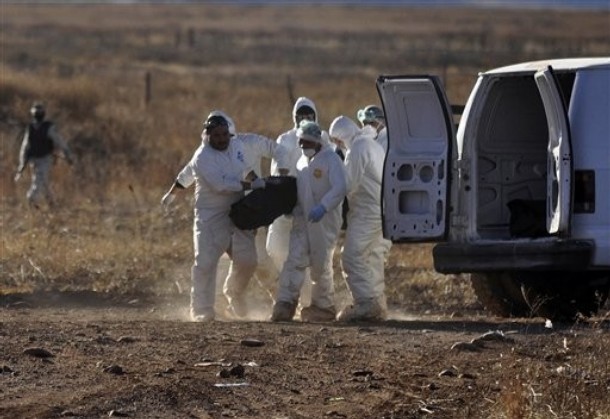
Forensic workers carry a body inside a body bag that was found at a clandestine grave in the town of Asencion, near the northern border city of Ciudad Juarez, Mexico, Saturday Dec. 11, 2010. At least 5 bodies have been found in three separate clandestine graves found in the site. (AP Photo/Raymundo Ruiz)
Phi Beta Iota: Both Mexico and the USA are “unintelligent” countries lacking in strategic analytics able to clearly demonstrate “cause and effect.” If they were “smart nations” as we have been advocating since 1995, marijuana would have been legalized long ago, corruption among local officials squelched, pay and training for the police substantially increased….and so on. Everything is connected. For example, the weapons do not really come from US handgun stores–they come from the Guatemalan military that sells entire shipments of “old” weapons provided to the US, and then tells the US the weapons were destroyed. The serial numbers on the captured weapons tell the truth. Until nations learn to think honestly and holistically, any single flaw can be fatal, and multiple flaws will interact in unanticipated and increasingly costly ways. In the USA, crime runs from the border to Wall Street, where drug money laundering has long been known to be a major source of liquidity. Politicians in both countries are paid to be anemic in their thinking and ineffective in their duty to the public. Under these circumstances, neither law enforcement nor the military can be effective. Integrity is the missing factor.
The overwhelming cultural consensus of the post-WWII generation was that if you are middle-class, then you simply must own your own home and your children must go to college. Out of that cultural consensus emerged a complex system of tax breaks and special lending deals designed to make sure that the number of Americans who bought houses and bachelor's degrees was as high as possible–or maybe more so.
Many people now understand that this system of tax-and-lend has created a multigenerational housing bubble. But only a few have noticed that a very similar tax-and-lend system has also created a multi-generational higher education bubble.
Read rest of article…. Phi Beta Iota: There is good news. The smartest of the smart have been dropping out of high school, not just college, and then learning what they need to learn online and through hands-on experience. Like most bubbles, including not just the housing mortgage bubble but also the DoD acquisition bubble, the DoD private military contractor bubble, and so on, this bubble rests on fraud being permitted–a lack of accountability for outcomes. In today's world, with transparency emergent and soon rampant, accountability is going to be a fact of life. That is a good thing.
Open Minds (formerly known as March Madness for the Mind) is the acclaimed annual exhibition of cutting-edge innovation from NCIIA's (National Collegiate Inventors and Innovators Alliance) best student teams. The exhibition takes place each year during NCIIA's annual conference, and is an opportunity for student teams to demonstrate their products and companies, and receive local and national media coverage. 10-15 teams are selected to participate in this high profile event, which involves an evening exhibition for NCIIA conference attendees as well as an exhibition open to the general public and an exciting video competition.
September 2010
Authors: Todd Gabe, Jaison R. Abel, Adrienne Ross, and Kevin Stolarick
This study identifies clusters of U.S. and Canadian metropolitan areas with similar knowledge traits. These groups—ranging from Making Regions, characterized by knowledge about manufacturing, to Thinking Regions, noted for knowledge about the arts, humanities, information technology, and commerce—can be used by analysts and policymakers for the purposes of regional benchmarking or comparing the types of programs and infrastructure available to support closely related economic activities. In addition these knowledge-based clusters help explain the types of regions that have levels of economic development that exceed, or fall short of, other places with similar amounts of college attainment. Regression results show that Engineering, Enterprising, and Building Regions are associated with higher levels of productivity and earnings per capita, while Teaching, Understanding, Working, and Comforting Regions have lower levels of economic development.
In the first treatise written on the art of war, sometime around 450 BC [1], Sun Tzu explained why “the wise general sees to it that his troops feed on the enemy,”
EXTRACT: The militarization of development aid is a central pillar of General Petaeus's counterinsurgency strategy to buy the hearts and minds of the Afghan people, ninety per cent of whom are spread out in remote rural areas. So it should not be surprising that the military is controlling the bulk of the billions of dollars in aid money flowing into (and being smuggled out of) Afghanistan.
In the very important CounterPunch report on 13 December, Patrick Cockburn, certainly one of the most informed observers of insurgencies in the Middle East and Central Asia, described how the militarization of development aid in Afghanistan is riven with corruption.