Design for the Other 90% Exhibit + “Micro-Giving” Global Needs Index to Connect Rich to Poor/Fullfill Global-to-Local Requests

01 Poverty, 02 Infectious Disease, 03 Economy, 04 Education, 06 Family, 07 Health, 12 Water, Civil Society, Collective Intelligence, Geospatial, Gift Intelligence, International Aid, microfinancing, Mobile
Link to online exhibit

“The majority of the world’s designers focus all their efforts on developing products and services exclusively for the richest 10% of the world’s customers. Nothing less than a revolution in design is needed to reach the other 90%.”
—Dr. Paul Polak, International Development Enterprises

Exhibition on view National Geographic Museum, Washington, DC through September 6, 2010

Imagine connecting item & service-requests to those lacking basic needs into a global online and mobile market forum like a Craigslist.org merged with Kiva+ SMS/txt message capabilities, something like Ushahidi, Wikimapia, as well as GoogleEarth-like & SecondLife-like 3D map to post photos and messages of requests and successful transactions without a centralized “middle-man” who manages everything.

Example: An African farmer needs a part for 1950’s Romanian pump. An aid worker posts need via UNICEF Rapid SMS. A Romanian engineer volunteers to make the part; a German pays for FedEx from Romania to Nigeria; a tourist commits to personally delivering it and posting a photograph of the farmer and repaired engine online to close out need.

It would be designed so that anyone could add “affordable” items (that meet a particular criteria) to the list. Please email earthintelnet |at| gmail.com if you have suggestions. For more info on the concept, see page 7 of the Earth Intelligence Network overview draft and this global range of nano-needs graphic. On 7/21/10 Craig Newmark of Craigslist.org sent this email: “..a number of people say they're working on similar efforts,” but he did not specify. Another great example is Practical Action's “Practical Presents” store where a goat, fish cage, farm tools, and many more products can be purchased for donation.

Global Range of Needs Index/Map/Forum could include the following items:
+ Cheap colloidal silver-treated water filters: see Potters Without Borders & Potters for Peace

+ Lifestraw, the one person water filter that can be worn around the neck

+ Saline water condenses into drinkable water using the WaterCone (video) (product info)

+ Various water storage products (bladder & plastic lined pond)

+ Peanut butter project (child malnutrition) connected with UNICEF, Doctors without Borders, USAID, etc and PlumpyNut

+ Affordable burn-proof stove | Guatemala Stove Project | stoves fr the Congo | Darfurstoves.org

+ Hand-Crank Battery-Free Dynamo Flashlight | “Light Up the World” solar powered battery L.E.D. lighting

+ List of innovations here from the Honey Bee Network

+ Cell phones (regionally compatible) / One Mobile per Human / One Mobile per Child / instead of just One Laptop per Child (see the $12 computer project) There are phone donation campaigns but the closest one found so far aims only at health care workers. And this wireless, local, do-it-yourself, telephone company toolkit.

+ KICKSTART water pumps for crop farming

+ Micro-irrigation systems for small plots (mentioned in this video at the chapter 6 mark), also called PEPSEE systems (also see DripTech)

+ Moringa seeds/leaves (nutrients + water filtering)

+ “Pot-inside-Pot Cooler” filled with sand and water (see 36 sec video). When that water evaporates, it pulls heat from the interior of the smaller pot, in which vegetables and fruits can be kept. See this African “refrigerator” called Zeer Pot (also: link1 | link2 | link3) which can keep meat fresh for five days mentioned in the book Fortune at the Bottom of the Pyramid.

+ Shoes (Soles4Souls.org)

+ Shelter (mini-domes) and Architectureforhumanity.org (video in Haiti), Open Architecture Network, rammed earth, tires, and plastic bottle innovation, Earthship Biotecture, Grassroots United, and Uber Shelter (video).

+ 10 cent blood-type test, 99 cent ovarian cancer blood test

+ Toothpaste & toothbrushes or teeth-cleaning twigs | African twig brush/chew sticks (sell to Westerners, sold here) | traveler feedback on chewsticks | Miswak | Other African info and some historical perspective on chew sticks

+ Solar dynamo radios + Farm Radio (African rural poor)| Healthy Radio

+ Bicycles / bicycles for humanity (and locks!) ONE | TWO

+ Devices powered by bicycle (Global Cycle Solutions)

+ Durable versatile safer wheelchairs Video 1 | Video 2 | Whirlwind Wheelchairs International (open source)

+ Low-cost infant warmers

+ Affordable prosthetics, eyeglasses, mobile eye exam lense

Other needs: medical supplies ($3 negative pressure pump, telemedicine microscope, Rice Univ project list), seeds & fertilizer, toilets (see this loo, & one-time use bags), electricity and medical equipment in Afghan hospitals, products for the elderly, games for children, and services such as the needs for software to be developed where there is a desire for “Code in Country” (CIC), and a global “classifieds” tool for job-hunting via mobile SMS (Craigslist.org but with more reach and aware to those without a web connection). Continue reading “Design for the Other 90% Exhibit + “Micro-Giving” Global Needs Index to Connect Rich to Poor/Fullfill Global-to-Local Requests”

Aid Data (Beta) fr AidData.org | Tracking Development Finance

01 Poverty, 02 Diplomacy, 02 Infectious Disease, 03 Economy, 04 Education, 06 Family, 07 Health, 11 Society, 12 Water, International Aid, Research resources
website link

AidData attempts to capture the universe of development finance and foreign aid, increase the value of data by providing more descriptive information about development activities, provide data in an accessible format, and strengthen efforts to improve donor and recipient strategic planning and coordination. The PLAID Project — the predecessor to AidData — benefits from significant support given by the Bill & Melinda Gates Foundation, the Hewlett Foundation, Richard and Judy Finch, and the National Science Foundation. PLAID is a partnership of the College of William and Mary and Brigham Young University. Its successor, AidData, is a merger of PLAID and the Development Gateway's Accessible Information on Development Activities (AiDA) Additionally, our work would not be possible without the institutional support of the College of William and Mary, Brigham Young University, and the Development Gateway Foundation.

The AidData team is committed to building an easy-to-use, comprehensive, and timely resource describing the universe of development finance project-by-project, including all grants and loans committed by all major bilateral and multilateral aid donors. We currently have the most comprehensive database on development finance, but have plenty of additional work to do. Better data will help increase aid targeting and coordination, and it will enable better measurement and evaluation of aid effectiveness. AidData is currently developing a publicly-accessible interface that will enable researchers, field workers, and policy makers interested in development finance to access detailed project level data in order to increase transparency, accountability, and effectiveness.

Where We Are Winning – Where We Are Losing: Futurologists Publish Annual Report on Major World Problems and Opportunities

01 Poverty, 03 Economy, 03 Environmental Degradation, 04 Education, 05 Energy, 06 Family, 11 Society, 12 Water, Academia, Civil Society, Collective Intelligence, Commerce, Corruption, Government, Key Players, Non-Governmental, Peace Intelligence

Millennium Project / State of the Future web portal

Where We Are Winning – Where We Are Losing:

Futurologists Publish Annual Report on Major World Problems and Opportunities

Berlin 7th July 2010 – Can civilization implement solutions fast enough to keep ahead of the looming challenges? The Millennium Project, a global independent think tank of futurologists, and thought leaders, today published its 14th report on global perspectives in Germany and around the world. Until two years ago the report showed a positive trend in the so-called “State of the Future Index” (SOFI). Triggered by the financial and economic crises and the failure of the climate conference in Copenhagen, the current SOFI shows that the prospects of success in solving some major global challenges have become somewhat clouded.

What the authors see as lacking the most, according to Jerome Glenn,
Director of the Millennium Project, are a serried of serious global
strategies to be implemented by governments, companies, NGOs, UN
institutions and other international bodies.” The world is in a race between
implementing ever-increasing ways to improve the human condition and the
seemingly ever-increasing complexity and scale of global problems. After 14
years of research into the future within the framework of the Millennium
Project it is increasingly clear that the world has the necessary capacity
to cope with its problems. However, it remains unclear whether humankind
will make the right decisions on the scale necessary to meet the global
challenges appropriately”, said Glenn.

Among the regular sections in the ninety page ‘State of the Future' report
are the annually updated analyses of the fifteen key global challenges, as
well as the publication of the State of the Future Index (SOFI). The index
identifies areas in which there has been either an improvement or
deterioration during the past 20 years and creates projections for these
scenarios over the coming decade. All relevant and recognised studies by the
UN or World Bank are distilled as part of these projections.

On individual results of the State of the Future Index:

Where We Are Winning
Continue reading “Where We Are Winning – Where We Are Losing: Futurologists Publish Annual Report on Major World Problems and Opportunities”

Event: 28 Jun 2010, Wash D.C. – TEDxOilSpill

03 Economy, 03 Environmental Degradation, 05 Energy, 07 Health, 12 Water
Link to event details

For a so called independent event there are a ‘number' of mainstream players involved such as National Geographic, World Wildlife Fund, UN Foundation, Richard Branson's “Carbon War Room,” and Greenpeace (speakers).

|||
|||

Location:
Woolly Mammoth Theatre
641 D Street, NW (7th & D)
Washington, DC

Comment: It will be interesting to see how many events develop like this that address poverty/wealth creation strategies and infectious diseases (see: analytical matrix card).

Afghanistan War Wealth + Corruption Cycle (Opium, Hashish, Minerals, Past Pipeline Attempts)

01 Agriculture, 01 Poverty, 03 Economy, 05 Energy, 07 Other Atrocities, 08 Wild Cards, 10 Security, Afghanistan, Corruption, Geospatial, Government, Military

Talk of wealth from minerals by US geologists and Pentagon personnel add to the darkening view that those involved in war, corruption and disregard for the people of Afghanistan (and sacrificed soldiers + more to be sacrificed) will prosper…

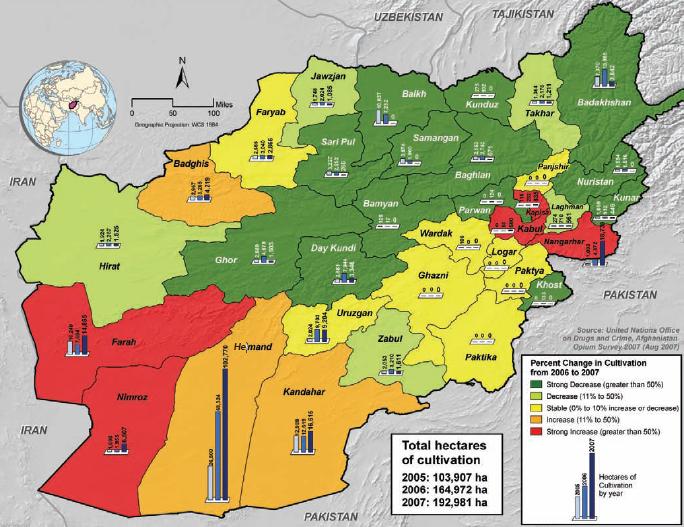
+ Opium = supplies 90% of crop source for heroin (president Karzai's brother links to heroin trade)

2005-2007 production (source: U.N.) Click to Enlarge

+ Hashish = April 2010 report: Afghanistan Hashish, (not only opium) Declared World’s Largest Producer

Income from cannabis per ha (gross/net) US$ 3,900 / US$ 3,341 | Income from opium per ha (gross/net) US$ 3,600 / US$ 2,005 | Income from wheat per ha (gross/net) US$ 1,200 / US$ 960

+ Minerals = US geologists, Pentagon, Indian firms claim 1-3 trillion dollar value of mineral wealth in Afghanistan
and “Afghanistan's resources could make it the richest mining region on earth” and more importantly, this being ‘known' in 2007. (direct: USGS link) and that the Soviets were aware of mineral wealth during their Afghanistan occupation.

+ Gas Pipeline attempts = 1998 Congressional record related to Unocal/U.S. interests in Central Asia & November 2001 Asia Times article about the book “Bin Laden, la verite interdite (Bin Laden, the forbidden truth)” mentioning the US government's main objective in Afghanistan was to consolidate the position of the Taliban regime to obtain access to the oil and gas reserves in Central Asia.

past pipeline planned

BBC in 2002 mentions Unocal (Unocal.com is now Chevron.com) and others abandoning pipeline plans due to U.S. missile attacks in 1999. Reports on Enron attempts to make a deal with the Taliban (this 2002 CounterPunch article too). Encyclopedia of Earth also has a short mention of this topic

+ HistoryCommons.org Unocal profile timeline on their Central Asia activities
+ HistoryCommons.org timeline of president Karzai (election organized by the United Nations).

+ Corruption in Afghanistan = Transparency International ranks Afghanistan 179th of 180 countries.  And Afghan corruption has doubled since 2007 (IntegrityWatch survey).
Pre-existing plan to attack Taliban before 9/11 was even posted in the BBC and a variation of this was posted at MSNBC in 2002.

“To be truthful about it, there was no way we could have got the public consent to have suddenly launched a campaign on Afghanistan but for what happened on September 11”
-Tony Blair (London Times, 7/17/02)
originally at http://www.timesonline.co.uk/article/0,,2-358038,00.html but no longer at that URL

Related:
+ Karzai Aide in Corruption Inquiry Is Tied to C.I.A. (Aug 26, 2010)
+ Corruption Suspected in Airlift of Billions in Cash From Kabul (WSJ: June 25, 2010)
+ Event Report: 20 Nov 09 NYC, Counterinsurgency–America’s Strategic Burden
+ (Book) Taliban: Militant Islam, Oil and Fundamentalism in Central Asia by Ahmed RashidMar. 1, 2001
+ Afghan War Diaries Explorer
+ UN/World Bank Afghanistan Drug Industry Report (2006)
+ SourceWatch: Opium economy in Afghanistan
+ GlobalSecurity.org: Afghanistan Opium cultivation
+ Wkipedia: Trans-Afghanistan Pipeline
+ Free Book: “The Politics of Heroin in Southeast Asia by Alfred W. McCoy

The Mexico + American Narcosphere (Calling Carlos “Slim” Helu)

01 Poverty, 02 Diplomacy, 03 Economy, 04 Education, 06 Family, 07 Health, 07 Other Atrocities, 08 Immigration, 09 Justice, 09 Terrorism, 10 Security, 10 Transnational Crime, 11 Society, Audio, Civil Society, Commerce, Corruption, Government, Law Enforcement, Media, Military, Mobile, Research resources, Videos/Movies/Documentaries

Excellent May 31, 2010 New Yorker article by William Finnegan called Letter from Mexico, Silver or Lead which is unfortunately only available by subscription only (click here for link to abstract also pasted below) The most telling two words of the article = “state capture.”
ABSTRACT: LETTER FROM MEXICO about La Familia Michoacana and the pervasive power of drug traffickers in the country. Writer visits the hill town of Zitácuaro in the Mexican state of Michoacán. On the morning before his arrival, the dismembered body of a young man was left in the middle of the main intersection. It was an instance of what people call corpse messaging. Usually it involves a mutilated body and a handwritten sign. “Talked too much.” “You get what you deserve.” The corpse’s message—terror—was clear enough and everybody knew who left it: La Familia Michoacana, a crime syndicate whose depredations pervade the life of the region.

Mexico’s president, Felipe Calerón declared war—his metaphor—on the country’s drug traffickers when he took office, in December, 2006. It was a popular move. Although large-scale trafficking had been around for decades, the violence associated with the drug trade had begun to spiral out of control. More than twenty-three thousand people have died since Calderón’s declaration. La Inseguridad, as Mexicans call it, has become engulfing, with drugs sliding far down the list of public concerns, below kidnapping, extortion, torture, unemployment, and simple fear of leaving the house. The big crime syndicates still earn billions from drugs, but they have also diversified profitably. In Michoacán a recent estimate found eight-five per cent of legitimate businesses involved in some way with La Familia. Among Mexico’s drug trafficking organizations, La Familia is the big new kid on the block. It first gained national attention in September, 2006, when five severed heads rolled onto the dance floor at a night club in Uruapan, Michoacán. A senior American official in Mexico City told the writer, “La Familia is looking more and more like an insurgency and less like a cartel.” Mentions one of La Familia’s leaders, Nazario Moreno González, who is also known as El Chayo, or El Más Loco (the Craziest). Writer discusses La Familia’s activities with a local politician and relates how the cartel has, in some places, filled the vacuum created by public distrust of the police and the courts.

The overwhelming growth of organized crime in Mexico in the past decade is often blamed on multiparty democracy. Until 2000, the country was basically a one-party state for seventy-one years under the Institutional Revolutionary Party (PRI). Drug trafficking flourished, but its practitioners enjoyed stable relations with officialdom. Describes how the election of Vicente Fox in 2000 changed the status quo between drug traffickers and government. Writer gives a survey of other significant Mexican drug cartels, including the Sinaloa cartel, and the Zetas, who had previously occupied Michoacán. Tells about the rise of La Familia in 2006 and its expansion into nearby states. Discusses U.S.-Mexico relations and the drug trade. Writer visits a drug-rehabilitation center in Zamora. Describes acts of kidnapping and extortion perpetrated by La Familia.

Links Connecting Police Corruption + Narcosphere + U.S. + North Mexico/Chihuahua/Juarez & Beyond: Continue reading “The Mexico + American Narcosphere (Calling Carlos “Slim” Helu)”

Journal: Dropping COIN–McChrystal Returns to His Roots

03 Economy, 04 Inter-State Conflict, 05 Civil War, 07 Other Atrocities, 08 Wild Cards, 10 Security, Ethics, Military, Peace Intelligence
Chuck Spinney Recommends

By FRANKLIN C. SPINNEY, Counterpunch, 27 May 2010

FULL STORY ONLINE

For the past several years Americans have been inundated by reams of journalistic puff pieces extolling the virtues of the new US Counterinsurgency (COIN) Strategy documented by General Petraeus in his much ballyhooed COIN manual — which for the most part was a merely regurgitation of the failed thinking of French Marshal Lyautey's ink spot strategy (that counterinsurgent forces should aim to secure an ever expanding geographic zone of security with each new area secured providing a basis for further spreading, and so on.)
It is becoming clear, however, the showpiece of this new strategy, the Marjah operation, has failed to deliver on the promised security improvements to the people, and in the words of the theater commander, General Stanley McChrystal, has become a “bleeding ulcer.” 
Coupled with the deadlines imposed by President President Obama, when he approved McChrystal's ill-thought out plan last Fall, notwithstanding the cogent misgivings expressed by Ambassador Eikenberry, it is now clear that McChrystal is under mounting pressure to deliver some progress by the end of the year. 

Indeed, hair may be on fire at McChrystal's Bagram headquarters.  Rumors are circulating in military circles of backbiting and finger pointing, as well as complaints that MacChrystal is being set up as a fall guy, while his boss, General Petraeus, skates to a Republican presidential nomination in 2012.

Continue reading “Journal: Dropping COIN–McChrystal Returns to His Roots”