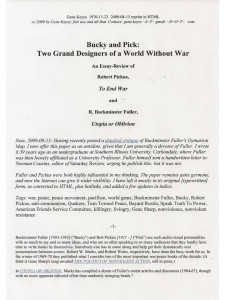
Extract from Conclusion in the Above: I have observed the World Game as a student-participant, and wish it well. I have also observed Bob Pickus's work, as a student-participant in Turn Toward Peace, and wish him well. There are still other alternatives, but whichever road leads us faster into a world without war, what I gain most from Pickus and Fuller is their sense of the Big Picture. No one else can match their indefatigable and comprehensive efforts to see the problem whole, and to steer the world's energy into a grand design of peace.
Insofar as I know, the DoD military Services remain under broad and explicit proscription from accessing the Wikileaks site or the Wikileaks releases in any form. Some of the Service directives are very intimidating, threatening court martials for military members, loss of security clearances, etc., etc. From the broadcast media, it appears that major lockdowns of information will shortly follow. And SPC Bradley Manning, currently confined at Quantico, will probably walk as, I suspect, will Hasan at Fort Hood. MA
Phi Beta Iota: This demonstrates that the National Clandestine Service (NCS) is completely ignorant of what can be known through open sources, and that the Secretary of State is not doing her job of assuring that diplomacy is not micro-tasked into what are clearly clandestine and covert operations support functions absolutely not appropriate to diplomatic status. These people should not have message release authority. The US Government needs a total make-over. First, however, CIA needs a director that is fully capable on day one.
WASHINGTON — The United States has expanded the role of American diplomats in collecting intelligence overseas and at the United Nations, ordering State Department personnel to gather the credit card and frequent-flier numbers, work schedules and other personal information of foreign dignitaries.
Revealed in classified State Department cables, the directives, going back to 2008, appear to blur the traditional boundaries between statesmen and spies.
The cables give a laundry list of instructions for how State Department employees can fulfill the demands of a “National Humint Collection Directive” in specific countries. (“Humint” is spy-world jargon for human intelligence collection.) One cable asks officers overseas to gather information about “office and organizational titles; names, position titles and other information on business cards; numbers of telephones, cellphones, pagers and faxes,” as well as “internet and intranet ‘handles’, internet e-mail addresses, web site identification-URLs; credit card account numbers; frequent-flier account numbers; work schedules, and other relevant biographical information.”
Philip J. Crowley, a State Department spokesman, on Sunday disputed that American diplomats had assumed a new role overseas.
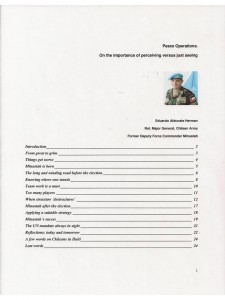
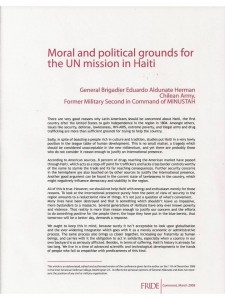
MajGen Eduardo ALDUNATE Herman, Chilean Army (Ret), served as the Deputy Force Commander of the United Nations Force in Haiti (MINUSTAH) in the earliest rounds, and was instrumental in both sponsoring the Joint Military Intelligence Analysis Center (JMAC) concept in its first modern field implementation, but also in evaluating most critically both the lack of useful intelligence from allies relying on secret sources and methods that did not “penetrate” to achieve gangs and neighborhoods; and the astonishing “one size fits all” propensity of the allies to treat every “threat” as one that could be addressed by force.
His contributions are helpful in understanding the more recent failure of allied relief operations in Haiti that again assumed that the use of armed bodies would address the problem, without making provision for real-world ground truth intelligence (CAB 21 Peace Jumpers Plus) or intelligence-driven harmonization of non-governmental assistance (Reverse TIPFID).
The U.S. government’s crackdown on file sharing and counterfeiting has
taken a new and disturbing turn.
Yesterday, we reported that the Department of Homeland Security’s
Immigration and Customs Enforcement office had seized Torrent-Finder.com,
a site that linked to other sites that hosted and shared torrent files of
copyrighted material. The news itself was not too unusual; what struck us
as out of order was that the site had been shut down without the owner
being notified and without a court conviction or, to our knowledge, any
other legal proceedings.
Phi Beta Iota: In addition, we wonder what this has to do with Homeland Security. The incoherence and lack of holistic integrity of US plans, programs, policies, and spending continue to astound.
Phi Beta Iota: More than six minutes–a special with decisive commentary on the government's failure to save the economy, choosing instead to save the financial super-parasites that fund the campaigns of the political parasites. Junk math, junk derivatives, junk politics…. Defense Budget & the Deficit: A Comparison of Reduction Scenarios
Several plans for cutting back the defense budget are floating around Versailles on the Potomac. These have taken the form of unsolicited proposals made to the Simpson-Bowles deficit commission. In this important CP report, Winslow Wheeler, a former staffer on the Senate Budget Committee cuts through the rhetoric surrounding these plans and places their budget scenarios in an apples versus apples comparison. Chuck
In some respects, the anguish exhibited by Ahmed Rashid in the attached report (Rashid is a supporter of the Afghan intervention) suggests that the situation in Afghanistan is beginning to look a little like Vietnam in 1963 before the assassination of Diem. We are faced with an escalating rural guerrilla war, where the guerrillas have the initiative. Our strategy to regain the initiative by winning the hearts and minds of a disaffected predominantly rural population focuses again on controlling urban areas. In a xenophobic society that traditionally picks its leaders and evolves its patterns of governance from the bottom up, we have maneuvered ourselves into a position of outsiders trying to redesign that traditional society from the top down by imposing our choices for leaders and our visions for building “democratic” institutions. Metrics of success in this kind of conflicted effort, naturally, devolve into a reflection of the lack of success in overcoming the insurmountable contradiction.
Inevitably, once again, we focus on our inputs rather that outputs — as can be seen in an increasing reliance on Taliban body counts, the number of Afghan troops we have trained, the size of the “surge,” etc.
Local security forces are corrupt and incompetent, and they are led by rapacious leaders and warlords more interested in feathering their own nests than in building a viable nation. Violence is escalating almost everywhere, yet that violence is itself being being touted as a sign of progress. In short, like Vietnam, the tunnel of Afghanistan is getting longer and darker. Like Vietnam, the political urge to find a neat, clean solution to an intractable problem made worse by the arrogance of our ignorance is increasing.
It is against this backdrop that political pressures are building to dump the corrupt stooge we put into place and replace him with a more pliable corrupt stooge, if only to justify a the war's continuation by providing a patina of progress to an increasingly war-weary Americans on the home front.
So, we face the same question we faced in Vietnam in the fall of 1963: If we dump our stooge because he is becoming uncooperative, who do we put in his place? The only comfortable options for our political leaders are once again the leaders (warlords) of the corrupt and rapacious groups we have promoted. Rashid ends his essay by saying that the US and Karzai will not not part ways. I am not so sure. But whatever the case, the name of the game is to buy time in a guerrilla war where time is on the side of the guerrilla. Like Sir Douglas Haig's decision to pour in reinforcements and continue the battle of the Somme for four months after taking 60,000 casualties the first day, a strategy to buy time by promoting more of the same is a strategy to reinforce failure that will eventually sputter out ineffectually at very high cost. Chuck
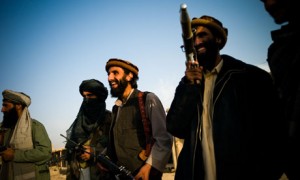
British-based men of Afghan origin are spending months at a time in Afghanistan fighting Nato forces before returning to the UK, the Guardian has learned. They also send money to the Taliban.
A Taliban fighter in Dhani-Ghorri in northern Afghanistan last month told the Guardian he lived most of the time in east London, but came to Afghanistan for three months of the year for combat.
“I work as a minicab driver,” said the man, who has the rank of a mid-level Taliban commander. “I make good money there [in the UK], you know. But these people are my friends and my family and it's my duty to come to fight the jihad with them.”
“There are many people like me in London,” he added. “We collect money for the jihad all year and come and fight if we can.”