
Recommended:
see http://p2pfoundation.net/Crisis_Mapping,
part of http://p2pfoundation.net/Category:Geography
and updated via http://delicious.com/mbauwens/P2P-Mapping

The truth at any cost lowers all other costs — curated by former US spy Robert David Steele.
Recommended:
see http://p2pfoundation.net/Crisis_Mapping,
part of http://p2pfoundation.net/Category:Geography
and updated via http://delicious.com/mbauwens/P2P-Mapping
I spend a lot of time looking at and writing about disruptive business models, and lately I have been talking about a handful that I think are really meaningful that will continue to mature over time and work their way into lots of other industries. 1) Friending. 2) Getting nothing, but paying for it. 3) Getting something, but not paying for it. 4) David beating Goliath. 5) Adding a third party to two party transactions. Visit Blog for full text accompanying each of the above. Phi Beta Iota: At DEMO Spring 2011 the deep persistent theme was the embedding of social media into everything. This is also one of the themes in Jane McGonigal's book, Reality Is Broken–Why Games Make Us Better and How They Can Change the World.
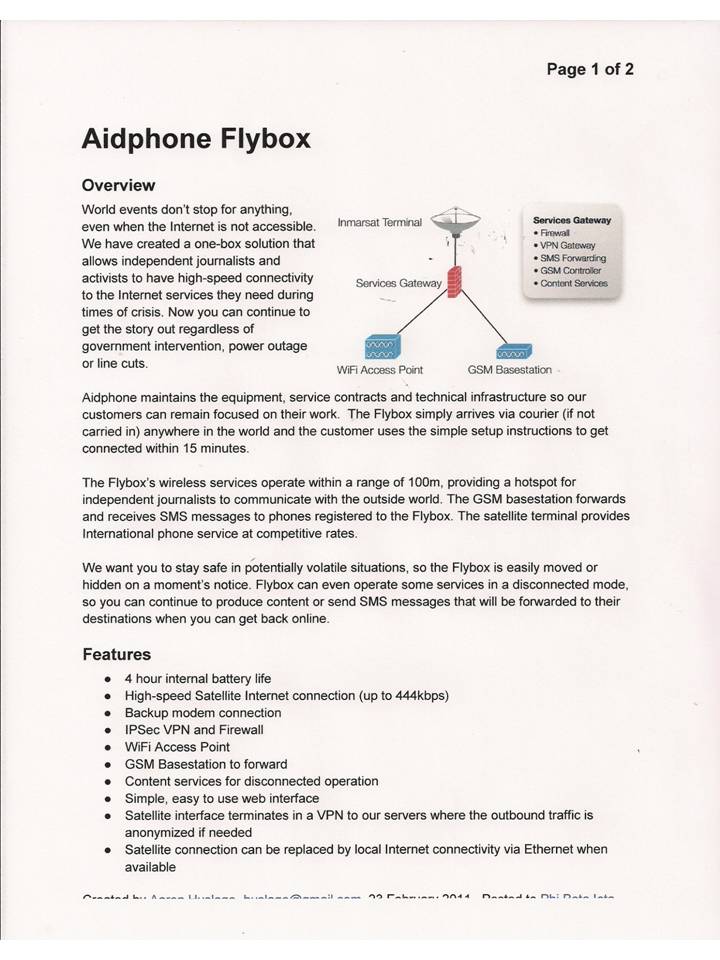
Two Pages Online . . Aaron Huslage . . ContactCon

Interesting, and if the point about Garmin is true, what is the relationship between them and the Air Force? The Air Force has gotten into a lot of areas that include tracking to the individual level (RFI) under the guise of tracking logistics….
Following a navigation system's instructions without driving into a ravine is hard enough as it is — can you even imagine how hard it'd be if you kept losing GPS reception every time you drove within range of an LTE tower? There have been a few anecdotal concerns raised over the last several weeks that LightSquared's proposed LTE network — which would repurpose L-band spectrum formerly used for satellite — is too close to the spectrum used by the Global Positioning System, leading to unintentional jamming when the towers overpower the much weaker GPS signals. Things have gotten a little more interesting, though, now that the US Air Force Space Command has officially piped in. General William Shelton has gone on record saying that “a leading GPS receiver manufacturer just … has concluded that within 3 to 5 miles on the ground and within about 12 miles in the air GPS is jammed by those towers,” calling the situation “unbelievable” and saying he's “hopeful the FCC does the right thing.”
Phi Beta Iota: Electromagnetic conflicts have been a known issue since the 1980's. The Soviets had emission control standards ten times tougher than the US, which had (and continues to have) virtually no standards at all. This is one reason why US forces in Afghanistan are so severely hampered, with drones, aircraft, radars, and various other “systems” all interfering with one another. Elsewhere, notably in England, modern cars come to a complete stop within a couple of kilometers of certain Royal Air Force emitting stations. All of this can be attributed to at least four root problems:
1. An acquisition archipelago (nothing sytematic about it) so stupid and out of control as to defy belief. No standards, no brains, no integrity.
2. Service-centric and mission-centric “preferred contractor” and “proprietary single point solutions” standard operating processes that are deliberately not orchestrated with other services, civilian elements of the government, or other nations.
3. A lack of integrity among senior officers who should know better.
4. A lack of integrity in Congress, where the focus is on collecting the 5% kick-back from delivered programs, not on actually serving the public interest by insuring affordability, interoperability, sustainability, and utility.
See Also:
Continue reading “USA Spectrum Out of Control & Self-Destructing”
 HOW TO COMMUNICATE IF THE U.S. GOVERNMENT SHUTS DOWN THE INTERNET
02-07-2011 8:48 pm – Wallace
Liberty News Online
Scenario: Your government is displeased with the communication going on in your location and pulls the plug on your internet access, most likely by telling the major ISPs to turn off service.
This is what happened in Egypt Jan. 25 prompted by citizen protests, with sources estimating that the Egyptian government cut off approximately 88 percent of the country's internet access. What do you do without internet? Step 1: Stop crying in the corner. Then start taking steps to reconnect with your network. Here’s a list of things you can do to keep the communication flowing.
———————
PREVENTIVE MEASURES:

16+ Projects & Initiatives Building Ad-Hoc Wireless Mesh Networks
For those interested in alternative internet infrastructures, I’ve been assembling a list of projects and initiatives working to build mesh network solutions, as well as communities and resources around this topic. I’ve also posted this on Quora. Please feel free to add any projects I’ve missed. We’re hoping to understand the landscape of this initiative and how these projects & communities can better coordinate their efforts, in preparation for the Contact Conference in NYC this October 20, 2011.
 Projects:
– Open Mesh Project – building a mesh network for Egypt
– Open Source Mesh – group looking at how to build a reliable open source meshing software
– B.A.T.M.A.N. – better approach to mobile ad-hoc networking; routing protocol for multi-hop ad-hoc mesh networks
– Roofnet – 802.11b/g mesh network in development at MIT CSAIL
– GNUnet – framework for secure p2p networking that doesn not use any centralized or otherwise trusted services
– Dot-P2P – a free, decentralized, and open DNS system
– SMesh – seamless wireless mesh network being developed at John Hopkins University
– Coova – open source software access controller for captive portal (UAM) and 802.1X access provisioning
– Babel – a loop-free distance-vector routing protocol for IPv6 & IPv4
– SolarMESH – solar powered IEEE 802.11 wireless LAN mesh network and relaying infrastructure solution
– WING – wireless mesh network for next-generation internet; partially built on Roofnet
– Daihinia – a tool for WiFi; turns a simple ad-hoc network into a multi-hop ad-hoc network
– P2P DNS – building a distributed p2p DNS system
– Digitata.org – develop an inexpensive infrastructure (low bandwidth internet terminals) for basic internet exposure to children in African countries
– Netsukuku – an ad-hoc netowork that uses only WiFi connectivity and a specifically-built adddress system that allows direct communications between machines without resorting to the HTTP protocol
– Tonika – open source organic network project; administration-free platlform for large-scale open-membership (social) networks with robust security, anonymity, resilience and performance guarantees
Phi Beta Iota: We now see a three-phase path for creating the World Brain and Global Game.
Phase One, which we now recognize must be first, is to create the aggregate people power to overcome secular corruption that is the source of all scarcity and conflict, is the distribution of simple free open source cellular access to the five billion poor. This includes both OpenBTS as a new global standard, and solar-powered mesh Internet that cannot be shut down by governments, corporations, or predatory non-governmental organizations.
Phase Two is not smart phones–an overpriced over-complex toy for the one billion rich–but rather the creation of national, regional, and virtual call centers that can both educate the poor one cell call at a time, and harness the distributed intelligence of all humans in all languages all the time–the back office functions and the desktop analytics of this second tier of intermediate processing are critical to machine speed information sharing and sense making.
Phase Three must be the application of the Strategic Analytic Model in conjunction with the establishment of “true cost” information for every product and service, and the coincident establishment of local water, power, and currency options that begin to dismantle the dysfunctional grid that wastes half of what it moves in the movement.
