
Review (Retired Reader): Solving the People Puzzle — Cultural Intelligence and Special Operations Forces

4 Star, Asymmetric, Cyber, Hacking, Odd War, Best Practices in Management, Culture, Research, Force Structure (Military), Information Operations, Intelligence (Government/Secret)
Amazon Page

Dr. Emily Spencer (Author)

4.0 out of 5 stars Intelligence Support for Speical Operations Forces,August 15, 2011

This book provides an excellent description of the personal, organization and mission of what are called Special Operations Forces (SOF) and their relationship to conventional forces. More importantly it introduces the concept of `cultural intelligence' as the precise type of intelligence information that SOF unit need to successfully execute their missions.

Cultural Intelligence which Spencer refers to as “CQ” (to avoid confusion with Counter Intelligence (CI)) is a combination of ethnography, sociology, and psychology. As Spencer makes clear successful counter-insurgency operations (COIN) and counter-terrorism (CT) programs depend on understanding the cultural environment in which they are conducted. That is it is necessary to understand the underlying social structures, beliefs, and motivations of the populations constitute what she refers to as the Contemporary Operating Environment within which SOF missions are conducted. This important insight is one of those concepts which appear obvious, but only have somebody has developed it.

Continue reading “Review (Retired Reader): Solving the People Puzzle — Cultural Intelligence and Special Operations Forces”

Review: International Intelligence Cooperation and Accountability

4 Star, Intelligence (Government/Secret)
Amazon Page

Hans Born (Editor), Ian Leigh (Editor), Aidan Wills (Editor)

4.0 out of 5 stars Four for Content, Zero for Price,August 16, 2011
There are some good contributions in this book, and it is certainly recommended for institutional purchase, but the price is utterly outrageous and completely unacceptable for the individual professional, scholar, or practitioner interest in learning from these authors. The book should be offered immediately at no more than $35.00.

The book is focused on governments. Worse, it is focused on governments exchanging secret or sensitive information with one another.  While there is one extraordinary chapter on intelligence in international operations, the book as a whole is government centric a decade (or two) after the rest of us began routing around government. The new meme is M4IS2: Multinational, Multiagency, Multidisciplinary, Multidomain Information-Sharing and Sense-Making, and the eight tribes that do M4IS2 (when properly led, which is almost never) are academic, civil society, commerce, government, law enforcement, media, military, and non-government/non-profit.

The general concept of the book, that a frame of reference for accountability is needed, is a good one, but overlooks the obvious fact that 80-90% of information sharing must be multinational, multiagency, and not secret–unclassified open sources and methods are the vast majority of what needs to be shared.  In that context, I would suggest that all governments fail the most basic accountability test: they persist in spending taxpayer money on secret intelligence that provides, “at best” 4-10% of what the full range of government needs for decision-support are.  It's time we start holding secret intelligence accountable for being largely worthless in the overall scheme of human affairs, and in relation to the ten high-level threats identified and prioritized by the United Nations High Level Panel on Threats, Challenges, and Change.

See Also: [Amazon insert a link remains broken for books]

Continue reading “Review: International Intelligence Cooperation and Accountability”

Worth a Look: Books on Reinventing Education Updated July 2012

04 Education, Education (General), Education (Universities), Worth A Look

Phi Beta Iota:  There are other books but these are the ones that have caught our attention.

Now You See It, by Cathy N. Davidson

A New Culture of Learning by Douglas Thomas and John Seely Brown

21st Century Skills by James Bellanca and Ron Brandt

Making Learning Whole: How Seven Principles of Teaching Can Transform Education David N. Perkins

Reinventing Higher Education: The Promise of Innovation by Ben Wildavsky, Andrew Kelly, Kevin Carey

Rethinking Education in the Age of Technology by Allan Collins and Richard Halverson

Teaching Digital Natives by Marc Prensky

The Leader's Guide to 21st Century Education: 7 Steps for Schools and Districts by Ken Kay and Valerie Greenhill

The Innovative University by Clayton Christensen and Henry Eyring

The Open Source Everything Manifesto by Robert Steele

The Seven Futures of American Education: Improving Learning & Teaching in a Screen-Captured World by John Sener

The World Is Open: How Web Technology Is Revolutionizing Education by Curtis J. Bonk

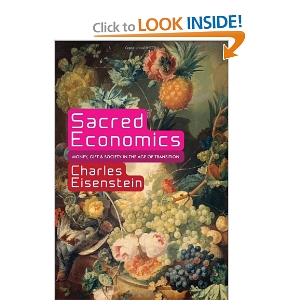
Review: Sacred Economics – Money, Gift, and Society in the Age of Transition

6 Star Top 10%, America (Founders, Current Situation), Capitalism (Good & Bad), Change & Innovation, Complexity & Resilience, Consciousness & Social IQ, Culture, Research, Democracy, Economics, Environment (Solutions), Intelligence (Collective & Quantum), Intelligence (Public), Intelligence (Wealth of Networks), Peace, Poverty, & Middle Class, Politics, Power (Pathologies & Utilization), Stabilization & Reconstruction, Survival & Sustainment, Values, Ethics, Sustainable Evolution, Voices Lost (Indigenous, Gender, Poor, Marginalized), Water, Energy, Oil, Scarcity
Amazon Page

Charles Eisenstein

5.0 out of 5 stars Beyond 5 Stars, an Integrative Pioneering Work,August 13, 2011


Sacred Economics is the second book in the new Evolver Editions imprint, following Jose Arguelles Manifesto for the Noosphere. Other books in the first season include What Comes After Money, The Secret Tradition of the Soul, The Four Global Truths, The Electric Jesus, Star Sister, and Nothing and Everything.

I read a lot, and the one word that really describes this book is “integrative.” The author describes, in three parts, what is wrong with what he calls the “economics of separation,” today's money and financial network economy that lacks soul or spirit; its alternative, the “economics of reunion” in which all forms of transaction have memories, gifts and reciprocal gifts and localized forms of exchange rule, and economics is fully integrated with society to produce social and cultural dividends. The third and last part closes the circle with a hundred-page discourse (double-spaced large print, this is not a hard book to read) on how to live within the new economy in which gifting, community, and beauty are integrated.

Throughout the book the author evolves his core point: money is “hard” and nurtures external diseconomies, including grave destruction of cultural and social intangible value-gradually the author builds up to his conclusion, that beauty is a tangible value, that relatedness is a tangible value, and that in the past century or two we have stripped so much value from what it means to be human as to have become less than human, less than we can be.
Continue reading “Review: Sacred Economics – Money, Gift, and Society in the Age of Transition”

Review: Keeping Watch – Monitoring Technology and Innovation in UN Peace Operations

5 Star, Information Operations, Information Technology, Intelligence (Government/Secret), Intelligence (Public), Peace, Poverty, & Middle Class, Stabilization & Reconstruction, United Nations & NGOs, War & Face of Battle
Amazon Page

Walter Dorn

5.0 out of 5 stars Phenomenal Contribution to UN and to Literature,August 13, 2011

Professor Walter Dorn is the de facto dean of the small number of scholars who study the specific topic of peacekeeping intelligence, or intelligence support to United Nations (UN) operations. Since his pioneering early studies of UN successes in the Congo in the 1960's to his more recent articles on the introduction of the Joint Military Analysis Centre (JMAC) in Haiti, he is both the closest academic observer, and the most well-written in this area.

I read this book with great interest. It is the first comprehensive look at technologies that are directly applicable to the fulfillment of UN mandates, the design and security of multinational forces, the effective management of tactical campaigns, and of course being technical, it is the first and last word on surveillance technologies vital to peacekeeping and peace enforcement across vast regions.

Pending the “Inside the Book” feature being available for this just published book, here is the table of contents from my own copy.

1 Introduction
2 The Evolution of Peacekeeping
3 Monitoring: The Constant Need
4 Survey of Technologies
5 Aerial Surveillance: Eye in the Sky
6 Traditional Peacekeeping: Cases
7 Modern Multidimensional Peacekeeping: Cases
8 Current UN Standards: Starting from Near Zero
9 Challenges and Problems
10 Recommendations
11 Conclusions

I recently attending a conference on the history and future of UN Air Power, and in both my own presentations and those of others, “Peace from Above” was a recurring theme. The importance of assuring that UN elements have the best possible human and technical surveillance technologies cannot be understated–for modest investments–including Unmanned Aerial Vehicles–the UN can save lives, money, and time–on the latter point, Colin Gray, in Modern Strategy, observes that time is the one strategic variable that can neither be purchased nor replaced.

A word on pricing: as those who follow my reviews know, I will occasionally single out extraordinary books that are so grotesquely priced as to dishonor the entire publishing world. This book is perfectly priced, close to my standard of page count with one decimal. I salute the UN Press for bringing this book into the world. It should become a standard volume, not only for UN training classes, but for all war colleges as well as for commercial security training and operations.

See Also:

Peacekeeping Intelligence: Emerging Concepts for the Future

Vote on Review

Review (Guest): Deep Green Resistance – Strategy to Save the Planet

5 Star, America (Founders, Current Situation), Asymmetric, Cyber, Hacking, Odd War, Complexity & Resilience, Culture, Research, Economics, Education (General), Environment (Solutions), Intelligence (Public), Justice (Failure, Reform), Nature, Diet, Memetics, Design, Peace, Poverty, & Middle Class, Philosophy, Politics, Power (Pathologies & Utilization), Priorities, Secession & Nullification, Survival & Sustainment, Values, Ethics, Sustainable Evolution
Amazon Page

Derrick Jensen (Author), Aric McBay (Author), Lierre Keith (Author)

About the Authors

Activist, philosopher, teacher, and leading voice of uncompromising dissent, DERRICK JENSEN holds degrees in creative writing and mineral engineering physics. In 2008, he was named one of the Utne Reader’s “50 Visionaries Who Are Changing Your World,” and in 2006 he was named Press Action’s Person of the Year for his work on the book Endgame. He lives in California.

Writer, activist, and small-scale organic farmer ARIC MCBAY works to share information about community sufficiency and off-the-grid skills. He is the author of Peak Oil Survival: Preparation for Life after Gridcrash and creator of “In the Wake: A Collective Manual-in-progress for Outliving Civilization.”

LIERRE KEITH is a writer, small farmer, and radical feminist activist. She is the author of two novels, as well The Vegetarian Myth: Food, Justice, and Sustainability, which has been called “the most important ecological book of this generation.” She's also been arrested six times. She lives in Humboldt County, CA.

5.0 out of 5 stars finally, a book to meet the scale of our predicament,June 7, 2011
By  Owen Lloyd (Eugene, OR) – See all my reviews

What is different about Deep Green Resistance is that it is the first book that offers a solution that is scaled to the size of our predicament.

Continue reading “Review (Guest): Deep Green Resistance – Strategy to Save the Planet”

Review: Reflections on Higher Education

5 Star, Best Practices in Management, Change & Innovation, Education (Universities), Leadership
Amazon Page

Stephen Joel Trachtenberg

5.0 out of 5 stars Relevant Today–Perhaps Still Not Appreciated Today, August 10, 2011

There is nothing in this book that I could disagree with, which instantly marks it as iconoclastic rather than traditional or elitist. This long-serving president spent close to three decades managing two universities, the longest The George Washington University which can legitimately lay claim to being intended by Founding Father George Washington to be a “national” university.

Prior books against which I compare this one include

The Uses of the University by Clark Kerr
Universities in the Marketplace by Derek Bok

The book consists of three parts that meld 11 speeches and 2 articles from the 1998-2001 timeframe. This particular book was distributed by the GW Board of Trustees to parents of the incoming GW Class of 2006.

QUOTE (19): “The entire planet is in the process of turning itself into an educational institution, the faculty of which consists of the entire human species.”

QUOTE (21): “The problem boils down to this: How do you get the *universe* of all things into the classroom?”
Continue reading “Review: Reflections on Higher Education”

noble gold