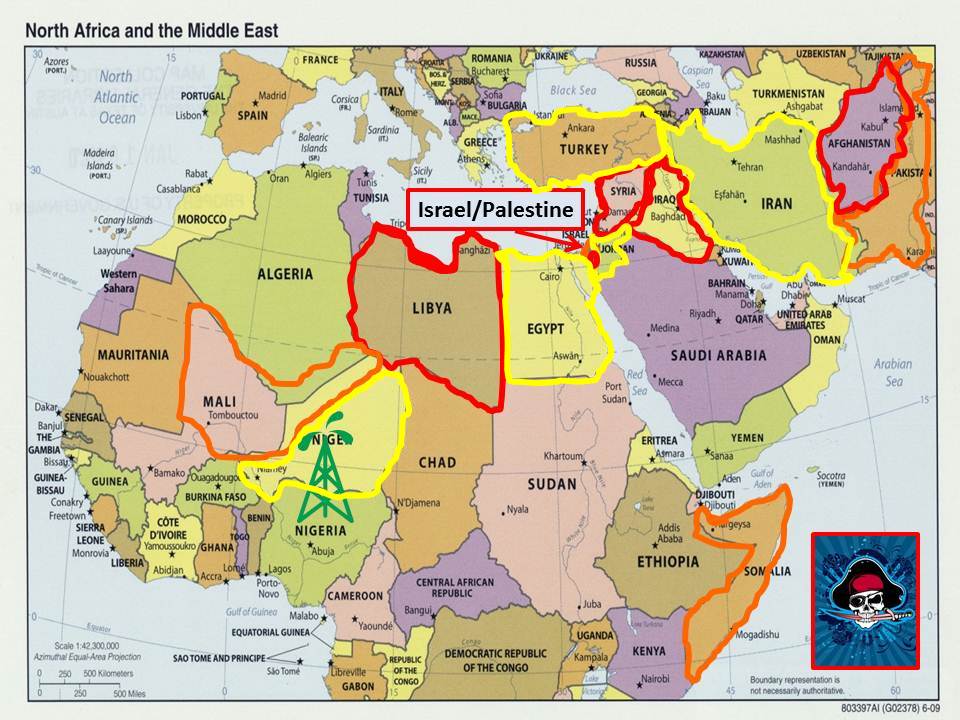
Citation: “Graphic: Updated US Swath of Destruction from Afghanistan to Niger,” Phi Beta Iota the Public Intelligence Blog, 31 May 2013.

The truth at any cost lowers all other costs — curated by former US spy Robert David Steele.
Citation: “Graphic: Updated US Swath of Destruction from Afghanistan to Niger,” Phi Beta Iota the Public Intelligence Blog, 31 May 2013.

Huh?
Thousands call on Turkey’s leader to quit
Protests swept Turkey on Friday and deep into Saturday morning as thousands of protesters called on prime minister Recep Tayyip Erdogan to resign.
What began as a demonstration against a shopping mall project turned into one of the biggest challenges in recent years to Mr Erdogan’s rule, as whole districts of Istanbul resounded to the banging of pots and pans into the early hours of the morning. Drivers hit car horns in support of the demonstrators.
. . . . . . . .
However, the size of the protests, and the speed with which they grew, appeared to be a reaction not just to the police crackdown on the initial demonstration in Gezi Park but to Mr Erdogan’s general approach to government.
“Gezi park is the new Tahrir of the region,” said Koray Caliskan, a Turkish columnist, in reference to the epicentre of Egypt’s 2011 revolution.

The article is long and certainly worth reading, with many links. Below are two comments that capture the hacker view of this initiative.
This Pentagon Project Makes Cyberwar as Easy as Angry Birds
WIRED Magazine, 28 May 2014
EXTRACT (Comments):
BillStewart2012 ErikasBulbasaur • 3 days ago
Yes, it's the camo-colored-hat skript k1dd13 tool. And is it going to check whether it has the required warrants or legal authorization before launching an attack on a target, or just fire away? I've got some guesses..
. . . . . . . .

My Interview with Electrical-Engineer and Tesla-Technologist Thomas Imlauer on the topics of Scalar-Wave Theory, Zero-Point Technology, and Rethinking the Natural Order. Online, Thomas operates under the pseudonym TheOldScientist. On both his personal website and YouTube he has posted numerous in-depth videos cataloguing his innovative work/theories. Thomas is also a contemporary/acquaintance of other visionaries in the field including Eric Dollard, Konstantin Meyl, and Jean-Louis Naudin. Reference the Abstracted Outline below for effective skimming:
0.min-5.min: Experience as industrial designer/electrician/IT-
5.min-17.min: Tesla Magnifying Transmitter = musical instrument; Longitudinal-Wave dynamics; Transverse-Waves byproduct of L-Waves; Maxwell’s original formulations; Energy flow outside conductors; Meyl’s Potential-Vortex Theory; Super-Luminal Propagation; L-Wave penetration of Faraday-Cages; Dielectric/Near-Field Effects; Verifiable proof of L-Waves; L-Waves in Biological Systems; Zero-Point Field Connectivity; Electro-Smog
17.min-25.min: Asymmetric Systems; Symmetry as an Illusion; Gold-Mean/Ratio; Perception and Aesthetic Beauty in Nature; Sacred Geometry; Human Body as a Harmonic-Resonant Structure; Kepler’s Mysticism; Reconnecting w/ Nature; Paranormal = Normal; Quantum Fluctuations; Casmir Force; Virtual Fields/Pair Production; ZPF = God-Field/Ether; Big-Bang Fallacy; Irreconcilables of BB-Theory; Non-mystical Nomenclature; Electric-Universe Paradigm
25.min-36.min: Ether History; Harold Aspden’s Liquid-Crystal Aether; Resonance and Electromagnetism; Tapping Zero-Point Energy through Resonance; Sympathetic Resonance and Quantum Fluctuations/Virtual Photons; Rethinking Over-Unity; Close-System Myth; Universe = Open-System; Backwardness of Current Energy Systems; COP > 1.0 Systems in Nature
36.min-44.min: LENR/Cold-Fusion; Hot-Fusion Fallacy; Sun Not a Hot-Fusion Reactor; Fallacy of Particle-Accelerators/
Moises Naim
4.0 out of 5 stars What kind of power, for whom, and for what?, May 31, 2013
By Tom Atlee (Eugene, OR USA) – See all my reviews
Moises Naim's new book THE END OF POWER should properly be called “The Decay of Power”. His thesis is that while it is becoming easier to get power, it is also becoming harder to use it to control others and harder to keep it once you have it.
Naim suggests that globalization, economic growth, a growing global middle class, the spread of democracy, and rapidly expanding telecommunications technologies have changed our world. Together these developments have created a fluid and unpredictable environment which has unsettled the traditional dominions of power.
Three revolutions, he says, “make it more difficult to set up and defend the barriers to power that keep rivals at bay.” He details these revolutions as follows:
* “the More revolution, which is characterized by increases in everything from the number of countries to population size, standards of living, literacy rates, and quantity of products on the market”;
* “the Mobility revolution, which has set people, goods, money, ideas, and values moving at hitherto unimagined rates toward every corner of the planet”; and
* “the Mentality revolution, which reflects the major changes in mindsets, expectations, and aspirations that have accompanied these shifts.”
In other words, says Naim, there is too much going on, too much moving around, too many changing demands and perspectives – and at any time someone new can show up and effectively challenge or undermine your power. In addition, “when people are more numerous and living fuller lives, they become more difficult to regiment and control.” Among other things, such people value transparency, human rights, and fairness to women and minorities – and they share a sense that “things do not need to be as they have always been – that there is always…a better way” and that they need not “take any distribution of power for granted.”
All this is happening at the very time when large hierarchical institutions are losing their “economies of scale” and becoming increasingly difficult to manage, while smaller, more flexible organizations and networks are proving increasingly successful.
Naim provides compelling evidence that power is decaying in all these ways in all fields – from business, governance, geopolitics, and military affairs to religion, philanthropy, labor, and journalism.

PDF: ARSTRAT_IO_Newsletter_v13_no_07
Articles in this issue are:
1. Social Banditry and the Public Persona of Joaquín “El Chapo” Guzmán
2. India Sets Up Social Media Monitoring Lab
3. Hacking the News: Information Warfare in the Age of Twitter
4. Information Operations Is Just another Media Format Vying For the Eyes of
the Audience
5. China’s Cyberspies Outwit Model for Bond’s Q
6. Getting Inside the Head of Italian PSYOPS: Interview with Colonel Marco
Stoccuto
7. Understanding Groupthink
8. Are Military Hackers Targeting Tibetan Activists?
9. DOD Forming Information Operations Executive Steering Group
10. Pentagon: China Views Information Warfare as Key to Countering U.S.
Pacific Forces
11. US Directly Blames China’s Military for Cyberattacks
12. Pentagon Warns North Korea Could Become a Hacker Haven
13. Loose Lips: Candid Camera Club Alerts N. Korea of USS Nimitz's Arrival
14. Why Two Domains Are Better Than One
15. The Problem with Crowdsourcing Intelligence in Syria
16. US Government Becomes ‘Biggest Buyer' Of Malware
17. How Twitter Is Messing With Al-Qaeda's Careful PR Machine
18. Chinese University Lab Linked To PLA Cyber Attacks
19. China Conducts Test of New Anti-Satellite Missile
20. New Payload Brings Jamming Capability To An Army UAS For The First Time
21. Communication Systems Subject To Monitoring, OPSEC Reminders
22. US Could Use Cyberattack on Syrian Air Defenses
23. GAO: Military Propaganda Efforts Flawed
24. ¡Dios Mío! Pentagon’s Latest Weapon in Colombian Drug War? Soap Operas
25. Tracking Cyberterrorists
26. US Ill-Prepared For EMP Attack
27. Waging the Cyber War in Syria
28. Globalization Creates a New Worry: Enemy Convergence
Presented to NSA in 2007, printed in The Green Bag
EXTRACT:
Now that I have told you why lawyers are some of the finestanalysts in the world, let me get closer to the core value of good lawyering and the rule of law. I’d like to call this part: “Intelligence Under the Law – The Value of No.”
It can be very, very hard to be a conscientious attorney workingin the intelligence community, particularly for those whose worktouches on counter-terrorism and war-fighting. It is not because wedon’t work with great people. We do. We work with people whohave dedicated their lives to protecting this great country and all itstands for.It can be hard, instead, because the stakes couldn’t be higher.Hard because we are likely to hear the words: “If we don’t do this,people will die.” You can all supply your own this: “If we don’t col-lect this type of information,” or “If we don’t use this technique,” or“If we don’t extend this authority.” It is extraordinarily difficult to be the attorney standing in front of the freight train that is the needfor “this.” Because we don’t want people to die. In fact, we havechosen to devote our lives to institutions whose sworn duty it is toprevent that, whose sworn duty it is to protect our country, ourfellow Americans.
But it’s not that simple, although during crises, at times of greatthreat, it can surely seem that simple, certainly to the policy maker and operator, and even to the lawyer. We lawyers know – orshould know – better than anyone, that it is not that simple.At the outset, we know that we are a nation of laws, not men.We have chosen a profession that internalizes that truth. We knowthat the rule of law sets this nation apart and is its foundation. Wealso know that we took an oath to support the constitution of theUnited States. We know that there may be agonizing collisions be-tween our duty to protect and our duty to that constitution and therule of law.
