Berto Jongman: The Nation on “You Are A Guinea Pig” for the Largest Most Complex Testing of Toxic Materials in History. There is no opt-out option.

03 Economy, 07 Health, Commerce, Corruption, Earth Intelligence, Government, Law Enforcement
0Shares
Berto Jongman
Berto Jongman

You Are a Guinea Pig

David Rosner and Gerald Markowitz

The Nation,

A hidden epidemic is poisoning America. The toxins are in the air we breathe and the water we drink, in the walls of our homes and the furniture within them. We can’t escape it in our cars. It’s in cities and suburbs. It afflicts rich and poor, young and old. And there’s a reason why you’ve never read about it in the newspaper or seen a report on the nightly news: it has no name—and no antidote.

The culprit behind this silent killer is lead. And vinyl. And formaldehyde. And asbestos. And Bisphenol A. And polychlorinated biphenyls (PCBs). And thousands more innovations brought to us by the industries that once promised “better living through chemistry,” but instead produced a toxic stew that has made every American a guinea pig and has turned the United States into one grand unnatural experiment.

Today, we are all unwitting subjects in the largest set of drug trials ever. Without our knowledge or consent, we are testing thousands of suspected toxic chemicals and compounds, as well as new substances whose safety is largely unproven and whose effects on human beings are all but unknown. The Centers for Disease Control (CDC) itself has begun monitoring our bodies for 151 potentially dangerous chemicals, detailing the variety of pollutants we store in our bones, muscle, blood and fat. None of the companies introducing these new chemicals has even bothered to tell us we’re part of their experiment. None of them has asked us to sign consent forms or explained that they have little idea what the long-term side effects of the chemicals they’ve put in our environment—and so our bodies—could be. Nor do they have any clue as to what the synergistic effects of combining so many novel chemicals inside a human body in unknown quantities might produce.
Read full article.

Berto Jongman: Computational Intelligence (aka Artificial Intelligence and/or Intelligent Systems)

Information Technology, Worth A Look
0Shares
Berto Jongman
Berto Jongman

2013  Computational Intelligence: A Methodological Introduction

2012 Computational Intelligence and Decision Making: Trends and Applications (Intelligent Systems, Control and Automation: Science and Engineering)

2012 Computational Intelligence and Its Applications: Evolutionary Computation, Fuzzy Logic, Neural Network and Support Vector Machine Techniques

2012 Computational Intelligence for Privacy and Security (Studies in Computational Intelligence)

2012 Modern Advances in Intelligent Systems and Tools (Studies in Computational Intelligence)


Berto Jongman: YouTube (7:20) Intuitive Intelligence

Cultural Intelligence, YouTube
0Shares
Berto Jongman
Berto Jongman

The Heart's Intuitive Intelligence: A path to personal, social and global coherence

Published on Apr 22, 2013

The Spiritual Heart — is in a way a little like a smart phone, invisibly connecting us to a large network of information. It is through an unseen energy that the heart emits that humans are profoundly connected to all living things. The energy of the heart literally links us to each other. Every person's heart contributes to a ‘collective field environment.' This short video explains the importance of this connection and how we each add to this collective energy field. The energetic field of the heart even connects us with the earth itself.

The Institute of HeartMath (http://www.heartmath.org) is helping provide a more comprehensive picture of this connection between all living things through a special science-based project called the Global Coherence Initiative (http:///www.glcoherence.org.) They hope to help explain the mysteries of this connection between people and the earth…and even the sun.

Scientists at the Institute of HeartMath (IHM) have already conducted extensive research on the power of heart, the heart/brain connection, heart intelligence and practical intuition.

Whether personal relationships, social connections, or even the global community – we are all connected through a field of electromagnetic energy. Increasing individual awareness of what we bring to this field environment could be the key to creating a sustainable future, a future that we can be proud to have helped create. Learn more about this research, http://www.heartmath.org/heart-intell…, scroll to bottom of the page.

Dan Zak: Prophets of Oak Ridge – Activists as Terrorists — Conscience vs. Courts

Cultural Intelligence, Peace Intelligence
0Shares
Dan Zak
Dan Zak

This is the story of two competing worldviews, of conscience vs. court, of fantasy vs. reality, of history vs. the future.

The Prophets of Oak Ridge

Dan Zak

Washington Post, 30 April 2013

Click on Image to Enlarge

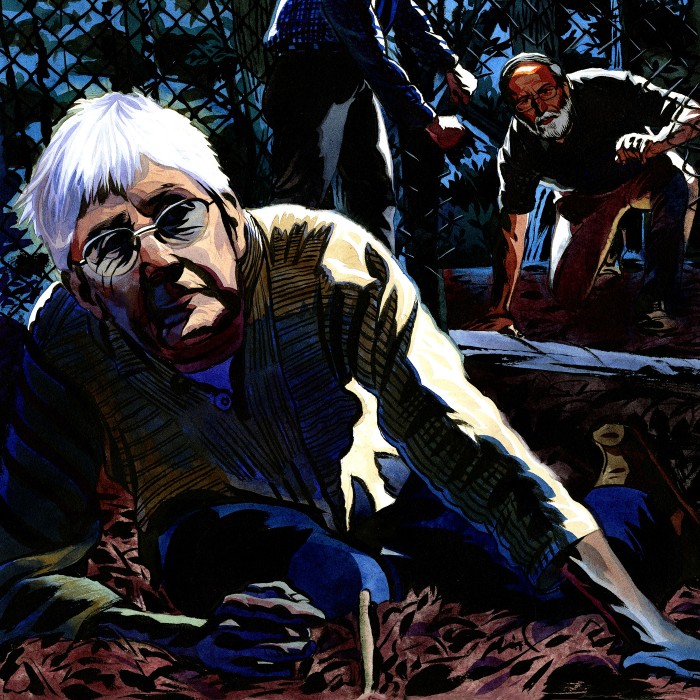
Last summer, in the dead of night, three peace activists penetrated the exterior of Y-12 in Tennessee, supposedly one of the most secure nuclear-weapons facilities in the United States. A drifter, an 82-year-old nun and a house painter. They face trial next week on charges that fall under the sabotage section of the U.S. criminal code. And if they had been terrorists armed with explosives, intent on mass destruction? That nightmare scenario underlies the government’s response to the intrusion. This is the story of two competing worldviews, of conscience vs. court, of fantasy vs. reality, of history vs. the future.

“It’s idolatry, putting trust in weapons. And weapons are made like gods. … Weapons are always false gods because they make money. It’s profiteering.”Sister Megan Rice

Read full article with graphics.

Review (Guest): Surveillance or Security?: The Risks Posed by New Wiretapping Technologies

5 Star, America (Founders, Current Situation), Censorship & Denial of Access, Communications, Crime (Corporate), Crime (Government), Information Operations, Information Society, Information Technology, Intelligence (Government/Secret), Intelligence (Public), Justice (Failure, Reform), Power (Pathologies & Utilization), Public Administration, Secrecy & Politics of Secrecy, Security (Including Immigration), Values, Ethics, Sustainable Evolution
0Shares
Amazon Page
Amazon Page

Susan Landau

5.0 out of 5 stars Definitive text on the topic July 8, 2011

Ben Rothke

Surveillance or Security?: The Risks Posed by New Wiretapping Technologies is a hard book to categorize. It is not about security, but it deals extensively with it. It is not a law book, but legal topics are pervasive throughout the book. It is not a telecommunications book, but extensively details telco issues. Ultimately, the book is a most important overview of security and privacy and the nature of surveillance in current times.

Surveillance or Security? is one of the most pragmatic books on the topic is that the author never once uses the term Big Brother. Far too many books on privacy and surveillance are filled with hysteria and hyperbole and the threat of an Orwellian society. This book sticks to the raw facts and details the current state, that of insecure and porous networks around a surveillance society.

In this densely packed work, Susan Landau, a fellow at the Radcliffe Institute for Advanced Study at Harvard University details the myriad layers around surveillance, national security, information security and privacy. Landau writes that her concern is not about legally authorized law enforcement and nationally security wiretapping; rather about the security risks of building surveillance into communications infrastructures.

Jean Lievins: Africa’s Great Green Wall

03 Environmental Degradation
0Shares
Jean Lievens
Jean Lievens

The Great Green Wall Of Africa — A 4,000 Mile Defense Against Climate Change

One of the most unique large-scale international climate change projects is underway in Africa. A 4,000 mile “wall of trees” is being constructed across the east-west axis of the continent as a defense against rapid, expanding desertification of the Sahara.

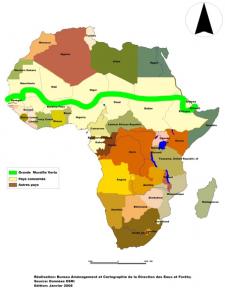
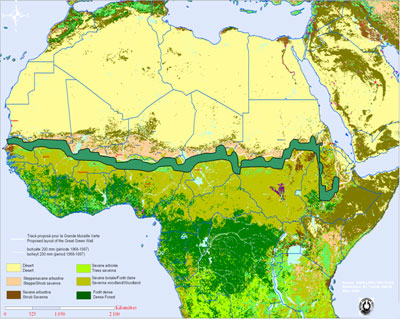
11 nations — Mauritania, Senegal, Mali, Burkina Faso, Niger, Nigeria, Chad, Sudan, Ethiopia, Eritrea, and Djibouti — have agreed to participate in The Great Green Wall initiative (GGW), planting a contiguous “wall of trees” stretching 4,300 miles long and 9 miles wide, across the entire width of the African continent from Djibouti in the east to Senegal on the west.

africa green 1The project was approved by the African Union in 2007, under the umbrella of the  Community of the Sahel-Saharan States (CEN-SAD). In 2008, the first trees were planted along the wall’s path.

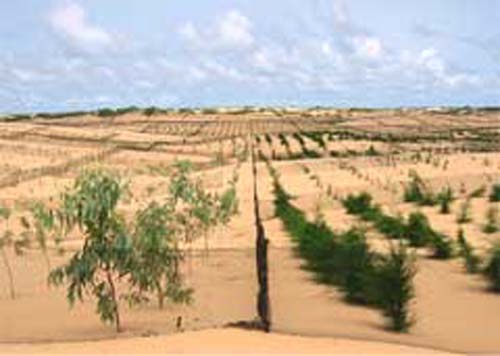
Progress (and reporting) currently varies from nation to nation; the process is still in its infancy and will take several years to complete. Nevertheless, the project is already showing some success: a World Food Program (WFP) report from Senegal details how villages in Widou Thiengoli are now harvesting fresh fruits and vegetables from the dry desert sands, a by-product of the Wall initiative. Some 50,000 acres of trees have already been planted in Senegal, according to press reports.

Desertification has emerged as a “major planetary threat” with particularly daunting challenges for Africa. Climate change has led to prolonged periods of drought and other symptoms of desertification, which are being experienced by a growing number of countries. The UN Food and Agriculture Organization (FAO) reports that two-thirds of the African continent is classified as desert or dry lands. Rainy seasons and other weather patterns — long consistent – are now changing across the region. In Senegal, for example, the rainy season now begins in September — it traditionally started in July.

Click on Image to Enlarge

The UN estimates that two-thirds of Africa’s arable land could be lost by 2025 if this trend continues.

According to the Great Green Wall website, the goal is to help mitigate the environmental effects of climate change, including the expansion of desertification.   The trees will act as a barrier against desert winds, help to hold moisture in the air and soil, reduce erosion, enhance biodiversity, provide new grazing land and be a source of vegetation. The project is also recognized for the role it will play in local agriculture and employment.  

“People used to go to towns to seek paid work during the lean season, but since the project started, that has changed,” says Papa Sarr, Technical Director of the Senegal National Agency of the Great Green Wall.

Click on Image to Enlarge

The Great Green Wall initiative is supported by the UN Environment Programme (UNEP), the World Food Programme, the UN Convention to Combat Desertification (UNCCD) and the UN-backed Global Environment Facility (GEF) – the largest public funder of UN environmental projects.  

The Great Green Wall has received a total of $1.8 billion dollars from the World Bank and another $108 million from the Global Environment Facility. 
Ulrich Apel, a forestry expert with GEF, said the program could serve as a model for similar projects around the world in areas, such as central Asia, which face similar challenges in adapting to a rapidly changing climate.    

The Green Wall, said Apel, “is off to a promising start.” Standing near a row of waist-high trees in Widou village – one of Senegal’s Green Wall locations — he said: ”In 10 to 15 years this will be a forest. The trees will be big and this region will be completely transformed.”

John Robb: #Bitcoin Many Global Uses

Money
0Shares
John Robb
John Robb

#Bitcoin as a Publishing System: From Wikileaks to Pedophile Links

Bitcoin is an open source software system.  That means nobody owns it.

Up until now, it's been used as a decentralized currency system.

Bitcoin makes it possible to make non-reversible decentralized transactions on a global scale.

It's visibility as a currency has been good for bitcoin.  Speculation has driven up the price of bitcoin to a market cap over $1 billion.

That's attracted lots of use and investment activity (mostly in mining), which has grown bitcoin much faster than it would have grown otherwise.

However, one thing that most people don't understand:  bitcoin is more than just a currency.

NOTE: Actually, it's more of a fungible share of ownership in the system than a pure currency, as you will see.

Firstly, it's the first system to deploy that solves the distributed consensus problem in computing (a hard problem).   That means a clone of the system has many potential uses.  For example, it could be used a global reputation system (as in, everyone on the system says this person has the good reputation they claim).

It also some uses in its current form that most people don't know.  For example, it has a limited capability to publish information.  It was built into the system by the original designer, who left some notes on what the system was originally designed to do.

That publishing capability was put into use a couple of days ago when someone publish 2.5 MB of Wikileaks cables in the bitcoin blockchain.  It cost a bit of money (about $500) to accomplish that, but the information that was published is now going to be public forever.

Of course, it didn't take long for someone to up the ante.  Someone decided to publish links to pedophile links in the blockchain.

It's going to be interesting to see how Bitcoin responds to this.