
Reference: Earth System Science for Global Sustainability–Grand Challenges

Analysis, Augmented Reality, Budgets & Funding, Communities of Practice, Earth Intelligence, Ethics, Geospatial, History, info-graphics/data-visualization, InfoOps (IO), Intelligence (government), International Aid, IO Sense-Making, Key Players, Maps, Methods & Process, microfinancing, Mobile, Open Government, Policies, Politics of Science & Science of Politics, Power Behind-the-Scenes/Special Interests, Real Time, Secrecy & Politics of Secrecy, Standards, Strategy, Technologies, Threats, Tools, Waste (materials, food, etc)
0Shares
Main Document (24 Page PDF)

The International Council for Science (ICSU) is spearheading a consultative Visioning Process, in cooperation with the International Social Science Council (ISSC), to explore options and propose implementation steps for a holistic strategy on Earth system research. Five Grand Challenges were identified during step 1 of the process. If addressed in the next decade, these Grand Challenges will deliver knowledge to enable sustainable development, poverty eradication, and environmental protection in the face of global change.

The details of the Grand Challenges are contained in the document ‘Earth System Science for Global Sustainability: The Grand Challenges’, representing input from many individuals and institutions.
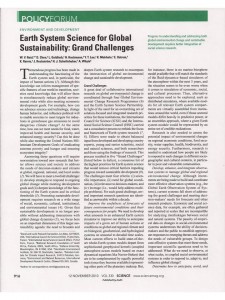
Science Article (2 Page PDF)

INTERNATIONAL COUNCIL FOR SCIENCE – PRESS RELEASE

Thursday 11 November 2010

Scientific Grand Challenges identified to address global sustainability

Paris, France—The international scientific community has identified five Grand Challenges that, if addressed in the next decade, will deliver knowledge to enable sustainable development, poverty eradication, and environmental protection in the face of global change. The Grand Challenges for Earth system science, published today, are the result of broad consultation as part of a visioning process spearheaded by the International Council for Science (ICSU) in cooperation with the International Social Science Council (ISSC).

The consultation highlighted the need for research that integrates our understanding of the functioning of the Earth system—and its critical thresholds—with global environmental change and socio-economic development.

The five Grand Challenges are:

  1. Forecasting—Improve the usefulness of forecasts of future environmental conditions and their consequences for people.
  2. Observing—Develop, enhance and integrate the observation systems needed to manage global and regional environmental change.
  3. Confining—Determine how to anticipate, recognize, avoid and manage disruptive global environmental change.
  4. Responding—Determine what institutional, economic and behavioural changes can enable effective steps toward global sustainability.
  5. Innovating—Encourage innovation (coupled with sound mechanisms for evaluation) in developing technological, policy and social responses to achieve global sustainability.

Continue reading “Reference: Earth System Science for Global Sustainability–Grand Challenges”

Journal: Arrogance, Rankism, & Incapacity

Corruption, Cultural Intelligence, IO Sense-Making, Officers Call, Power Behind-the-Scenes/Special Interests
0Shares

Seth Godin Home

Arrogance is a bug in signal processing

We care a lot about finding people who are brilliant, who get things done, who make a difference. We care a lot about finding a playwright with talent, a surgeon who can cure us, a programmer who can get the thing to work.

Along the way, many of the linchpins who are able to do work like this develop affectations, quirks and even obnoxious qualities. They might demand an over-equipped dressing room or a private jet or merely be a jerk in meetings (or show up late, which is almost as bad).

We often put up with this, because, after all, they're superstars, right?

Somewhere along the way, we confused the signals with the work. Now there are people who start with the bad behavior and the affectations, hoping that it will be seen as a sign of insight and talent. And they often get away with it. “Who's that?” we wonder… “I don't know, but they must be good at what they do, because why else would we put up with them?” It's a great plan when it works, but I don't think it's a strategy to be counted on.

The key to getting a reputation for being brilliant is actually being brilliant, not just acting like you are.

Phi Beta Iota: The literature on organizational pathologies also refers to this as “rankism,” an affliction suffered by most who rise to the top ranks and allow themselves to be cut off from reality.  Daniel Elsberg's quote from Secrets: A Memoir of Vietnam and the Pentagon Papers, is still the best:

The danger is, you’ll become like a moron. You’ll become incapable of learning from most people in the world, no matter how much experience they have in their particular areas that may be much greater than yours” [because of your blind faith in the value of your narrow and often incorrect secret information].

Journal: Pentagon Acquisition

03 Economy, 10 Security, Corruption, Military
0Shares
DefDog Recommends...

Pentagon’s Favorite Jet Delayed as Costs Rise Yet Again

Add another several billion dollars and years in delays to the military’s most important new jet. Nearly a year after Defense Secretary Robert Gates fired the head of the F-35 Joint Strike Fighter program for failing to keep costs and performance under control, a new internal Pentagon review finds the $382 billion stealth plane might get pushed back as much as three years, with an added $5 billion price tag.

. . . . . . .

The delay is due to a host of problems central to the aircraft, including “software, engineering and flight difficulties,” according to Bloomberg. Fixing them will require jacking program costs up an estimated $5 billion. Worse, Venlet’s review is supposed to find that the Joint Strike Fighter will be “as much as 1 1/2 times more expensive to maintain” as the F-16, the F/A-18, the A-10 and the AV-8B — the planes the Joint Strike Fighter is supposed to replace.

Read rest of article….

Phi Beta Iota: The literature on complexity & catastrophe is quite clear–one cannot micro-manage complexity, and the Pentagon keeps trying to do precisely that: build more and more complex systems that fail in unanticipated cummulative ways.  The mind-set is broken, and no amount of money can fix that mind-set.  It is going to take a kick-ass Secretary of Defense willing to actually do a clean-sheet redesign of Whole of Government and M4IS2 operations, using information and intelligence to reconnect PPBS to reality, and to harmonize other people's money.  What we have now is flat out nuts, unaffordable, and ineffective.

See Also:

Continue reading “Journal: Pentagon Acquisition”

Journal: Petraeus Criticizes Karzai

04 Inter-State Conflict, 05 Civil War
0Shares
DefDog Recommends...

The saga continues….

Petraeus warns Afghans about Karzai's criticism of U.S. war strategy

Washington Post Foreign Service
Monday, November 15, 2010; 12:24 AM

KABUL – Gen. David H. Petraeus, the coalition military commander in Afghanistan, warned Afghan officials Sunday that President Hamid Karzai's latest public criticism of U.S. strategy threatens to seriously undermine progress in the war and risks making Petraeus's own position “untenable,” according to Afghan and U.S. officials.

Officials said Petraeus expressed “astonishment and disappointment” with Karzai's call, in a Saturday interview with The Washington Post, to “reduce military operations” and end U.S. Special Operations raids in southern Afghanistan that coalition officials said have killed or captured hundreds of Taliban commanders in recent months.

Phi Beta Iota: There are clearly alternative realities at play here.  On balance we believe Karzai is closer to ground truth.  Petraeus is out of synch with both Karzai and Obama.  His position was untenable before he got there.

See Also:

Journal: Afghanistan Winds Down

Journal: AF BODY COUNT–$50 Million Per Body

Journal: Taliban Tet a Tet + Tet Offensive

Journal: Taliban’s grip is far stronger than the West will admit

Journal: Taliban Letter to Congress, Lobbying Starts Now

Journal: Putin to Obama–Stay in Afghanistan + RECAP

Journal: The Future of the Internet

03 Economy, Analysis, Audio, Augmented Reality, Collective Intelligence, Collective Intelligence, Commercial Intelligence, Computer/online security, info-graphics/data-visualization, InfoOps (IO), IO Technologies, Journalism/Free-Press/Censorship, Maps, Methods & Process, Mobile, Open Government, Real Time, Standards, Strategy, Technologies, Tools
0Shares
Jon Lebkowsky Home

Tim Wu and the future of the Internet

Tim Wu explains the rise and fall of information monopolies in a conversation with New York Times blogger Nick Bilton. Author of The Master Switch: The Rise and Fall of Information Empires (Borzoi Books), Wu is known for the concept of “net neutrality.” He’s been thinking about this stuff for several years, and has as much clarity as anyone (which is still not much) about the future of the Internet.


I think the natural tendency would be for the system to move toward a monopoly control, but everything that’s natural isn’t necessarily inevitable. For years everyone thought that every republic would eventually turn into a dictatorship. So I think if people want to, we can maintain a greater openness, but it’s unclear if Americans really want that…. The question is whether there is something about the Internet that is fundamentally different, or about these times that is intrinsically more dynamic, that we don’t repeat the past. I know the Internet was designed to resist integration, designed to resist centralized control, and that design defeated firms like AOL and Time Warner. But firms today, like Apple, make it unclear if the Internet is something lasting or just another cycle.

Worth a Look: Thom Hartmann on Rebooting the American Dream

Culture, Research, Democracy, Worth A Look
0Shares
Amazon Page

This book is offered at Amazon for under $17.00, or at Truthout where one can read an Excerpt and if desired pay $35 as a donation and receive the book from there.

Amazon's Look Inside feature has been activated for this book, the table of contents and other visible materials should help with respect to the decision whether or not to buy.

Reference: Book By and Books on George W. Bush

Book Lists
0Shares
Amazon Page

UPDATE OF 14 Nov 2010

George Bush Book ‘Decision Points' Lifted From Advisers' Books (Huffington Post)

Bush and his supporting authorized plagarized freely.  Huffington Post has both a serious article and a sixteen photo slide show with side by side text showing the plagarism found so far.

UPDATE OF 12 Nov 2010

Stewart Tackles George W. Bush's Contradictions In Recent Interviews (VIDEO)

A Careless Man: What the Bush Memoir Reveals (TIME, Joe Klein)

Bush breezes through fundamental and earth-shattering decisions without slowing down to acknowledge their moral complexity. At the most important moments of his presidency — most notably, the decision to go to war in Iraq — he refuses to honestly consider opposing points of view or see the long-term, ancillary effects of what he is deciding.

As I read on, trapped in the sketchy carelessness of this presidency, I was surprised by how angry I didn't become. For me, at least, weariness has replaced anger. Bush's was an exhausting presidency that will, I suspect, be remembered more for its waste — of time, lives, money, moral standing and economic strength — than for anything else.

Continue reading “Reference: Book By and Books on George W. Bush”