Review: The Future of American Intelligence

2 Star, Intelligence (Government/Secret)
0Shares

Future IntelVery Poor–Old, Tired, Out of Touch,

February 18, 2007

Peter Berkowitz

Although I respect Retired Reader very much, and have found his reviews to be very accurate, I take a special interest in the intelligence discipline and the price was right for simply taking a look directly even knowing more or less what I was buying into.

This is a very sad little book. It is the last gasp of the old dogs and the new neo-con puppies trying desperately for relevance in a world that has passed them by. The only two guys in this book that actually know what they are talking about are Reuel Marc Gerecht, former case officer, whose chapter could have been done in two lines:

1) Cut intelligence budget by three quarters, “giving money to CIA is like giving crack to a cocaine addict;” and

2) End official cover and go to a very small cadre of truly extraordinary non-official cover officers.

and Kevin O'Connell, who has the most coherent topic overview.

I will take each of these five shallow and largely out of touch (which is to say, witless about the much larger literature outside the neo-con self-licking self-absorption cone).

The Era of Armed Groups by Richard Shultz. I have to say first that Shultz is a phenomenally good academic, and his edited work “Security Studies for the 21st Century” remains a standard for the field. His chapter in this volume is 20 years too late. I will mention only one seminal work: General Al Gray, then Commandant of the Marine Corps, “Global Intelligence Challenges of the 1990's” as published in the American Intelligence Journal, Winter 1988-1989. General Gray and I (as the senior civilian founder of the Marine Corps Intelligence Command in 1988) championed this for four years inside the US Intelligence Community, from 1988-1992, and from the National and Military Intelligence Boards down, *no one wanted to hear it.*

Truth to Power? Rethinking Intelligence Analysis by Gary Schmidt. This has a core idea that is correct, that further centralizing both intelligence and homeland security is the *last* thing we should be doing, but it is completely lacking in any understanding of the 18 functionalities needed for desktop analysis such as conceptualized by Diane Webb in 1986, it does not understand the NIMA Commission Report of 1999 on the paucity of funding for integrated and distributed sense-making and broad sharing, and it completely misses the true breadth of multinational, multiagency, multidisciplinary, multidomain information sharing and shared analytic endeavors.

Restructuring the Intelligence Community by Gordon Lederman. This is an especially pathetic piece of work by the young man that was purportedly responsible for Open Source Intelligence reflections on the 9-11 Commission, where Lee Hamilton understood the issue from the Burundi Exercise when OSS.Net beat the entire US Intelligence Community overnight on the topic of Burundi, with just six phone calls. This young man is regurgitating portions of the 9-11 Commission report while neglecting the extraordinary failures of that Commission across a number of fronts. This particular chapter is the last gasp on top of the last Commission from the era of the walking dead.

A New Clandestine Service by Rauel Marc Gerecht. Gerecht could still be saved, he just needs new company. He packs the two ideas mentioned above into 35 pages. There is no mention of the five-part plan for saving the Clandestine Service by limiting new hires to one-fifth, and spreading the other four fifths to mid-career US citizen hires who have already created their cover and regional access (and are 4-level language qualified before being considered); mid-career third country principal agents; mid-career rotationals from other countries for regional Stations focused on targets of mutual concern; and straight one-time “it's just business” approaches to businessmen for specific tactical technical or other accommodations.

The Role of Science and Technology in Transforming American Intelligence by Kevin O'Connell is not bad as a superficial overview, and with more detail, more charts, and better documentation, could actually become useful. He was the staff director for the NIMA Commission, and while he is astonishingly superficial here (“data mining” are the only two words in his chapter covering what can be better understood by looking at the charts I have posted on Amazon for the book, “Wikinomics: How Mass Collaboration Changes Everything,”), he does address some challenges. His most important idea, which I credit to Jim Clapper and Mike Hayden, is that of Horizontal Integration–I did not see any mention of the equally important point made by Mike Hayden to the Intelink Conference in Boston a couple of years ago, which is that all dots must start connecting to one another from the moment they are ingested, not just in the finished production phrase. In general, however, he completely misses the reality that the US Intelligence Community is inside out and upside down (see the Forbes article on “Reinventing Intelligence”) and the next President will be well served by reducing secret intelligence to $15 billion a year, while re-directing the rest of the money to Digital Natives, Serious Games, and the Way of the Wiki (the title of my next book on intelligence).

Bottom line: This book is not worth buying unless you want to understand just how impoverished the extreme right and the neocons are with respect to the most important topic of our time, NATIONAL intelligence. You would be much better off using my lists at Amazon, and systematically reading my summative reviews of the thoughts of vastly more competent authors with vastly more diverse and nuanced views. This book is NOT about the future of American intelligence, which will be NOT Federal, NOT Secret, and NOT expensive. This book is the dying breath–an accurate representation–of the good-hearted but myopic bureaucrats that got us to today because they could not think for themselves, and were stuck in the military-industrial system, running on auto-pilot with no end in sight.

AA Mind the GapClick Here to Vote on Review at Amazon,

on Cover Above to Buy or Read Other Reviews,

I Respond to Comments Here or There
Review: Into the Buzzsaw–Leading Journalists Expose the Myth of a Free Press

4 Star, Media, Misinformation & Propaganda
0Shares

BuzzsawFirst Published in 1980, Need Another Whole New Book,

February 18, 2007

Kristina Borjesson

There are many excellent reviews of this book, many with real substance that need not be repeated.

I searched in vain across all 44 reviews and could not find anyone pointing out that this book was first published in 1980, a quarter-century ago.

It's a worthy book, but completely out of date–the practices it describes are not out of date, but we all need a major update.

I recommend Fog Facts: Searching for Truth in the Land of Spin and Lost History: Contras, Cocaine, the Press & ‘Project Truth' as two current updates.

From the larger literature within which I appreciate this book, I see four fully interwoven reasons why America is no longer a republic:

1) Excessive concentration of wealth at the top, CEOs earning 400 times more a year than their lowest paid employee. See Lee Iacocca's recent work, Where Have All the Leaders Gone?

2) Wealth corrupting politicians, while corporate personality avoids justice. The Federal Reserve in particular needs to be closed down.

3) A house-broken media unwilling to challenge “the establishment,” and

4) An inert public, not realizing that it is being treated–in human terms–just as inhumanely as cattle force fed to death in fourteen months.

“Live Free or Die.” Now there's a theme. There are 27 secessionist movements in America, among which Vermont's is the most viable. The time may well have come to dissolve the existing federal government if we cannot achieve electoral reform and the restoration of constitutional integrity.

AA Mind the GapClick Here to Vote on Review at Amazon,

on Cover Above to Buy or Read Other Reviews,

I Respond to Comments Here or There

Review: Petrodollar Warfare–Oil, Iraq and the Future of the Dollar

5 Star, Banks, Fed, Money, & Concentrated Wealth, Capitalism (Good & Bad), Complexity & Resilience, Congress (Failure, Reform), Country/Regional, Economics, Empire, Sorrows, Hubris, Blowback, Executive (Partisan Failure, Reform), Iraq, Power (Pathologies & Utilization), Survival & Sustainment
0Shares

Petrodollar WarfareA summative work, focus on fall of dollar versus rise of euro,

February 18, 2007

William R. Clark

I was tempted to give this book only four stars, because as some reviewers suggest, it is mostly a summative work, drawing heavily on several books I have already reviewed, as well as a number of studies and article. In the end I decided to go with five stars because this is the only book I have found that really drew my attention to the turning point in US-Iraq relations: not Gulf I, but rather Iraq's declared intention to break the dollar monopoly and begin trading oil in Euros. Today of course we have Iran, Russia, and Venezuela trading in currencies other than the dollar.

First off, this is one of those rare books where in addition to carefully studying the table of contents, which is superbly devised, almost an executive summary on its own, you should also *first* read the End Notes and also the Afterword by LtCol Karen Kwiatkowski, now retired, who earned lasting recognition for resigning and challenging the lies coming out of the politically-appointed Pentagon officials.

Although this book is labeled by some (who would have us ignore it) as part of the “conspiracy” literature, I find myself reading more and more books in this vein, spanning 9-11, peak oil, corporate personality, and Wall Street-Washington corruption. I have to say, with all humility, if there is one privilege I would claim as the #1 Amazon reviewer of non-fiction, it is the privilege of stating clearly and on the record that this book, and other books in this vein, are NOT conspiracy literature, but rather the survivors, the vanguard that has avoided censorship. This book may not be perfect, it may overstate the case (personally I think Bush is as dim as Feith and did not understand the Euro issue while having a childish mind easily led by Dick Cheney), but it is part of an emerging literature that cannot be denied and must be given full attention.

The book highlights and reminds that we have lost the Republic to four interacting influences: concentrated wealth including perpeptual compounded wealth concealed in corporations improperly given personality rights; a completely corrupt Congress serving corporations rather than the public interest; the end of a free press with five media conglomerates happily practicing perception management on an ignorant and inattentive public; and a Federal Reserve that is not part of the government and not acting in the public interest, but instead creating credit out of thin air, and selling that to the government at a price that is both dear, and unconstitutional.

Having come late to much of this literature, the term “proto-fascism” was new to me, but it fits: Wall Street wealth, plus political corruption, plus a military too eager to follow orders without thinking. I remind all who care to understand a military perspective that General Smedley Butler's book, “War is a Racket,” recounts his disdain for being a an “enforcer” for corporations.

The author of this book on petrodollar warfare does an excellent job of recounting the history of the dollar, setting the stage for both the end of the gold standard under Nixon, and the manner in which petrodollars from the 1970's were recycled as loans to the Third World.

There are two really superb charts from other sources in this book, one on page 105 showing “The Lie Factory” led by Dick Cheney and Doug Feith; and another on page 112 showing the claims by Cheney and others about Iraq having Weapons of Mass Destruction (WMD), both before (of course they do) and after (none found).

Today an attack on Iran looms. I have done everything I could as an individual citizen, including a protest package to the Senate, press releases, a fax to the Chief of Naval Operations and the Commandant of the Marine Corps, and a posting at OSS.Net of Howard Bloom's memorandum on a potential nuclear ambush by Iran, and Webster Tarpley's powerpoint on the fragile ground supply line from Kuwait to Baghdad. I share his view that the Siege of Baghdad will make the Siege of Stalingrad look like mercy killings. Think Black Hawk Down times a million.

This is a very fine book. It took me a year to notice it, but I will be more attentive now. New Society Publishers is in my view a national treasure. I admire them and will look forward to reading and reviewing many more books that they publish for the right reasons: to inform citizens and improve society.

AA Mind the GapClick Here to Vote on Review at Amazon,

on Cover Above to Buy or Read Other Reviews,

I Respond to Comments Here or There
Review: The Seventeen Traditions

5 Star, Best Practices in Management, Civil Society, Communications, Consciousness & Social IQ, Culture, Research, Democracy, Diplomacy, Education (General), Leadership, Values, Ethics, Sustainable Evolution
0Shares

17 TraditionsA Gift to Newlyweds of Decency and Traditional Values,

February 17, 2007

Ralph Nader

This is an absolute gem of a book, and the PERFECT GIFT for newlyweds.

I read it in an afternoon, and I confess to it's being a long afternoon of nagging dismay, as I reflected on how many of these lessons we have not taught our three cyber-era teenagers.

The seventeen lessons cover listening, family table, health, history, scarcity, equality, education, discipline, simple enjoyments, reciprocity, independent thinking, charity, work, business, patriotism, solitude, and civics.

While very heavily leavened with autobiographical reflections, this absolutely beautiful, moral, intelligent, well-written book is a gift to us all. For many of us it is too late–if I were starting over my kids would be banned from computers much of the time, and I would have refused the grandparents gifts of a personal TV to each child.

Bottom line: this is a keep-sake book with an enormous amount of common sense and tranditional values with none of the pontifical sanctimony usually found in such books. This is a first rate piece of work and reflection, ably presented in elegant language, and the absolutely perfect gift for all newlyweds you know. Buy ten copies. This kind of decency does not come available very often.

AA Mind the GapClick Here to Vote on Review at Amazon,

on Cover Above to Buy or Read Other Reviews,

I Respond to Comments Here or There

Review: Crisis Preparedness Handbook–A Comprehensive Guide to Home Storage and Physical Survival

6 Star Top 10%, Survival & Sustainment
0Shares

Crisis PreparednessThe One Book to Buy–Be Ready to Work Hard,

February 17, 2007

Jack A. Spigarelli

This is quite an extraordinary book. I read a lot, mostly non-fiction, and I give this author credit for doing an absolutely tremendous job of research, of book construction, and of presentation.

THe bulk of the book is about food and water–stockpiling, production, and preservation are the three largest chapters–but the rest of it is completely useful as well.

The resources section is lengthy, explicit, diverse, and totally helpful.

I put the book down with a comment to my wife that survival is very hard work, and preparing for survival is almost as hard. This book does everything possible to help you get started. It is chock full of gems, for example, plan on 26 rolls of toilet paper per person per year. I had no idea!

I also admire the author for being blunt about not favoring “retreat homes.” His common sense view is that you have two choices: move now, or prepare your existing home for survival. His thinking, that it may be impossible to GET to your retreat home (or, I would add, once you get there, take it back from the armed strangers that have broken in and will kill you on sight) makes perfect sense.

This is not the only book you want. I admire the two spotlighted reviews very much, and have kept my own review short because of the excellence of the other reviews. Let there be no doubt: this book is worth every penny, and every minute of your time.

I recommend a four-part approach to preparedness: a below-ground safe room and iodine pills, train the kids to go deep and sit for three days in case of a nuclear event; a 3-4 week supply of water, food, and essentials that assumes NO ELECTRICITY; a one-year rudimentary supply kit; and a neighbohood association to study and prepare for survival as a group.

AA Mind the GapClick Here to Vote on Review at Amazon,

on Cover Above to Buy or Read Other Reviews,

I Respond to Comments Here or There
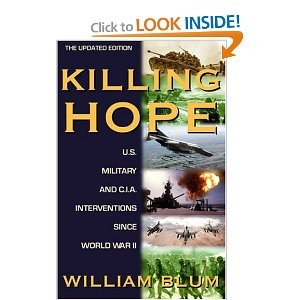
Review: Killing Hope–U.S. Military and C.I.A. Interventions Since World War II-Updated Through 2003

5 Star, Empire, Sorrows, Hubris, Blowback, Executive (Partisan Failure, Reform), Intelligence (Government/Secret)
0Shares
Amazon Page
Amazon Page

Essential Reference, Should be Updated to Include Drone Depredations

February 17, 2007

William Blum

Over-all, this is a very precious book, and an essential reference on the history of US intervention, both military and clandestine or covert. I consider it an essential reference, and would like to see a 2014 edition updated to include rendition, torture, and assassination by drone with 2% effectiveness, meaning 98% of the thousands killed by CIA drones are “collateral damage” — women, children, and other innocents.

As a former Marine Corps infantry office and former clandestine services case officer, and as an avid reader of non-fiction, I will gladly state on the record that this author has it largely right.

There are other books that complement this one–everything by Noam Chomspky, Derek Leebaert's “The Fifty-Year Wound,” Chalmers Johnson on “Sorrows of Empire,” Robert McNamara et al, “Wilson's Ghost,” the DVD “Why We Fight,” Ambassador Palmer's “The Real Axis of Evil” (on the 45 dictators we SUPPORT), and–with respect to the ignorance of America about reality, the two books, “Fog Facts,” and “Lost History.” See also Marine General Smedley Butler's short but hard-hitting work, “War is a Racket.”

While I take the author with a grain of salt and do not appreciate his collaboration with Phil Agee, who betrayed his oaths to the US, whatever his reasons, on balance this book is an essential reference for anyone who wishes to understand why the rest of the world is beginning to conclude that we are the worst of all evils in our foreign policy behavior and misbehavior.

Failed States: The Abuse of Power and the Assault on Democracy
The Fifty-Year Wound: How America's Cold War Victory Has Shaped Our World
The Sorrows of Empire: Militarism, Secrecy, and the End of the Republic (The American Empire Project)
Wilson's Ghost: Reducing the Risk of Conflict, Killing, and Catastrophe in the 21st Century
Why We Fight
Breaking the Real Axis of Evil: How to Oust the World's Last Dictators by 2025
War Is a Racket: The Anti-War Classic by America's Most Decorated General, Two Other Anti=Interventionist Tracts, and Photographs from the Horror of It
Lost History: Contras, Cocaine, the Press & ‘Project Truth'
Fog Facts : Searching for Truth in the Land of Spin (Nation Books)
Weapons of Mass Deception: The Uses of Propaganda in Bush's War on Iraq

AA Mind the GapClick Here to Vote on Review at Amazon,

on Cover Above to Buy or Read Other Reviews,

I Respond to Comments Here or There

Review: Secrecy & Privilege–Rise of the Bush Dynasty from Watergate to Iraq

4 Star, Crime (Government), Executive (Partisan Failure, Reform), Impeachment & Treason, Misinformation & Propaganda, Politics, Secrecy & Politics of Secrecy
0Shares

Secrecy PrivilegeSuperb Personal Effort, Narrow, Needs Other References,

February 17, 2007

Robert Parry

This is a superb personal effort by the author, and it does a tremendous job of harvesting both news media stories and key books. It is however a bit anrrow, and I recommend other references.

A simple example: he speaks of the narrow Bush victory in Florida without reference to Greg Palast's PRE-ELECTION reporting, subsequently summarized in the book, The Best Democracy Money Can Buy or any understanding of the fact that over a year in advance of the election Jeb Bush stole the election by disenfranchizing over 35,000 black voters whose names were remotely–very remotely–linked to the names of felons from other states (only Florida felons cannot vote, but Jeb Bush wanted this so bad he paid ten times the going rate to a “friendly” company that used Texas felon lists to “disqualify” voters who only found out they were disqualified on election day.

Another example: he has a great (but dated) appendix on CIA and who it has funded as intermediaries and end recipients of CIA cash all over the world, but he completely misses the same necessary information for Wall Street, the 40,000 non-profits created to hide wealth and manage perceptions (as well as lure people off land with gold, see Confessions of an Economic Hit Man).

There are many other books on the Nazi, mafia, and Saudi corruption ties of the Bush family, and there are also other books that are more comprehensive and current on the problems we face today because of young Bush II and his war criminal vice President. See for example, “Crossing the Rubicon: The Decline of the American Empire at the End of the Age of Oil; Rule by Secrecy: The Hidden History That Connects the Trilateral Commission, the Freemasons, and the Great Pyramids and my personal favority, Vice: Dick Cheney and the Hijacking of the American Presidency.

Robert Parry is a gifted investigative reporter. His first book, Lost History: Contras, Cocaine, the Press & ‘Project Truth' remains among my favorites. In this book, what may be his most important message is this: the extremists Republicans (I am an estranged moderate Republican disgusted with Karl Rove's hijacking of the party) have combined secrecy, lies, and “perception management” to completely confuse and mislead the public, while carrying out high crimes and misdimeanors against the government, the treasury, the military, and the people.

From Henry Kissinger and Richard Nixon to Karl Rove and Dick Cheney and the young (and rather stupid) George Bush II, this book paints a very ugly and accurate picture of the pathological abuse of power and of the public purse by these people. Most of them need to be tried, convicted, and jailed. None of them are fit for public office in a moral informed democracy, but then, as the author makes clear, we do not live in a moral, informed democracy. We live in a The Cheating Culture: Why More Americans Are Doing Wrong to Get Ahead where most Americans cannot identify all the states around their own, much less other countries. We have gotten the government we deserve.

One final observation: this book is super but in isolation. I am increasingly persauded that Amazon should digitize ALL books, so that customers can “buy” composite renditions of information that honor copyright at the paragraph and page level, while creating unique original visualizations and summarizations that are free of copyright and can be bought on their own. I would pay $1,000 for a visualization–a poster–of all of the criminal, dictator, and immoral connections of George Bush II and his evil former master, Dick Cheney (whose Secret Service nickname is “Edgar,” for the guy that managed the puppet). Bush has finally figured out, way too late, that Cheney hijacked and destroyed the first six years.

See also:
Bush's Brain
9/11 Synthetic Terror: Made in USA, Fourth Edition
Failed States: The Abuse of Power and the Assault on Democracy

AA Mind the GapClick Here to Vote on Review at Amazon,

on Cover Above to Buy or Read Other Reviews,

I Respond to Comments Here or There