
NIGHTWATCH: On Afghanistan, UN Report, Kabul

08 Wild Cards

Afghanistan Comment: NightWatch's reading of the just released UN report is different from the mainstream media coverage. Two paragraphs of the 17 page update deal with security and they received most of the news coverage. Violence was up in early 2010 and the UN attributed it correctly to the increase in US operation in Helmand and supporting NATO operations in Kandahar. The late winter surge in fighting was Coalition-initiated and contrary to the seasonal winter lull. In May, Taliban announced their spring/summer offensive, which is a seasonal effect.

The New York Times story pretty much repeated the two paragraphs on security, but in a way that suggested there was more to the story. There is not: lots of violence and lots of IEDs. The US command has made that point.

One news account said that only five of 80 key districts are “sympathetic” to the central government, according to the US command. None are described as loyal, which is probably a semi-permanent condition. Without a baseline for loyal districts dating from the overthrow of the Taliban in 2001, it is impossible to credit the assertion as significant. It is not wrong, it just lacks context.

What is missing is commentary on the geographic distribution of attacks. NightWatch has continued to monitor and document the daily fighting as reported in open sources. There is no significant change. The Taliban have not broken out of the Pashtun communities and the government has made no inroads in building support among Pashtuns. Geographically and ethnically, there are no winners and no losers.
In an essentially pre-modern economy, Kabul is where legitimate business is conducted with the outside world. This is a role it has performed for several centuries, through strong and weak central governments. Provincial and district leaders, who need to deal formally with the outside world, must deal with Kabul, the primary, single point of legal contact. Dealing with Kabul is not the same as supporting or sympathizing with it. The idea of supporters and sympathizers is Western and not really relevant to Afghanistan. Loyalty is not a zero sum game in Asia.

Internal instability, however, always is centripetal. Since the Pashtuns are not fighting to secede, they must capture Kabul if they hope to return to government for all Afghanistan. Otherwise they fail, remaining a chronic, but not terminal, security problem. At this point, they are unable to capture Kabul or to hold territory against NATO. The scale of violence has increased but control of the land has not changed much, based on open source reporting.

The big stories in the report are the peace jirga and corruption. No new ground in either.

Phi Beta Iota:  We hold NIGHTWATCH's mind in very high regard.  The question the above suggests that any President paying attention should ask, is this: “Where are we on Whole of Government, Multinational-Multifunctional campaign for turning Kabul into a modern efficient connected city with reliable services, and where are we on eliminating corruption in the government by using preventive measures that make it difficult for any government official to mis-appropriate or mis-direct funds?
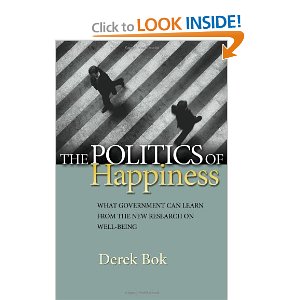
Review: The Politics of Happiness–What Government Can Learn from the New Research on Well-Being

4 Star, America (Founders, Current Situation), Best Practices in Management, Civil Society, Complexity & Resilience, Consciousness & Social IQ, Culture, Research, Democracy, Disease & Health, Economics, Education (General), Education (Universities), Electoral Reform USA, Environment (Solutions), Future, Intelligence (Public), Peace, Poverty, & Middle Class, Philosophy, Politics, Priorities, Public Administration, Voices Lost (Indigenous, Gender, Poor, Marginalized)
Amazon Page

4.0 out of 5 stars Absolutely Righteous, Mis-Leading Title

June 20, 2010

Derek Bok

First off, I'm back. After three months integrating into a field position with a prominent international organization, with three days off the whole time, I am finally able to get back to reading, and have about fifteen books on water I was going to read for UNESCO but will now read and review for myself. Look for two reviews a week from this point on, absent another tri-fecta (volcano, storm, minor coup).

This book is the first of three books that I am reviewing this week, the other two are The Hidden Wealth of Nations, which will be a five, and Identity Economics: How Our Identities Shape Our Work, Wages, and Well-Being, probably a five as well, but I continue to be stunned as how people limit their references to the last 10 years when so much has been done that is relevant in the last 50.

This book is not about the politics of happiness. It is more about the possibilities of public administration of happiness.

This will be a long review–apart from the author being one of a handful to truly top-notch minds with a historical memory, the topic is important–much more important than I realized until I starting following unconventional economics (ecological economics, true cost, bio-mimicry, sustainable design, human development and non-financial wealth).

The author opens with Bhutan and its Gross National Happiness (GNH) concept, with four pillars (good governance, stable-equitable social development, environmental protection, preservation of culture). Elsewhere (on the web) I learn that the 72 indicators are divided into nine domains (time use, living standards, good governance, psychological wellbeing, community vitality, culture, health, education, and ecology).

From there the author moves to the 1800's and Jeremy Bentham, and of course our own Founding Fathers who included “the pursuit of happiness” in the Declaration of Independence. As I have commented before in reviewing other books such as 1776; What Kind of Nation: Thomas Jefferson, John Marshall, and the Epic Struggle to Create a United States, and The Thirteen American Arguments: Enduring Debates That Define and Inspire Our Country, happiness in those days was interpreted as fulfillment, “be all you can be,” not frivolous joy of “excessive laughter.”

The author identifies and discusses six factors pertinent to happiness in the US context as he defines it: Marriage; Social Relationships; Employment (wherein trust in management is VASTLY more important than the paycheck); Perceived Health; Religion (in sense of community not dogma) and Quality of Government (as which point I am reminded of George Will's superb Statecraft as Soulcraft; Quality of government is further divided into Rule of Law, Efficient Government, Low Violence and Corruption; High Degree of Trust in Public Officials and Especially Police; and Responsive Encounters by Citizens with Government.

Note: 30 million in US population are “not too happy.”

Continue reading “Review: The Politics of Happiness–What Government Can Learn from the New Research on Well-Being”

Journal: Afghanistan, the United Nations

05 Civil War, 08 Wild Cards
Berto Jongman Recommends...

UN Security Council Report of the Secretary-General on Afghanistan

S/2010/10/318     16 June 2010

Overall, the number of security incidents increased significantly, compared to previous years and contrary to seasonal trends.  [II 18, p. 4]

The three political priorities include support for elections, reconciliation and reintegration, and regional cooperation; the fourth priority is aid coherence. [III A. p. 5]

Poli-Tricks: The Life and Death of Brothel Madams of New Orleans and D.C.

Crime (Government), Cultural Intelligence, Power Behind-the-Scenes/Special Interests, Videos/Movies/Documentaries
Deborah Palfrey

DEATH BY CLIENT LIST – One was murdered for revealing the client list (Deborah Jeane Palfrey), and one currently lives (and not in jail) because she did not reveal the client list (Jeanette Maier).

This weekend in Brooklyn, NY was the premiere of the film the “Canal Street Madam” about the life of Jeanette Maier and an FBI raid on her infamous family-run brothel in New Orleans. She appeared for the screening and after wards was on a panel for Q & A.

Mentioned in the film was the “DC Madam” (Deborah Jeane Palfrey) and audio of her being interviewed by Alex Jones that she would not commit suicide.

Jeanette Maier

Telephone conversations used in the film were from FBI wiretaps. The FBI used 10 agents taking turns listening to calls for 4 months (5,000 calls).  Jeanette Maier said during the Q & A panel that the FBI was wiretapping her phone while she was watching the September 11, 2001 attacks on the World Trade Center and that those tax dollars could have been spent helping keep the country safer.

Background on the Jeanette Maier case and family business:
+ Part One
+ Part Two
+ Part Three

::::

Related:
+ Palfrey page at NNDB
+ Palfrey and Maier connection to Louisiana Senator David Vitter
+ 598 page Book – Why Just Her: The Judicial Lynching of the D.C. Madam Deborah Jeane Palfrey by Montgomery Sibley

Journal: One Mobile Per Child

About the Idea, Civil Society, Collective Intelligence, Collective Intelligence, InfoOps (IO), IO Multinational, microfinancing, Mobile, Real Time, Reform, Tools

Phi Beta Iota: The idea of one mobile per person was originally devised by the Earth Intelligence Network, and is articulated in both brief form and in a full-length book.  Now the idea is emerging, spontaneously, from others.  Below is a link to a letter in the Journal of Health Informatics in Developing Countries.

Letter: One mobile per child: a tractable global health intervention

The authors, Prajesh Chhanabhai and Alec Hold, one working at the University of Otago in New Zeland, the other for the Department of Economic and Soical Affairs in the United Nations, make several important points, not least of which is the price point: mobile telephones are being offered in Venezuela for $15, which is half the price the World Bank negotiated with Motorola.

If and when the Chinese see the opportunity (free cell phone, no extra charge for listening in), we should see both free cell phones and eventually free airtime as well as free call centers to educate the poor “one cell call at a time” at the same time that we recoup the investment in elevated national productivity, now proven to be associated with the diffusion of cell phone access.

It merits observation that the cell phone is now the “gift of life” that any one of the one billion rich (80% of whom do not give to charity now) can endow, down to a specific person in a specific village.  The sooner we make cell phones ubiquitous, the sooner we can start exposing corruption at all levels (with web sites that make sense of text messages and expose corruption in near-real-time “by name,” and also creating infinite wealth among the four billion at the “bottom of the pyramid.”  The human brain is the one inexhaustible resource we have, giving every human a cell phone is the fastest way to harnessing the distributed intelligence of the Whole Earth.

Interesting Side Note: Carlos “slim” Helu (richest person in the world) has a major stake in Tracfone (some phones go for $10). He could be a major player in the one mobile per child campaign. Venezuela president Hugo Chavez has a Twitter account and the Earth Intelligence Network just posted >>  earthintelnet @chavezcandanga “the Vergatario” ($15 phone) + Carlos “Slim” Helu ? http://phibetaiota.net/?p=25785 #Vergatario #Venezuela #CarlosSlim

Journal: What Turkey Knows, Whither the Region

08 Wild Cards
Chuck Spinney Recommends

This is an excellent assessment, IMO.  Chuck


By RAMZY BAROUD,
Counterpunch

“Even despots, gangsters and pirates have specific sensitiveness, (and) follow some specific morals.”

The claim was made by Turkish Prime Minister Recep Tayyip Erdogan in a recent speech, following the deadly commando raid on the humanitarian aid flotilla to Gaza on May 31. According to Erdogan, Israel doesn’t adhere to the code of conduct embraced even by the vilest of criminals.

The statement alone indicates the momentous political shift that’s currently underway in the Middle East. While the shift isn’t entirely new, one dares to claim it might now be a lasting one. To borrow from Erdogan’s own assessment of the political fallout that followed Israel’s raid, the damage is “irreparable.”

Countless analyses have emerged in the wake of the long-planned and calculated Israeli attack on the Turkish ship, Mavi Marmara, which claimed the lives of nine, mostly Turkish peace activists.

In “Turkey’s Strategic U-Turn, Israel’s Tactical Mistakes,” published in the Israeli daily Haaretz, Ofra Bengio suggested Turkey’s position was purely strategic. But he also chastised Israel for driving Turkey further and faster “toward the Arab and Muslim worlds.”

In this week’s Zaman, a Turkish publication, Bulent Kenes wrote: “As a result of the Davos (where the Turkish prime minister stormed out of a televised discussion with Israeli President Shimon Peres, after accusing him and Israel of murder), the myth that Israel is untouchable was destroyed by Erdogan, and because of that Israel nurses a hatred for Turkey.”

In fact, the Davos incident is significant not because it demonstrates that Israel can be criticized, but rather because it was Turkey — and not any other easily dismissible party — that dared to voice such criticism.

FULLS STORY ONLINE

Journal: Interview on Syria, US, and Region

08 Wild Cards

Chuck Spinney Recommends

Overview of Syrian-US Relations

Joshua Landis, Syria Comment, Thursday, June 17th, 2010

Joshua M. Landis is Director of the Center for Middle East Studies and Associate Professor of Middle Eastern Studies at the University of Oklahoma. He is a member of the School of International and Area Studies.  He writes “Syria Comment,” a daily newsletter on Syrian politics that attracts some 3,000 readers a day. It is widely read by officials in Washington, Europe and Syria. Dr. Landis regularly travels to Washington DC to consult with the State Department and other government agencies.
Landis Interview with a Foreign Journalist

1. Professor Landis, tensions between the US and Syria have deteriorated. What are the main reasons of this deterioration?

READ FULL INTERVIEW ONLINE


noble gold
