Journal: CIA and the Culture of Corruption

07 Other Atrocities, 09 Justice, 10 Security, 11 Society, Corruption, Government, Intelligence (government), Methods & Process

CIA and the Culture of Corruption

by: Melvin A. Goodman, t r u t h o u t | News Analysis
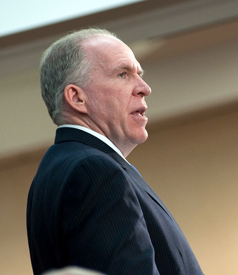
John Brennan.
CIA Deputy Executive Director John Brennan. (Photo: CSIS: Center for Strategic & International Studies / Flickr)

Last month, the Central Intelligence Agency (CIA) released a blistering report that documented a secret drug interdiction program in Peru that was responsible for the death of an American missionary and her infant daughter in 2001. The report provided a detailed study of the efforts of senior CIA leaders, including Deputy Director John McLaughlin and Deputy Executive Director John Brennan, to cover up the crime by stonewalling the White House, the Congress and the Department of Justice (DOJ) on the flaws of the interdiction program.

Brennan, who was President Obama's original choice to be CIA director until the report complicated the confirmation process, is currently the deputy director of the National Security Council (NSC).McLaughlin was the “villain” in the politicization of intelligence on Iraqi weapons of mass destruction, according to the chief of the Iraq Survey Group, David Kay. Few people remember that it was McLaughlin who actually delivered the “slam-dunk” briefing to the president in January 2003. Nevertheless, the Obama administration named McLaughlin to lead the internal investigation of the CIA's intelligence failures in the attempted bombing of a commercial airliner and the shootings at Fort Hood, Texas, in 2009.

The detailed report on Peru documents a culture of corruption and deceit at the highest levels of the CIA as well as the interventions of CIA lawyers to stop the DOJ from pursuing prosecutions in the case. The CIA office of general counsel's aggressive campaign to prevent a criminal prosecution of the agency officers culminated with Deputy Director McLaughlin's letter to the assistant attorney general that promised “significant disciplinary action” if CIA officers “lied or made knowingly misleading statements” to the Congress, DOJ, the NSC or office of inspectors general (OIG) investigators. The report carefully documents the lies and the stonewalling, but there was never any genuine punishment.

Read rest of this detailed article….

Melvin A. Goodman is national security and intelligence columnist for Truthout. He is senior fellow at the Center for International Policy and adjunct professor of government at Johns Hopkins University. His 42-year government career included service at the CIA, State Department, Defense Department and the US Army. His latest book is Failure of Intelligence: The Decline and Fall of the CIA.

See Also:

Journal: Mel Goodman on CIA Myths

Worth a Look: Book Reviews on Intelligence (Lack Of)

and especially;

Continue reading “Journal: CIA and the Culture of Corruption”
Journal: Groupon’s Missed Opportunity

11 Society, About the Idea, Collective Intelligence, Communities of Practice, Earth Intelligence, IO Mapping, IO Sense-Making, Methods & Process

Groupon's Missed Opportunity

The tech industry has a total crush on Groupon, that darling of the start-up scene that emails you huge discounts on everything from Gap jeans to gym memberships. Now that Google is about to acquire the Chicago-based start-up for billions of dollars, it’s like the tech blogs are all competing to see who can gush the most about how great Groupon is and how smart Google is for wanting to acquire them. It’s really not that big of a deal – how many times have we seen this kind of Cinderella story before?

Though I don’t find the acquisition all that interesting, I’m fascinated by the concept of Groupon, mainly for the incredible opportunity they missed. On the surface, Groupon seems to be about killer deals. They negotiate huge discounts with national and local businesses in exchange for the promise of thousands of new customers – pay $25 and get $50 worth of Thai food, for example, or pay $60 for a normally $250 dental exam. It’s a classic loss-leader tactic – gain new customers at a loss in hopes that they return and generate more business later.

When you take a closer look at Groupon’s phenomenal success, though, there’s a lot more going on than just bargains. Groupon was one of the first companies to successfully harness the power of group behavior across the social web in the name of a common purpose. That’s incredibly powerful! Think of the potential – for the first time in history, the physical barriers to collective, powerful action have been torn down, and Groupon figured out how to focus that power into a single, common goal. That’s huge!

Continue reading “Journal: Groupon's Missed Opportunity”

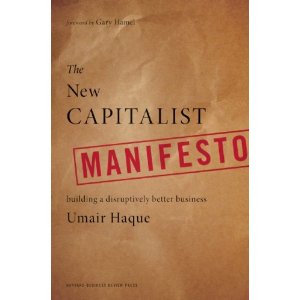
Worth a Look: The New Capitalist Manifesto

02 China, Commerce, Commercial Intelligence, Worth A Look
Amazon Page

The Worst Trade in the World

It's often said that America's an uncompetitive economy–unable to produce stuff that satisfies global demand. Hence, a yawning current account deficit.

I'd say the reality's harsher. America's caught in a toxic, self-destructive relationship with the globe's second most significant economy. In short, it's making the worst trade in the world.

See tables of what US exports to China (good stuff) and what China exports back to the US (mostly bad stuff).

Amazon Pre-Publication (4 January 2011) Review:

Product Description

Welcome to the worst decade since the Great Depression. Trillions of dollars of financial assets and shareholder value destroyed; worldwide GDP stalled; new jobs vanishingly scarce. But this isn’t just a severe recession. It’s evidence that our economic institutions are obsolete—a set of ideas inherited from the industrial age that no longer work for business, people, society, or the future.

In The New Capitalist Manifesto, economic strategist Umair Haque argues that business as usual has outgrown the old paradigm of short-term growth, competition at all costs, adversarial strategy, and pushing costs onto future generations. These outworn assumptions are good for creating only “thin” value—gains that are largely illusory and produce diminishing returns every year.

For “thick” value—enduring, meaningful, sustainable advantage that deeply benefits the larger society—Haque details five new cornerstones of prosperity in the twenty-first century:

•Loss advantage: From value chains to value cycles
•Responsiveness: From value propositions to value conversations
•Resilience: From strategy to philosophy
•Creativity: From protecting a marketplace to completing a marketplace
•Difference: From goods to betters

The New Capitalist Manifesto makes a passionate, razor-sharp economic case that these methods will produce a more enduring prosperity for business as well as society.

About the Author

Umair Haque is the Director of the London-based Havas Media Lab and heads Bubblegeneration, a strategy lab that helps discover strategic innovation. He studies the economics of the future: the impact that new technologies, management innovations, and shifting consumer preferences will exert tomorrow on the industries and markets of today.

See Also:

Worth a Look: Book Reviews on Bio-Economics

Worth a Look: Book Reviews of Capitalism Reincarnated

Worth a Look: Book Reviews on China

Worth a Look: Book Reviews on Civilization-Building

Worth a Look: Book Reviews on Collective Intelligence

Worth a Look: Book Reviews on Common Wealth

Worth a Look: Book Reviews on Conscious, Evolutionary, Integral Activism & Goodness

Worth a Look: Book Reviews on Dialog for Truth & Reconciliation

Journal: Smoke, Mirrors, and Hades Burning on the Hill

Budgets & Funding, Government, Law Enforcement, Military
Chuck Spinney Sounds Off....

This is a great example of the kind of gaming that keeps defense budgets high.  Kudos to Winslow Wheeler for smoking it out.

On Dec 3, 2010, at 7:56 AM, Winslow Wheeler wrote:

In a midnight switch, the Deficit Commission changed the dividing line between discretionary spending elements.  Was 050 (DOD,DOE, Misc.) versus the rest; now it's 050 plus VA, plus State, plus Homeland security versus the rest.  The split remains 50-50 (I'm pretty sure); the total discretionary savings went up a bit, but now DOD is a lesser part of the “security” share of cuts, plus it gets to raid its new (trembling) partners in its deficit reduction cage.  This was the idea not of the Republican defense apologists on the Commission but of the Democrat budget process “reformers” who were aping a long term goal to declare State a national security entity.

I bet the idea originated among the Pentagon milcrats, who fed to pliable democratic apparatchiks working for Gates, who in turn fed it to so-called democratic budget “reformers” on hill, on the commission, and/or in pro-dem thinktanks.  Be interesting to see if/how Pentagon's wholly owned subsidiaries at the Post and NYT play this.

It is almost as if Frank Carlucci was back in the Pentagon and it is 1981 … remember how Carlucci snookered David Stockman (Reagan's OMB director) in early 1981 into approving even higher defense budgets than Reagan campaigned for (I wrote about Carlucci's “nature” trick on pages 14-17 of Defense Power Games – also attached).

Chuck

Phi Beta Iota: Given integrity of intent and process on the Hill, neither of which exists today, this would actually be a good change, with the proviso that Commerce be added and Newt Gingrich be made Vice President for Global Engagement, as we propose in our Virtual Cabinet at The Huffington Post.  The misrepresentation of the defense budget has long been fraudulent (completely apart from the missing $2.3 trillion that DoD still cannot account for and never will), with externalized personnel and health costs not “visible” to most.  Getting a grip on the US budget process is not rocket science.  It requires just two elements: integrity in those at the top, and the enlistment of the public through the promised but not yet delivered transparency of process.

Journal: WikiLeaks Collaboration, WikiLeaks Attacked + CYBER RECAP

07 Other Atrocities, Collaboration Zones, Communities of Practice, Cyberscams, malware, spam, InfoOps (IO), IO Multinational, Standards, Technologies
DefDog Recommends...

Respected media outlets collaborate with WikiLeaks (NewsMeat)

WikiLeaks turned over all of the classified State Department cables it obtained to Le Monde, El Pais in Spain, The Guardian in Britain and Der Spiegel in Germany. The Guardian shared the material with the New York
Times, and the five news organizations have been working together to plan the timing of their reports.

They also have been advising WikiLeaks on which documents to release publicly and what redactions to make to those documents, Kauffmann and others involved in the arrangement said.

WikiLeaks switches to Swiss domain after attacks (NewsMeat)

Wikileaks was forced Friday to switch over to a Swiss domain name,
wikileaks.ch, after a new round of hacker attacks on its system prompted its American domain name provider to withdraw service.

WikiLeaks' U.S. domain name system provider, EveryDNS, withdrew service to the wikileaks.org name late Thursday, saying it took the action because the new hacker attacks threatened the rest of its network.

“Wikileaks.org has become the target of multiple distributed denial of service attacks. These attacks have, and future attacks would, threaten the stability of the EveryDNS.net infrastructure,” EveryDNS said in a statement.

Phi Beta Iota: The first story represents the emergence of hybrid governance and hybrid capabilities networks that will over time displace the inherently corrupt hierarchical stovepipes of the Industrial “Rule by Secrecy” era.  The second story represents both the emergence of jackals in cyber-space, attacking “because they can,” and the abject failure of both the Internet Service Providers (ISP) and the US Government to provide order, discipline, and security in cyberspace.  We recommend that WikiLeaks seek severe financial damages from both Amazon and EveryDNS–both have failed to be honest and diligent.  At the same time, this is an opportunity: any country, such as Chile, that can integrated unlimited low-cost renewable energy, massive data storage & services, and multinational intelligence, all in a cyber-cocoon of absolute confidence immune to attack, will bury the US and EU ISP and telecommunications industries.

See Also:

Reference: Bruce Schneier on Cyber War & Cyber Crime

Journal: Cyber-Heist 2nd Generation

Journal: Pentagon Network Attacks–Cloud Truth?

Journal: Who Controls (and Secures) the Internet?

Journal: US Research & Development in the Toilet

Journal: Army Industrial-Era Network Security + Cyber-Security RECAP (Links to Past Posts)

Reference: General David Petraeus–An Examination

04 Inter-State Conflict, 05 Iran, 10 Security, 11 Society, Cultural Intelligence, Military, Misinformation & Propaganda, Officers Call, Power Behind-the-Scenes/Special Interests
Chuck Spinney Recommends....

David Petraeus — Hero Celebrity

By Michael Brenner (Senior Fellow, the Center for Transatlantic Relations) – Huffington Post – December 2, 2010

There is one celebrity with the makings of a national hero, someone who has the qualities that might carry him right into the White House. It is David Petraeus. He is almost universally credited with the brilliant achievement of saving American honor and gaining an approximation of ‘victory' in Iraq. President Obama himself is in awe of this warrior-intellectual to whom he defers on all matters in the Greater Middle East. Petraeus' mythic standing is a perfect example of how the compelling demand for a hero creates the illusion that indeed a savior has arrived.

Read the balance of the article…

Reference: Policy Agendas Project Database

Budgets & Funding, Civil Society, Collective Intelligence, Cultural Intelligence, Earth Intelligence, Government, Methods & Process, Policies, Policy

“Online Database Tracks Congressional, Presidential and Public Priorities”

November 22, 2010 23:10

From a University of Texas at Austin Announcement:

As a new Congress prepares to take office, a powerful online tool from University of Texas at Austin political scientists can help answer questions about lawmakers' shifting focus over time, differences between Republican and Democratic priorities and whether wave elections correlate with policy changes in Washington.

The Policy Agendas Project database allows journalists, scholars and interest groups to easily track and compare the issues that presidents and members of Congress have taken up since 1947 and to assess how those actions reflected the mood of the country.

The interface lets users sift through dozens of issues and sub-issues — health care, the environment, taxes — to look at the topics leaders dealt with in congressional hearings, new laws, executive orders and State of the Union addresses, as well as public opinion about problems facing the nation.

[Clip]

The data generated by the project are free and publicly available. They come with software that allows them to be used in classrooms. Jones and his colleagues released earlier versions of the Policy Agendas Project while he was a professor at the University of Washington.

Tip of the Hat to Gary Price at LinkedIn.

Phi Beta Iota: This has some promise, especially if they design it to be scalable across countries and down to the state and local level.  However, since nothing is policy until it is in the budget, the real truth tellers will be if they can link this to actual budgetary authorizations, allocations, and obligations; factor in “true costs” of any given policy element; and open it up to fact-based citizen dialog and deliberation.