A six week course using asynchronous forums, blogs, wikis, mindmaps, social bookmarks, synchronous audio, video, chat, and Twitter to introduce the fundamentals of an interdisciplinary study of cooperation: social dilemmas, institutions for collective action, the commons, evolution of cooperation, technologies of cooperation, and cooperative arrangements in biology from cells to ecosystems.
If you are interested in signing up, contact howard@rheingold.com
QUOTE: “Remember, the media did its worst against Ronald Reagan in 1980, calling him a racist and a warmonger and he eventually prevailed. His cause was to save America from totalitarian communism. Our cause is to save it from ourselves.”
(Reuters) – Thrown by a mounting series of extreme events over the past four years, global policymakers and investors are being urged to think long and prepare more systematically for the worst.
. . . . . . .
Part of the problem today is that the latest wave of globalization was led solely by transnational corporations and their interwoven supply chains and by financial markets' 24/7 worldwide blizzard of electronic transactions.
While this greatly facilitated the transmission of shocks worldwide, it was not matched by countervailing global governance and regulation to keep this activity in check or mitigate its most socially- or systemically-threatening aspects.
More information on the OECD’s Future Global Shocks project is available at: www.oecd.org/futures, including case studies on cyber attacks, pandemics, geomagnetic storms, social unrest and financial crises.
Internet prime mover Vint Cerf echoes what I’ve been hearing from other architects of the TCP/IP network: we should focus on building much fatter pipes, and get away from the enforced/legacy scarcity and build gigabit broadband networks. Nothing here about the cost of providing gigabit access, nothing here about the fact that much of the (rural) U.S. has no access to broadband at any speed. What policies do we need to have pervasive gigabit broadband, urban and rural, in the U.S.? Who will pay for the buildout? [Link]
I’m aware of open spectrum… I’m in other conversations with various wonks & engineers who’re discussing bandwidth, spectrum, etc. Of course we could have a much different scene if we weren’t constrained by markets and politics. People how can see one sense of the obvious often miss another, which is that the world we’re in is not an ideal world, and the ideals we can conceive are not necessarily easy or even possible to implement. I pay less attention to the “next net” list we’re both on because so much of it is fantasy and masturbation.
I own a nice home in rural Texas but I can’t live there because I can’t even get 500kbps. I thought it was amusing that Vint is arguing for gigabit bandwidth when most of the U.S. is dark and there’s too little monetary incentive to bring light to the darkness. Of course I think we need a public initiative to make it happen, but in this era “public” is a dirty word. I halfway expect to see all roads become toll roads; a world where only the elite can travel, and only the elite will have broadband access. Though aging, I’m struggling to remain part of the elite… *8^)
Robert David STEELE Vivas
Robert Steele Comments:
Open Spectrum was part of my comment to Jon, but much more pointedly, I observed that Vint went to the dark side with Google, and has completely neglected both the Dutch model that Gordon Cook has documented so ably, and the desktop analytics as well as the back office M4IS2 processing that is required to create the World Brain and Global Game. I do not wish to publish the Operation Cloudburst memorandum that is before Microsoft, but now that Office 365 is out the way is open for some SERIOUS human-centric, data-centric, intelligence-capable M4IS2 innovation (Microsoft BI, Access, and MySQL are baby steps). Google, IBM, and Oracle are all great in their respective niches, but no organization–including Microsoft–is trained, equipped, and organized to create a global grid that is Open Everything. This is my specific calling in my last 25 years of productive work.
Using wikis and digital fabrication tools, TED Fellow Marcin Jakubowski is open-sourcing the blueprints for 50 farm machines, allowing anyone to build their own tractor or harvester from scratch. And that's only the first step in a project to write an instruction set for an entire self-sustaining village (starting cost: $10,000).
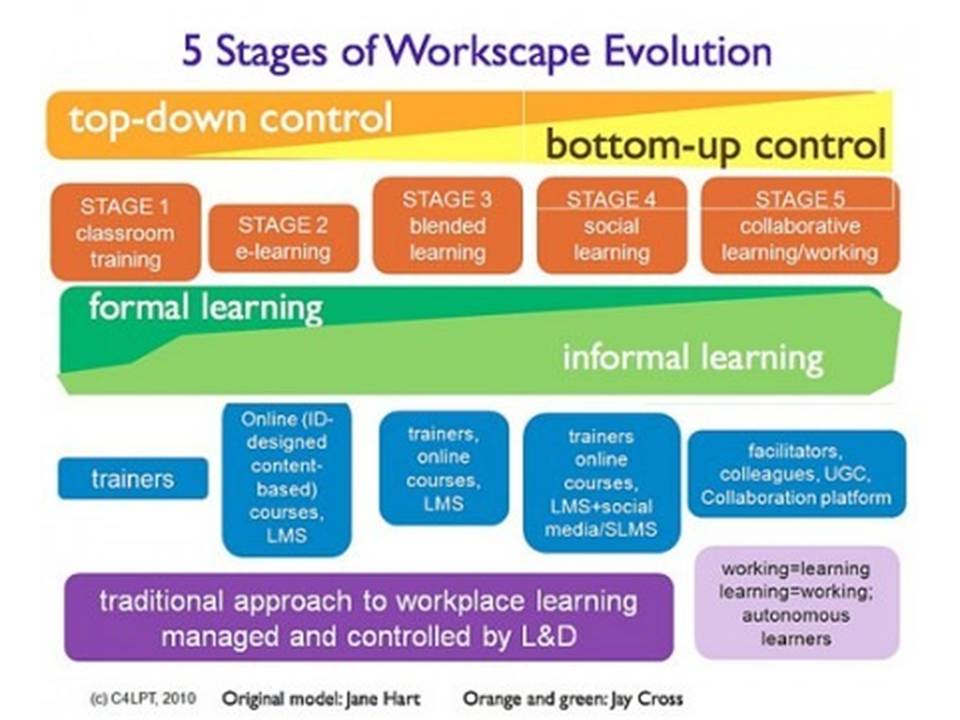
At its core, network learning is a way to deal with an ever-increasing amount of digital information. It requires an open attitude toward learning and finding new things. Each worker needs to develop individualized processes of filing, classifying and annotating information for later retrieval.
“In the period ahead of us, more important than advances in computer design will be the advances we can make in our understanding of human information processing – of thinking, problem solving, and decision making…” ~ Herbert Simon, Economics Nobel-prize winner (1968)
The World Wide Web is changing how many of us do our work as we become more connected to information and each other. In California, Ray Prock, Jr. (2010) uses a Web-based note system to store messages, manage his financial risk and stay on top of the multiple factors necessary to run a successful dairy farm. He is constantly learning as he works and has found a method to keep up, thanks to the Internet.
Phi Beta Iota: We asked Col Stu Herrington, USA (Ret), Army counterintelligence officer/interrogator with successful interrogation experience in three wars, what he thought of the matter of General Patraeus opening the door on torture, and here is what he thinks–we have to concur.