The recent emergence of the first, large-scale Facebook movement among Afghan university students calling for reform can't help but raise the question — will the wave of antigovernment dissent in the Middle East reach Afghanistan?
Since March, some 1,500 university students in Kabul, and another 3,000 elsewhere around the country, have “friended” the Facebook page “Reformists.” There, they meet daily for discussions about how to exert grassroots pressure on the government — pressure that barely exists in Afghanistan today.
In some ways, the movement is very much like similar Facebook groups in the Arab world.
Humans have an innate need for status and for novelty in their lives. Unfortunately, the modern world has adopted very energy- and resource-intensive ways of meeting those needs. Other ways are going to have to be found as part of the move to a more sustainable world.
Phi Beta Iota: Buckminster Fuller understood the centrality of time/energy, but he did not grasp the psychological roots of collective self-destruction. This is an extraordinary article in every possible way. Strategic Analytics & Smart Nations are a solution.
“Any coward can fight a battle when he's sure of winning, but give me the man who has pluck to fight when he's sure of losing. That's my way, sir; and there are many victories worse than a defeat.”
—George Eliot
We're losing! Here's a playbook, see especially the focus on new metrics that have more meaning.
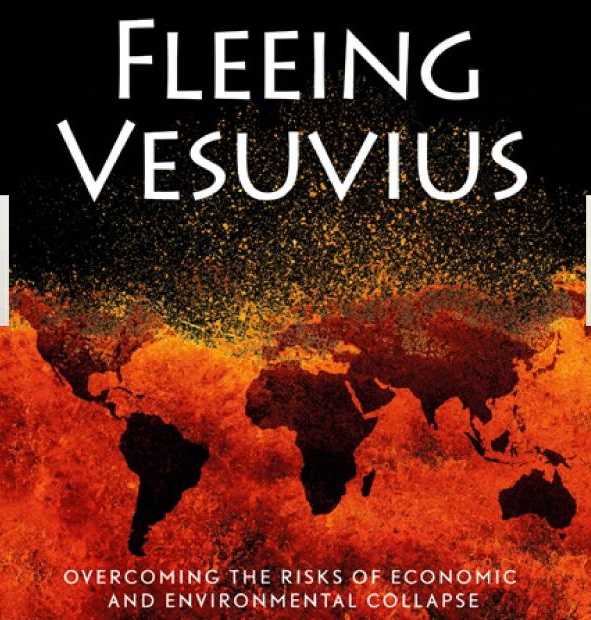
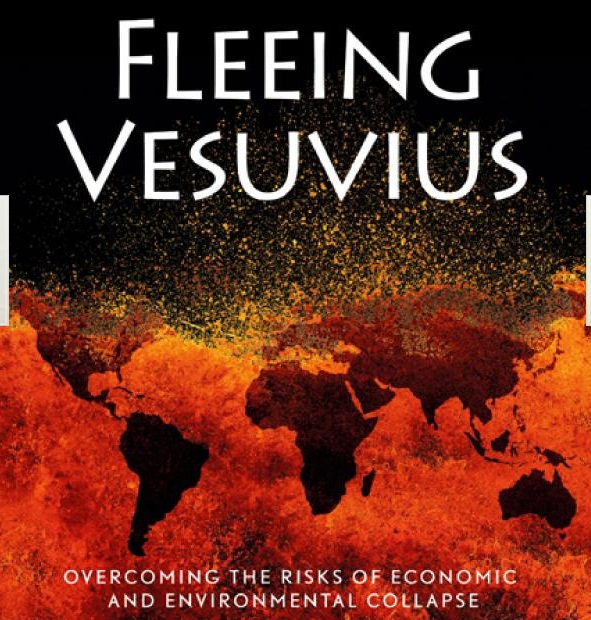
The essay below is an updated and edited version of a post I wrote here a few years ago, I'm Human, I'm American and I'm Addicted to Oil. Richard Douthwaite, Irish economist and activist, (and a fellow at the Post Carbon Institute), invited me to contribute it as a chapter in the just released book Fleeing Vesuvius, which is a collection of articles generally addressing “how can we bring the world out of the mess it finds itself in”? My article dealt with the evolutionary underpinnings of our aggregate behavior – neural habituation to increasingly available stimuli, and our evolved penchant to compete for status given the environmental cues of our day. And how, after we make it through the likely upcoming currency/claims bottleneck, we would be wise to adhere to an evolutionary perspective in considering a future (more) sustainable society.
Click here for the table of contents from Fleeing Vesuvius, followed by my article.
Phi Beta Iota: Will and Ariel Durant, in Lessons of History, state that the only real revolution is in the mind of man. We strongly believe that strategic analytics is the next revolution, and that strategic analytics will make possible transparency, truth, and truth leading to compassionate non-zero evolution–a world that works for all.
NUUK, Greenland — The eight Arctic nations pledged Thursday to create international protocols to prevent and clean up offshore oil spills in areas of the region that are becoming increasingly accessible to exploration because of a changing climate.
The Arctic Council — the United States, Russia, Canada, Iceland, Denmark, Norway, Finland and Sweden — said the protocols would be modeled on a separate agreement signed here in Nuuk on Thursday to coordinate search-and-rescue operations over 13 million square miles of ocean.
Phi Beta Iota: This is potentially world-changing, but pedestrian at this time. Legal and logistics arrangements institutionalize old ways of doing things–slow, expensive, often inappropriate ways. Much more exciting would be for the nations to agree to create an Arctic M4IS2 Centre, perhaps based in Copenhagen or in Oslo, with an emphasis on sustainable energy and climate change to begin with, but rapidly filling out to provide holistic analytics across all threats and helpful to the harmonization of spending across all policies. Such a center could be innovative from the first day if it includes all eight tribes of intelligence in its organizational and outreach schema, creating a model for both the United Nations and for each of the continental political organizations.
Humanity and technology continue to co-evolve at an ever increasing pace, leaving traditional institutions (and mindsets) calcified and out of date. A new paradigm is emerging, where everything is increasingly connected and the nature of collaboration, business and work are all being reshaped. In turn, our ideas about society, culture, geographic boundaries and governance are being forced to adapt to a new reality.
While some fear the loss of control associated with these shifts, others are exhilarated by the new forms of connectivity and commerce that they imply. Transactions and interactions are growing faster and more frictionless, giving birth to what I call a “superfluid” economy.
Business will not return to usual. So let's discuss 4 key concepts to help us better understand the shifts that are underway:
1. Quantifying and mapping everything
2. Everyone has access to the internet
3. Self-organizing expands
4. Peer-to-peer exchange changes the future of money
I’m excited to be nearing the completion of my dissertation research. As regular iRevolution readers will know, the second part of my dissertation is a qualitative and comparative analysis of the use of the Ushahidi platform in both Egypt and the Sudan. As part of this research, I am carrying out some content analysis of the reports mapped on U-Shahid and the SudanVoteMonitor. The purpose of this blog post is to share my preliminary analysis of the 2,700 election monitoring reports published on U-Shahid during Egypt’s Parliamentary Elections in November & December 2010.
Deborah Austin-Ford (letter, April 9) asks what Martin Luther King‘s family would think of the choice of Van Jones as the annual King lecturer at Siena College. While the family's opinion would be of interest, we could turn to what King scholars might say and, even better, to King's own words.
Austin-Ford writes that Jones signed a 911truth.org petition and focuses attention on why communities of color are more likely to suffer environmental degradation and harm than white communities.
On Jones' alleged “socialism,” to this day, some accuse or disparage King for having been a “communist,” largely because he spoke out against U.S. foreign policy on Vietnam and Latin America. King gave many speeches in which he criticized America for its hypocrisy of supporting undemocratic regimes and its seeming pursuit of profit.



 The essay below is an updated and edited version of a post I wrote here a few years ago,