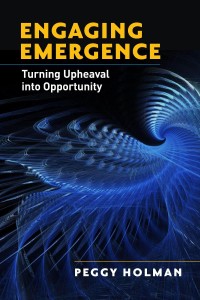
Worth a Look: Engaging Emergence

5 Star, Best Practices in Management, Collaboration Zones, Communities of Practice, Consciousness & Social IQ, Ethics, Key Players, Methods & Process, Policies, Strategy, Threats, Worth A Look

Amazon Page

Phi Beta Iota: Previously recommended in Worth a Look: New Book Engaging Emergence, we reiterate our regard for Peggy Holman, arguably one of a handful of leaders shaping our collective intelligence capacity today–Tom Atlee, Barbara Marx Hubbard, Harrison Owen, Thom Hartman, Jim Rough, Robert Fuller, Mark Tovey, are others, all helping shape community Open Space Open Source Collaborative Information-Sharing and Sense-Making.

See Also:

Review: The Handbook of Large Group Methods–Creating Systemic Change in Organizations and Communities

Review: The Change Handbook–The Definitive Resource on Today’s Best Methods for Engaging Whole Systems

From the Author

At long last, it is available.  I am delighted to say that Engaging Emergence: Turning Upheaval into Opportunity is now for sale from Amazon, Berrett-Koehler, Barnes and Noble, or through local bookstores.

I have a confession. I have an ambitious goal for the book: to meet today's needs in the way The Fifth Discipline did 20 years ago.  And you can help make that happen.

Continue reading “Worth a Look: Engaging Emergence”

Dept of Homeland Sec Dogs for “Bed Bugs?”

03 Economy, 03 India, 07 Health, 08 Immigration

Cimex lectularius

Bed Bug Infestation Is Scaring Millions Of Americans

By  Anneli Rufus

Outbreaks of bed bugs, soaring in the most unexpected places — like CNN's headquarters — stoke some of our deepest fears.   Virtually eradicated nationwide sixty years ago thanks to superpowered pesticides such as DDT, bedbugs are back — largely because those chemicals are now banned, but also thanks to what experts quoted in news reports call “increased foreign travel.” (Claims a rise in bed bugs of 80% since year 2000).
Comment: This article at times rises into exaggeration but is useful overall. In the comments section after the article, solutions to get rid of bedbugs mentioned were Food Grade Diatomaceous Earth and Borax.|

A Wake-Up Call on Bedbugs

Continue reading “Dept of Homeland Sec Dogs for “Bed Bugs?””

Journal: Social Security Being Set Up for a Fall

03 Economy, 09 Justice, 11 Society, Civil Society, Cultural Intelligence, Government
Chuck Spinney Recommends

My good friend Marshall Auerbach has one answer — can you “refudiate” it?

Which Party Poses the Real Risk to Social Security’s Future?

NewDeal2.0.org, Monday, 08/16/2010 – 5:02 pm by Marshall Auerback

Hint: it’s not Republicans.

Social Security remains one of the greatest achievements of the Democratic Party since its creation 75 years ago. Although Republicans have historically fulminated against the program (Ronald Reagan once likened it as something akin to “socialism”), they have actually made little headway in touching this sacred “third rail” in American politics. President Bush pushed for partial privatization of the program in 2005, but the proposal gained no policy traction (even within his own party) because Social Security continues to be hugely popular with American voters. It’s a universal program that benefits all Americans, not a government handout to a few privileged corporations.

Which is why it’s odd that Democrats seem almost embarrassed to continue to champion the legacy of FDR. The party frets about long-term deficits and the corresponding need to “save” Social Security from imminent bankruptcy and, in doing so, opens the gate to radical cuts in entitlements that will do nothing but further destroy incomes and perpetuate our current economic malaise.

FULL STORY ONLINE

Continue reading “Journal: Social Security Being Set Up for a Fall”

Worth a Look: Strong Signal–Anger in the Heartland

Cultural Intelligence, Worth A Look
Marcus Aurelius Recommends

Phi Beta Iota: America is divided into Nine Nations culturally and geographically, 50 States that comprise the United STATES of America, many now considering nullification and some considering secession, and two parties that shut out one third or more of the electorate and electoral candidates.  Sadly, Americans agree on 80% of the issues but spend all of their time in conflict on the 20% that are ideologically rooted, while also refusing to see that the only thing America needs to get back on track is Electoral Reform–restoring the integrity of the connection between citizens, their taxes, and how their government spends those taxes.  Below, from Marcus Aurelius, is a “strong signal” representing anger in the heartland.

Signs Northbound on I-5 near Chehalis, WA (88 miles south of Seattle )

One of Twelve Signs

Click on the Image to see the other eleven.

Project Masiluleke: The Mobile Phone as Life-Saving Device Against HIV/AIDS in South Africa

01 Poverty, 02 Infectious Disease, 07 Health, Geospatial, Mobile, Technologies

Project Masiluleke is a South African project that aims to find solutions for the country's growing AIDS pandemic. The project is unique in that it enjoys the collaboration of a group of leading South African and international partners in the clinical, technical, philanthropic, development and design arena's. The project was unveiled globally at the annual Pop!Tech Conference in Camden, USA in October 2008 and will be officially launched in South Africa in 2009.

Intended Impact

In a country where less than 5% of the adult population knows their HIV-status and more than 24% is HIV positive (close to 40% in provinces like Kwazulu Natal), Project Masiluleke has the potential to:

  • Bring large numbers of people into testing without spending millions on expensive and often unsuccessful awareness campaigns,
  • Empower people to know their HIV status by testing privately and accurate for the disease, in the privacy of their own homes,
  • Involve adherent ARV patients as role-models and mobile support agents, through the virtual call centres,
  • Keep patients on treatment and increase treatment effectiveness, through regular doctor's visits and clinical support.

Project brief (pdf)

Other links on the same project:

Video of the project

http://www.frogdesign.com/services/project-masiluleke.html

http://www.nationalgeographic.com/field/projects/project-m.html

Worth a Look: Clay Shirky on Cognitive Surplus & Crisis Mapping

Augmented Reality, Collaboration Zones, Collective Intelligence, Communities of Practice, Counter-Oppression/Counter-Dictatorship Practices, info-graphics/data-visualization, InfoOps (IO), International Aid, IO Sense-Making, Journalism/Free-Press/Censorship, Maps, Methods & Process, Policies, Tools, Worth A Look

About this talk

Clay Shirky looks at “cognitive surplus” — the shared, online work we do with our spare brain cycles. While we're busy editing Wikipedia, posting to Ushahidi (and yes, making LOLcats), we're building a better, more cooperative world.  TED Video of Talk.

About Clay Sharpey

Clay Shirky believes that new technologies enabling loose ­collaboration — and taking advantage of “spare” brainpower — will change the way society works.  Learn more.

Core Point: Over a trillion hours a year in cognitive surplus–Internet and media tools are shifting all of us from consumption to production.  We like to create; we like to share.  Now we can.

More From TED on The Rise of Collaboration

Recommended by Dr. Kent Myers.  His additional commentary:

This talk gets at something that could go into the proposal for Virtual Systemic Inquiry (VSI).  I need to emphasize that the VSI products have civic value.  That motivates participation, but we also need to make it a little more obvious and easy how to participate, in order that generosity can flow more readily from more people.  That's what I was trying to get at by making projects more standardized and quick.  Software can let that flow, as Shirky says.  The process and products should probably be pretty in some way too, like IDEO (also LOL cats).

noble gold