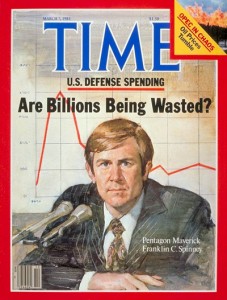
Here's what is circulating (assuming this budget impasse can be resolved, it gets more severe if it isn't):
DoD to cut $800 billion over 4 years. $200 billion a year out of a $600 b budget.
3 government employees must retire/leave before any new hire is made.
About 3 years ago when I was a speaker at the Highlands Conference (they run a private conference for the Secretary of Defense), I was asked what the biggest unexpected challenge facing the US defense department was. My answer: The DoD will only have half the budget it has today in five years. The trick is going to be: how to get down to that number in an orderly way.
Phi Beta Iota: These are long overdue cuts and barely scratch the surface. Between out of control research, overseas bases, out of control contractors, and the Navy/Air Force obsession with big complex systems that are of little use 90% of the time, there is much more work to be done. It must be driven by intelligene with integrity. That is not something that is now available within the US Government. It is also time to end the early retirement of military employees that have not seen combat, and to end double-dipping by retirees who sign on with contractors. One paycheck per person should be the standard. Anyone working after retirement gets up to 80% of their retirement check suspended with thanks from a grateful public.
By David Greenberg, Washington Post Outlook, 29 July 2011
David Greenberg is a professor of history and of journalism and media studies at Rutgers University. He is a fellow at the Woodrow Wilson International Center for Scholars for the 2010-11 academic year.
EXTRACTS
“Age of Greed” chronicles how Americans ended up with the highly unregulated financial system that produced the meltdown of 2008 and the fallout that lingers three years later. What’s most novel about the book, which relies heavily on other secondary accounts, is that unlike other recent treatments of the financial crisis, it traces the origins of the problem not to the Bush or Clinton or even Reagan years, but all the way to the late 1960s.
. . . . . .
The real scandal revealed by Madrick’s important book is not the well-known tales of dastards such as telecom analyst Jack Grubman or Internet stock promoter Frank Quattrone, but the more elusive — and more consequential — story of how the government came to abdicate this supreme responsibility.
I have worked for several months to develop the ideas in this article and to articulate them in an accessible way. They are fundamental understandings underlying the co-intelligence vision of a wiser democracy.
If the ideas intrigue you, you can find a longer version with more detailed guidelines and references online. I wrote the abstract below to make it easier for you to see the whole pattern at once. I hope you find both versions interesting and useful.
As a civilization we have tremendous collective power, but we don't always use it wisely. We can make good decisions, but we face messy, entangled, rapidly growing problems with complex, debatable causes. Efforts to solve one problem often generate new ones. We need more than problem-solving smarts here. We need wisdom.
A good definition for wisdom here is
the capacity to take into account
what needs to be taken into account
to produce long term, inclusive benefits.
To the extent we fail to take something important into account, it will come back to haunt us. But often we only realize we overlooked something long after our decision has been implemented. Certain practices – because they lead us to include more of what's important – can help us meet this challenge. Here are eight complementary ways to do this. The more of them we do, and the better we do them, the wiser our collective decisions will be. Continue reading “Tom Atlee: Making Wise Decisions on Public Issues”
Attached 17-page (12 plus footnotes) paper is worth reading. Much to agree with, little to dispute. Major thesis is that Army has, since about 1989, transformed from a citizen force that may go nowhere for decades to a professional legion that deploys operationally on a routine basis.
The single part that most seized me is that portion of the abstract that reads, “… In the midst of a civilian society that is increasingly pacifistic, easygoing, and well adjusted, the Army (career and non-career soldiers alike) remains flinty, harshly results-oriented, and emotionally extreme. The inevitable civil-military gap has become a chasm.”
The government’s treatment of former National Security Agency official Thomas Drake was abusive and akin to acts of British tyranny in pre-Revolutionary War days, said Judge Richard D. Bennett at the July 15 sentencing hearing which concluded the Drake case, one of the Obama Administration’s record number of anti-”leak” prosecutions. A transcript (pdf) of that hearing was prepared at the request of Secrecy News.
Today, the Drake defense team filed a motion (pdf) to remove the court-imposed restrictions on one of the documents that Mr. Drake was accused of unlawfully possessing so that the purported classification of the document could be formally challenged by one of the defense’s expert witnesses — who is none other than the former head of the organization that oversees the entire classification system.
Phi Beta Iota: At multiple levels and in multiple forms, we consider the US Government abuse of secrecy–and its abuse of human beings behind the veil of secrecy, to fall into the “Other Atrocities” category among the ten high-level threats to humanity.
America owes foreigners about $4.5 trillion in debt. But America owes America $9.8 trillion.
Phi Beta Iota: Details below. The lies and misrepresentation from all sides in Washington are reprehensible. The distance between the truth and those in power has never been greater. It turns out the US owes the largest chuck (30.3%) to the US Treasury and the Social Security fund; next up is 6.6% to US households, and then a plethora of banks and funds that could easily be stiffed for a year.