Intelligence is a tool for power and traditionally very sensitive by nature. Well-established and bureaucratic resistance, international positioning and working methods hamper cooperation concerning intelligence. In a multifunctional and multinational peace operation a lot of informal structures are intertwined with formal structures.
EXTRACT
In order to create a picture of the widest spectrum in a multifunctional mission cooperation is necessary among military, police, Governmental- and International organisations and NGO`s. Intelligence services need to communicate with each other, and multi-lateral agreements need to be established to governing the collection, analysis and sharing of intelligence.
Despite budget woes, the military is preparing for a conflict with our biggest rival — and we should be worried
This summer, despite America’s continuing financial crisis, the Pentagon is effectively considering trading two military quagmires for the possibility of a third. Reducing its commitments in Iraq and Afghanistan as it refocuses on Asia, Washington is not so much withdrawing forces from the Persian Gulf as it is redeploying them for a prospective war with its largest creditor, China.
. . . . .
AirSea Battle, developed in the early 1990s and most recently codified in a 2009 Navy-Air Force classified memo, is a vehicle for conforming U.S. military power to address asymmetrical threats in the Western Pacific and the Persian Gulf — code for China and Iran. (This alone raises a crucial point: If the U.S. has had nothing but trouble with asymmetrical warfare for the last 45 years, why should a war with China, or Iran for that matter, be any different?) It complements the 1992 Defense Planning Guidance, a government white paper that precluded the rise of any “peer competitor” that might challenge U.S. dominance worldwide.
. . . . . . .
For the first time since the end of the Cold War, the U.S. government has encountered the practical limits of the 1992 Defense Planning Guidance.
. . . . . .
Here is a noble appeal for Washington to match its commitments with the resources needed to sustain them, the absence of which has fueled the debt crisis that nearly reduced the United States to a mendicant state. Such are the crippling costs of a defense policy that makes global hegemony a mindless imperative.
Three Good Reasons to Liquidate Our Empire and Ten Steps to Take to Do So
1. We Can No Longer Afford Our Postwar Expansionism
2. We Are Going to Lose the War in Afghanistan and It Will Help Bankrupt Us
3. We Need to End the Secret Shame of Our Empire of Bases
. . . . . . . .
Chalmers Johnson
10 Steps Toward Liquidating the Empire (Abridged)
Dismantling the American empire would, of course, involve many steps. Here are ten key places to begin:
1. We need to put a halt to the serious environmental damage done by our bases planet-wide. We also need to stop writing SOFAs that exempt us from any responsibility for cleaning up after ourselves.
2. Liquidating the empire will end the burden of carrying our empire of bases and so of the “opportunity costs” that go with them — the things we might otherwise do with our talents and resources but can't or won't.
3. As we already know (but often forget), imperialism breeds the use of torture. Dismantling the empire would potentially mean a real end to the modern American record of using torture abroad.
4. We need to cut the ever-lengthening train of camp followers, dependents, civilian employees of the Department of Defense, and hucksters — along with their expensive medical facilities, housing requirements, swimming pools, clubs, golf courses, and so forth — that follow our military enclaves around the world.
5. We need to discredit the myth promoted by the military-industrial complex that our military establishment is valuable to us in terms of jobs, scientific research, and defense. These alleged advantages have long been discredited by serious economic research. Ending empire would make this happen.
6. As a self-respecting democratic nation, we need to stop being the world's largest exporter of arms and munitions and quit educating Third World militaries in the techniques of torture, military coups, and service as proxies for our imperialism.
7. Given the growing constraints on the federal budget, we should abolish the Reserve Officers' Training Corps and other long-standing programs that promote militarism in our schools.
8. We need to restore discipline and accountability in our armed forces by radically scaling back our reliance on civilian contractors, private military companies, and agents working for the military outside the chain of command and the Uniform Code of Military Justice. Ending empire would make this possible.
9. We need to reduce, not increase, the size of our standing army and deal much more effectively with the wounds our soldiers receive and combat stress they undergo.
10. To repeat the main message of this essay, we must give up our inappropriate reliance on military force as the chief means of attempting to achieve foreign policy objectives.
Phi Beta Iota: The second article is a stunning review of the intellectual life of Chalmers Johnson, who was among many things a net assessments analyst for Allen Dulles. He pioneered the study of “State Capitalism” and considered the US to be a greatly under-performing economy for its failure to move away from military unilateralism and toward sustainable development.
Phi Beta Iota: DoD has not had a global engagement strategy nor a mature joint/multinational acquisition strategy that we know of….the Services have refused to work together and fought for budget share rather than for capabilities relevant to reality and to the safety of the individuals actually going into combat (4% of the force that gets 80% of the casualties and 1% of the budget). In a word, DoD lacks integrity at the policy and acquisition levels such that no degree of operational excellence can overcome. The top speed of the Chinook is 185 mph but that is when it is empty, flying below 6,000 feet, and on a delightfully warm not humid day. These people were sent to their death because DoD does not have the integrity to plan for combat helicopters capable above 6,000 feet. Sending them into combat like that is the equivalent of sending a SWAT team into a gang fight aboard a train of golf carts. SHAME!
My good friend Pierre Sprey took issue with my characterization of Steven Walt's critique of US grand strategy as being excellent subject to two omissions. Attached herewith are Pierre's comments — they are spot on, and I stand corrected on my characterization of “excellent” … or perhaps more accurately … I stand clearly and fairly skewered. 😉
Chuck Spinney
Cap Ferrat, France
Comments by Pierre Sprey:
Chuck,
Although I appreciate that Mr. Walt's heart is in the right place–particularly regarding his admirably staunch opposition to the malign influence of the Israelis, the neocons and “W”–his essay's concept of US grand strategy for the last two decades is just as shallow as the crap from the NYT, the WSJ, the Post and the Council on Foreign Relations. He commits the two fundamental errors common to nearly all foreign policy pundits, errors that inevitably reduce their beard-stroking discussions of “grand strategy” to silliness:
1. He assumes that the US has a foreign policy or a grand strategy when in fact it has none. The US government's actions, like every other country's, are dominated by its domestic politics. And those politics dominate every move made with regard to other countries.
2. He ignores the three most powerful–and most permanent–domestic influences on America's actions abroad: Big Oil, Wall Street and the MICC. Anybody who ignores these three in recounting U.S. actions abroad is either a) hopelessly out of touch, or b) is serving the interests of the defense, financial or oil establishments, or all three.
Aside from these two crippling errors in his reasoning, Mr. Walt's fulsome praise for the success of the USG's “offshore balancing”–that is, the Big Oil (and MICC) inspired policy of setting Iran and Iraq at each other's throats since the 1940s–shows either profound ignorance or profound Kissingerian cynicism.
One last piece of silliness in the Walt essay, quite common to journalists and historians seeking a “hook” for their American Empire story, is the idea of the August 2, 1990 “turning point”, a date that marks the beginning of the decline in our allegedly successful empire. Such hooks only mask the inescapable spread of rot within empires, usually starting at birth.
With Mr. Walt's help, I am coming to believe all public discussions of grand strategy should be greeted with howls of derisive laughter.
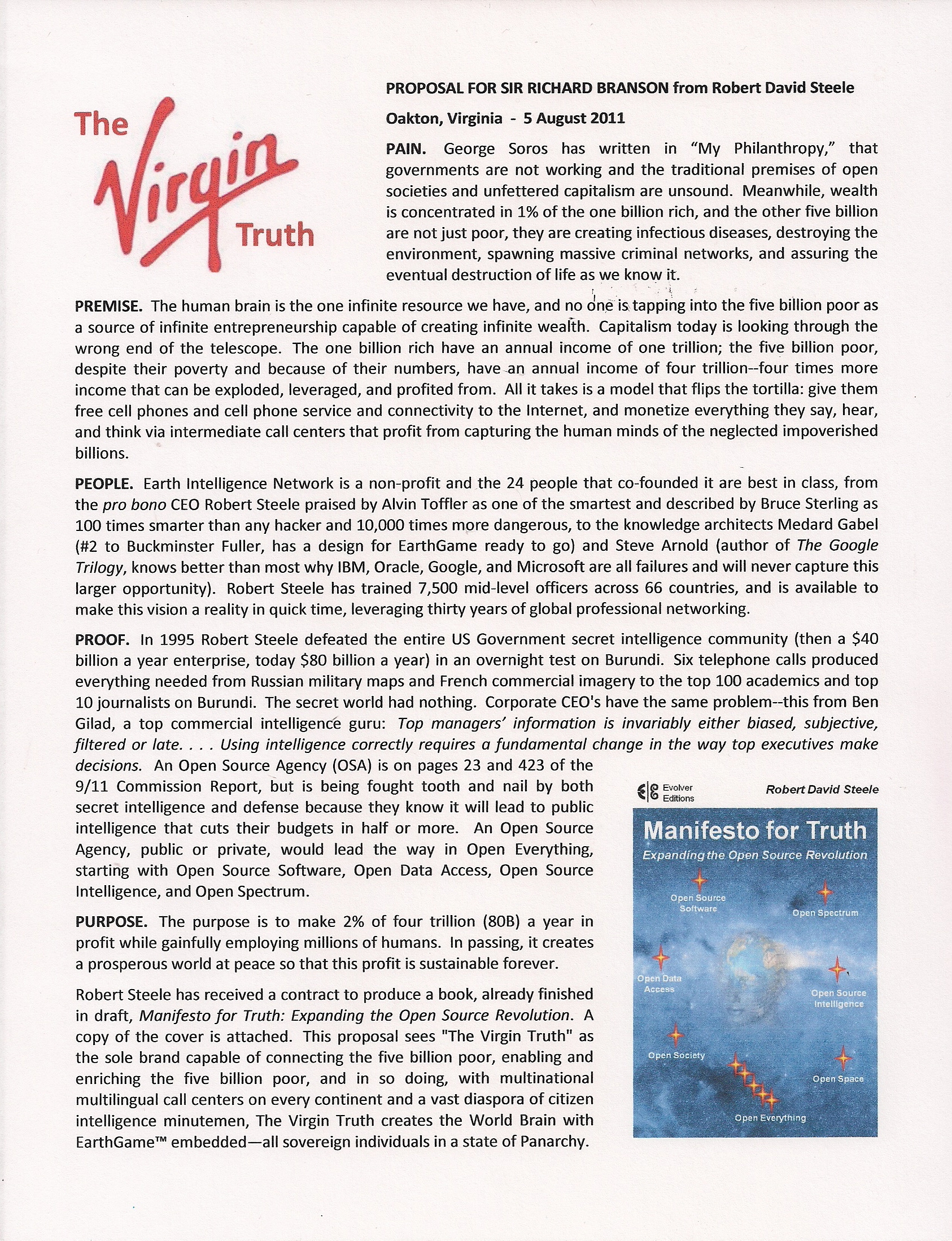
There is a very talented author, journalist, and speaker, Mike Southon, who publishes in the Financial Times. One of his articles, “Perfect Pitch,” 7 March 2009 was instrumental in crafting the below one-page “pitch.” Mike's four web sites:
There are numerous misleading and misinformed assertions being made about the defense spending parts of the debt deal.
The White House's “fact sheet” asserts a $350 billion savings in the “base defense budget.” The $350 billion in defense savings that the White House declares apparently uses a different “baseline” (basis of comparison) and pretends that a two year cap the bill establishes on “security” spending will extend to ten years. Most misleading of all, it assumes that all savings in the “security” category (which includes DOD, DOE/nuclear weapons, all State Department related spending, Veterans Affairs, and Homeland Security) will occur only in DOD spending. In fact, the “security” category was designed to broaden the base for “defense” cuts and to lessen the impact on DOD. The undocumented $350 billion in “security” savings will actually translate into lesser reductions in DOD spending, but the amount is unknown. The actual amount will be decided by Congress in the future.