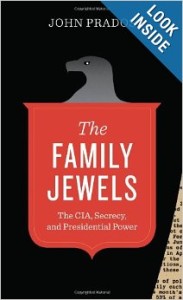
4.0 out of 5 stars5 fpr content, 3 for editing, 4 on balance — a unique book that could have been better, November 23, 2013
My review itemizes the highlights. This is a valuable book that is unique in its summary of both the historical misdeeds of the CIA and the fast forward current misdeeds of the past two Administrations (Bush-Cheney and Obama-Biden). However, this book could have been better. I recommend a second edition with vastly more attentive editing and a moderate inclusion of sub-titles and visualizations.
Three big points up front:
01 The author has chosen not to include mind-control in this book, nor does he include active ties with criminal organizations including the Boston to NYC to DC pedophile rings as well as the Catholic Church as enabler. So the book might better be titled “Most But Not All of the Family Jewels.”
02 By its nature, focusing on blatant mis-deeds, the book does not — nor should it be expect to — address the larger misdeeds of the CIA, such as being worthless or wrong most of the time [I've served in three of the four directorates, I continue to believe that CIA can and should be saved, but right now it is a basket case]. Under my signature below are four online references on this point.
03 This is a book about the CIA, which is the “runt” of the intelligence litter when compared to ODNI, NSA, NGA, and defense intelligence. I consider NSA to be vastly more criminal, vastly less constitutional, and vastly more worthless than CIA — the return on investment for CIA is perhaps 20%, for NSA less than 2%. For direct access to most of my reviews of intelligence books here at Amazon, seek out < Worth a Look: Book Reviews on Intelligence (Most) >.
The book is organized into a summary review of each of the following, with each chapter concluding with modern-day equivalents and prognostications that I consider a real value-added.
Important History Not Understood By Most, November 22, 2013
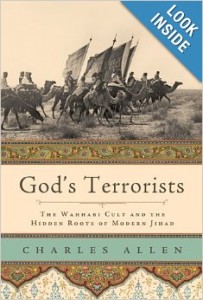
The historical half is mind-glazing, the more recent chapters highly relevant to understanding the deep ignorance of the US Intelligence Community and the US policy (prostitution) community these past 12 years.
I have given the book four stars in part because it is not designed to illuminate the threat in visualizable terms, and it is not up to date. Now that Saudi Arabia has declared war on the USA and the West generally (joining with Israel in a truly bizarre satanic alliance), and on Iran and the Shi'ite portion of Afghanistan specifically, this book absolutely merits updating and republication, hopefully with some decent maps and graphics and tables this next time around.
Early on in a nut-shell: Wahhabism spread in the 19th century, first throughout the Arabian penninsula and then to the Indian subcontinent including what are now India, Pakistan, and Afghanistan. Wahabbism is both a fundamentalist ideology that wins over deep converts, and a form of mercenary religion, buying its way into susceptible corners.
The most important point stressed throughout the book is that Wahhabism is outside the mainstream of Muslim society.
The big surprise for me, and one reason I am distressed at how badly we prepare people for service in this area, is the deep history of Wahhabism among the Pashtun. Today Saudi Arabia and to a lesser extent Qatar and the United Arab Republic seem bent on funding a religious war in Central and South Asia, and no one seems to be paying attention to this emergent threat. I would go so far as to say we are now, in this region, where we were in 1988-1989 when the Saudis first began funding the global Islamic outreach program led by Sheikh Binbaz and represented in part by young Bin Laden.
5.0 out of 5 starsAn amazingly deep yet concise review of Haqqani balancing act — local, regional, global, November 22, 2013
This book is in our J-2 library in Afghanistan and while I have not discussed it with others, believe it is well-regarded. For me it accomplishes something I have not seen elsewhere: it explains the Haqqani, the second most violent and largest group after the Taliban, and it does so concisely.
What I particularly appreciate about this book is the coherent manner in which it examines the value propositions that have positioned Haqqani today at the local, regional, and global levels.
The author's credit Haqqani's emergence in the early days to two value propositions: first, the offering of safehaven in Waziristan; and second, the ability to deliver violence on order for the Pakistani military and ISI.
The authors conclude that Haqqani displaced Hezb-i-Islami HIA/HIG) because the Haqqani have had and still have a superior savvy of tribal politics which in turn led to their earning a larger share of the CIA money passed through the ISA by CIA. Above all the authors credit the Haqqani with being able to manage a nuanced balancing act across borders and interests.
Here is the meat, summary notes for those without the time to absorb this excellent book directly:
5.0 out of 5 starsWell-Regarded in Afghanistan, A Real Gem, November 22, 2013
This book is in our J-2 Library in Afghanistan, and it is a very well-regarded gem.
This is a vitally important book. The author drives the value-proposition home with his Afterword, entitled “Truth as a Casualty of COIN.” His core point: lies kill military efficiency (including military learning). Those who would cite the vast spectrum of presidential and DoD directives and concepts and so on clearly are as out of touch with reality as the well-intentioned dolts that signed off on all that junk. Prior to reading this book I articulated — and had checked by colleagues at the US Army Strategic Studies Institute (SSI) and across Special Forces — some harsh comments in my summary critical review of The Accidental Guerrilla: Fighting Small Wars in the Midst of a Big One.
Being a strong critic of defense idiocy and corruption myself, coming off 20 years of trying to get the US Intelligence Community to actually produce ethical evidence-based decision-support, this book by a former commander who is now teaching history at West Point should be required reading in all the schools from entry-level to war college.
The author opens early with his view that the COIN understanding of “the population” is delusional (he is being kind). The population is indeed the center of gravity, but if one is going to substitute technology for thinking, ideology for policy, and corrupt puppets for indigenous leadership, then one should expect to implode. As I have lectured here are there, including to civil affairs cannon fodder at Fort Bragg, “no amount of tactical excellence can make up for strategic decrepitude.” (see the definition of the latter term of art in my review of Clausewitz and Contemporary War).
The book focuses on the disconnect between a military trained, equipped, and organized to fight wars, and the “light infantry” variant that pretends to win hearts and minds while kicking down doors and running air strikes on civilians. The fact is that if there is no Whole of Government endeavor, if the Department of State is the Department of Nothing as Andrew Cockburn recently slammed Boffo Haircut (who gave up his integrity when looking into CIA's role in Iran Contract and the cocaine crack explosion), then the military is on a fool's errand at great expense in terms of blood, treasure, and spirit.
I am reminded of DIME by the early portion of the book. We need all four — diplomatic, informational, military, and economic. The fact is that we have a military that is dysfunctional and corrupt to the bone across strategy, policy, acquisition and operations, and a “paper tiger” across the other three domains.
There are five short quotes I have selected that capture the essence of the book, which I will follow with a final comment and eight other recommended books.
QUOTE (117): “When a state gets its strategy right in war, tactical problems tend to be subsumbed and improved within it.” This is an entire book waiting to be written — and the obverse of my comment to the civil affairs gladiators.
QUOTE (118): “But sometimes, in a war that involves limited policy airms, there may well be alternatives to victory.” Here I would point out that until last year the morons in DC conflated Al Qaeda and the Taliban — I do not make this stuff up. These are the same people that did not know Iraq was a Sunni minority ruling over a Shi'ite majority.
QUOTE (127): “The counterintelligence narrative posits that savior generals have game-changing effects, but it over-states their influence on the course of the war.” Yes, to which I would add, it is not helpful to have a Zionist bimbo sharing your bed and a G-2 without the balls the call a counterintelligence foul when he sees one.
QUOTE (128): “…hearts and minds counter-insurgency carried out by an occupying power in a foreign land doesn't work, unless it is a multigenerational effort.” To understand the details, search for my Marine Corps University short paper (summary of a 1976 thesis), < 1992 MCU Thinking About Revolution >. No one in DC gets any of this.
QUOTE (132): “American strategy has failed in Afghanistan because it became tapped by the promise that counterinsurgency can work only if it is given enough time…” See my summary review of Colin Gray's utterly gripping Modern Strategy — time is the one strategic variable that cannot be bought nor replaced. The corruption of US foreign and national security policy, deepened by the assassination of John F. Kennedy 50 years ago by a mix of Texas energy, New York money, CIA, and out of control elements of the rest of the US government, has wasted 50 years and destroyed the Republic. Time matters. So does integrity.
I am not going to summarize the most precious part of the book, pages 133-135, read these in the library or a bookstore if you cannot take the time to ingest the entire book.
I've had to work my way through multiple generations of flag officers divorced from reality and inattentive to the public interest. I dare hope that the serving Chief of Staff of the US Army is paying attention, and that this particular colonel might rise to be one of the thinking generals. Certainly I cannot count more than five in my lifetime out of the sixty or so I have known (Zinni is one of best and on record as saying that the US IC provided him “at best” 4% of what he needed to know as CINCENT). Consider helping me with the following SSI monograph under development, search for < 2013 ON REVOLUTION — Helpng Transform the US Army Consistent with CSA Guidance >
Buy this book, read it, display it, and share it. Let that be your act of loyal dissent this week.
Semper Fidelis,
Robert David STEELE Vivas INTELLIGENCE for EARTH: Clarity, Diversity, Integrity, & Sustainability
This review is from: War Is a Force that Gives Us Meaning (Paperback)
War is a Force that Gives us Meaning
When cultures of violence get mixed up with myths of war
Chris Hedges is a scholar of immense talents, who has “been there, done that;” (and bought the Tee shirt). He is as familiar with the art of war as is Sun Tzu, and arguably much smarter. Plus his sensibilities are different: keener, and in the right place — more refined and more severely tilted towards an instinct for building a better more humane world. With his own considerable experiences as a war correspondent as backdrop, Hedges uses his award-winning literary skills and his “over-sized” intellect to enlighten us about things that we already should know about: That war is hell; and that everything that glorifies it is a monumental but soothing lie!
When Cultures of Violence get mixed with the Myths of War, November 19, 2013
Herberg L. Calhoun
When cultures of violence get mixed up with myths of war
Chris Hedges is a scholar of immense talents, who has “been there, done that;” (and bought the Tee shirt). He is as familiar with the art of war as is Sun Tzu, and arguably much smarter. Plus his sensibilities are different: keener, and in the right place — more refined and more severely tilted towards an instinct for building a better more humane world. With his own considerable experiences as a war correspondent as backdrop, Hedges uses his award-winning literary skills and his “over-sized” intellect to enlighten us about things that we already should know about: That war is hell; and that everything that glorifies it is a monumental but soothing lie!
Why should we already know this? Because all of the “true” soldiers, all of the “true” military patriots — from George Washington down to Generals Dwight Eisenhower and Wesley Clark — have told us that it is so. And yet, as this author's essay so aptly punctuates, we are all still intoxicated by war. It is a deadly insidious drug that we still just cannot give up. We readily “mainline it,” “we sample it,” “wallow in it,” tell lies about it, wish to be draped in its vicarious glory, and as a nation with an out of control military industrial complex, we have severely “OD-ed” on it.
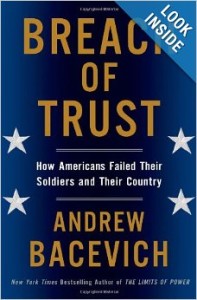
Andrew Bacevich's latest offering, BREACH OF TRUST, is going to make a lot of people squirm – if people read it, that is. Because in this book he tells us flat out that an all-volunteer army in a democratic society simply does not work, and that the present system is “broken.” It is bankrupting our country, and not just financially, but morally. He tells us that Iraq and Afghanistan, two of the longest and most expensive wars in U.S. history, have evoked little more than “an attitude of cordial indifference” on the part of a shallow and selfish populace more concerned with the latest doings of the Kardashians, professional superstar athletes or other vapid and overpaid millionaire celebrities, reflecting “a culture that is moored to nothing more than irreverent whimsy and jeering ridicule.”
Bacevich cites General Stanley McChrystal, former commander of all U.S. and NATO forces in Afghanistan, who spoke about having “skin in the game,” meaning that when a country goes to war every town and city should be at risk. McChrystal went on to say the unthinkable: “I think we'd be better if we actually went to a draft these days … for the nation it would be a better course.”
Horrors! That dreaded “D” word finally uttered aloud. Well, I'd say it's about damn time. And Bacevich agrees, noting that in his many speaking engagements over the past ten years “I can count on one hand the number of occasions when someone did NOT pose a question about the draft, invariably offered as a suggestion for how to curb Washington's appetite for intervention abroad and establish some semblance of political accountability.”

 Important History Not Understood By Most, November 22, 2013