Drawing upon 40 years' experience as an ecological farmer and marketer, Joel Salatin explains with humor and passion why Americans do not have the freedom to choose the food they purchase and eat. From child labor regulations to food inspection, bureaucrats provide themselves sole discretion over what food is available in the local marketplace. Their system favors industrial, global corporate food systems and discourages community-based food commerce, resulting in homogenized selection, mediocre quality, and exposure to non-organic farming practices. Salatin's expert insight explains why local food is expensive and difficult to find and will illuminate for the reader a deeper understanding of the industrial food complex.
Amazon Page
From farmer Joel Salatin's point of view, life in the 21st century just ain't normal. In FOLKS, THIS AIN'T NORMAL, he discusses how far removed we are from the simple, sustainable joy that comes from living close to the land and the people we love. Salatin has many thoughts on what normal is and shares practical and philosophical ideas for changing our lives in small ways that have big impact. Salatin, hailed by the New York Times as “Virginia's most multifaceted agrarian since Thomas Jefferson [and] the high priest of the pasture” and profiled in the Academy Award nominated documentary Food, Inc. and the bestselling book The Omnivore's Dilemma, understands what food should be: Wholesome, seasonal, raised naturally, procured locally, prepared lovingly, and eaten with a profound reverence for the circle of life. And his message doesn't stop there. From child-rearing, to creating quality family time, to respecting the environment, Salatin writes with a wicked sense of humor and true storyteller's knack for the revealing anecdote.
The food trend becomes ever more alarming. For people like Ronlyn and myself, who eat out of our garden, it has little impact, but for millions who don't have that option, the story is becoming ever bleaker. The Obama Administration's active complicity in this trend should be a national scandal.
Egypt:Mursi's speech. President Mursi delivered a televised speech late on 2 July in which he said he will complete his four year term of office. He mentioned the word democracy 20 times and legitimacy 57 times in the 37 paragraphs of the 40-minute speech
In the first 7 paragraphs Mursi reviewed the events that led to his election, stressing the word democracy.
In paragraph 8 he introduced the theme that democracy and the constitution approved last December are the bases of his legitimacy.
In 9 to 16 he accused Mubarak supporters of wanting to reverse the revolution; warned the youth to not be deceived and stressed that he was elected in free elections and his burdens are heavy.
In paragraph 17 he urged all Egyptians to avoid harming the Egyptian Army.
In 18 he stated that there is no alternative to legitimacy. He welcomed dialogue with peaceful opposition members who respect legitimacy but said he must act against those who threatened violence.
The most important paragraphs,18-22, have received no coverage in mainstream press.In these Mursi admitted that he had been informed by a mediator about an initiative to change the government, with the full knowledge of the Prime Minister and the Armed Forces command a few days ago. Paragraph 21 stipulates that this initiative involved holding new elections in six months, forming a national coalition, formation of a national reconciliation committee, development of a media code of conduct.
NOTICE: We are suspending our update of this index. All CRS reports will continue to be offered at the Federation of American Scientists, and updated as new version are received, but we will not longer maintain this separate index.
Updated FAS new 2 June 2015.
All links lead to Federation of American Scientists (FAS) archives. Only the most recent report in any given series is preserved, If it is listed, it is the latest available version.
NB 17 Jan 14: In the areas listed below and linked, FAS is the original comprehensive listing in reverse order as received — our index in support of FAS is in alphabetical order within a broader focus centered on intelligence and sane (honest) informed national strategy, policy, acquisition, and whole of government operations, all non-existent today in the USA. We have added Secrecy & Information Policy as a category.
Agriculture Including GMO & Global Food Aid
Acquisition, Fraud, Waste, & Abuse
Budget Including Authorization & Appropriations
Charity, Non-Profits, & Society
Commerce, Economy, Foreign Investment, Trade (with sub-categories)
Congress
Constitutional Issues
Cyber & Internet Including FOI, Privacy, NSA, Etcetera
Debt (including Deflation & Inflation)
Defense (with sub-categories)
Drugs, Drug Testing
Education including Student Loans
Electoral
Energy
Environment & Environmental Degradation and Disasters
Executive / Government Operations
Family including Abortion & Poverty
Foreign Relations (with countries in alphabetical order)
Health including Insurance
Homeland Security
Immigration
Indian Affairs
Intelligence Including Counterintelligence
Judiciary
Labor, Homelessness, Society, & Unemployment
Law Enforcement (includes Terrorism)
Research & Development
Revenue & Taxation [see also Debt]
Science, Technology, Engineering, & Mathematics
Secrecy & Information Policy
Social Security
Space Policy
State & Local Governance & Issues
Transportation Including Infrastructure & Risk
Wall Street, Federal Reserve, Financial Crime, IMF Plus
Water
There was a lot of talk about software agents about ten years ago — computer code that would seek, filter, and deliver information specific to your interests I have not tried this yet, but I'm interested that people are trying with today's technology — and that RSS is one of its building blocks.
But what if you don’t want to have to ask? Search engines are fantastic, but they still require that you go to them and then try to figure out how to formulate your query in a way that gets you decent results.
Primal already has the ability to understand what you want, and we’re now working on some technology that will let Primal deliver you the content that you truly care about before you know you want it.
Read on to learn more about Primal’s new software agent and content streaming framework.
What we’ve got cooking
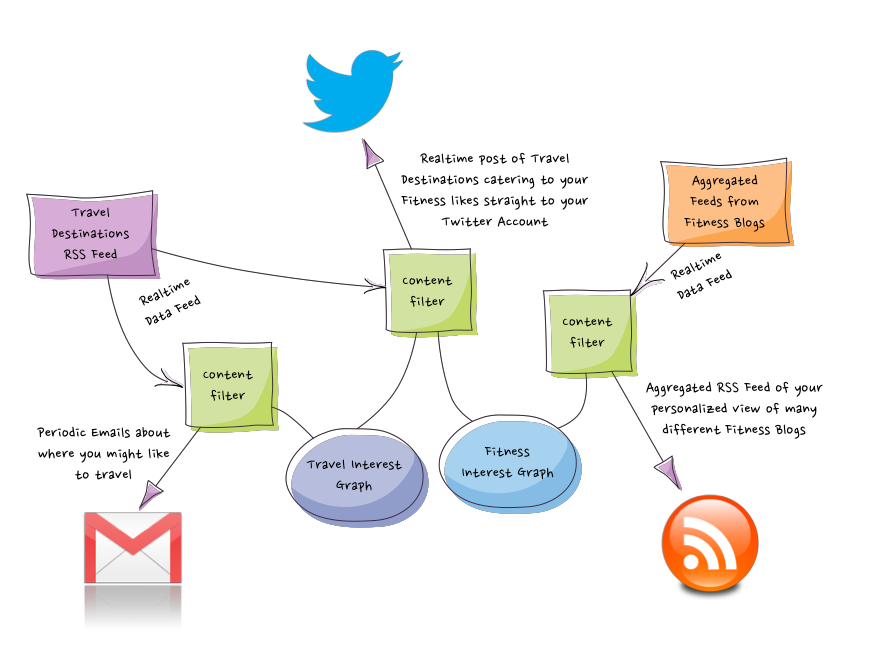
If you want Primal to bring you the content you care about, or send that content to someone else on your behalf, or mix it all up in a blender so you can drink it in your morning protein shake… no problem.Let’s say you have interests in Fitness and Travel. You’ve told Primal about these interests and Primal has dutifully created an interest graph to represent them. Now, you want to filter massive amounts of content through these interests as it becomes available, and route that to various places on your behalf.
The National Academy of Engineering (NAE) and US Institute of Peace (USIP) co-organized a fascinating workshop on “Sensing & Shaping Emerging Conflicts” in November 2012. I had the pleasure of speaking at this workshop, the objective of which was to “identify major opportunities and impediments to providing better real-time information to actors directly involved in situations that could lead to deadly violence.” We explored “several scenarios of potential violence drawn from recent country cases,” and “considered a set of technologies, applications and strategies that have been particularly useful—or could be, if better adapted for conflict prevention.”
. . . . . . . .
This explains why Sanjana is right when he emphasizes that “Technology needs to be democratized […], made available at the lowest possible grassroots level and not used just by elites. Both sensing and shaping need to include all people, not just those who are inherently in a position to use technology.” Furthermore, Fred is spot on when he says that “Technology can serve civil disobedience and civil mobilization […] as a component of broader strategies for political change. It can help people organize and mobilize around particular goals. It can spread a vision of society that contests the visions of authoritarian.”
In sum, As Barnett Rubin wrote in his excellent book (2002) Blood on the Doorstep: The Politics of Preventive Action, “prevent[ing] violent conflict requires not merely identifying causes and testing policy instruments but building a political movement.” Hence this 2008 paper (PDF) in which I explain in detail how to promote and facilitate technology-enabled civil resistance as a form of conflict early response and violence prevention.
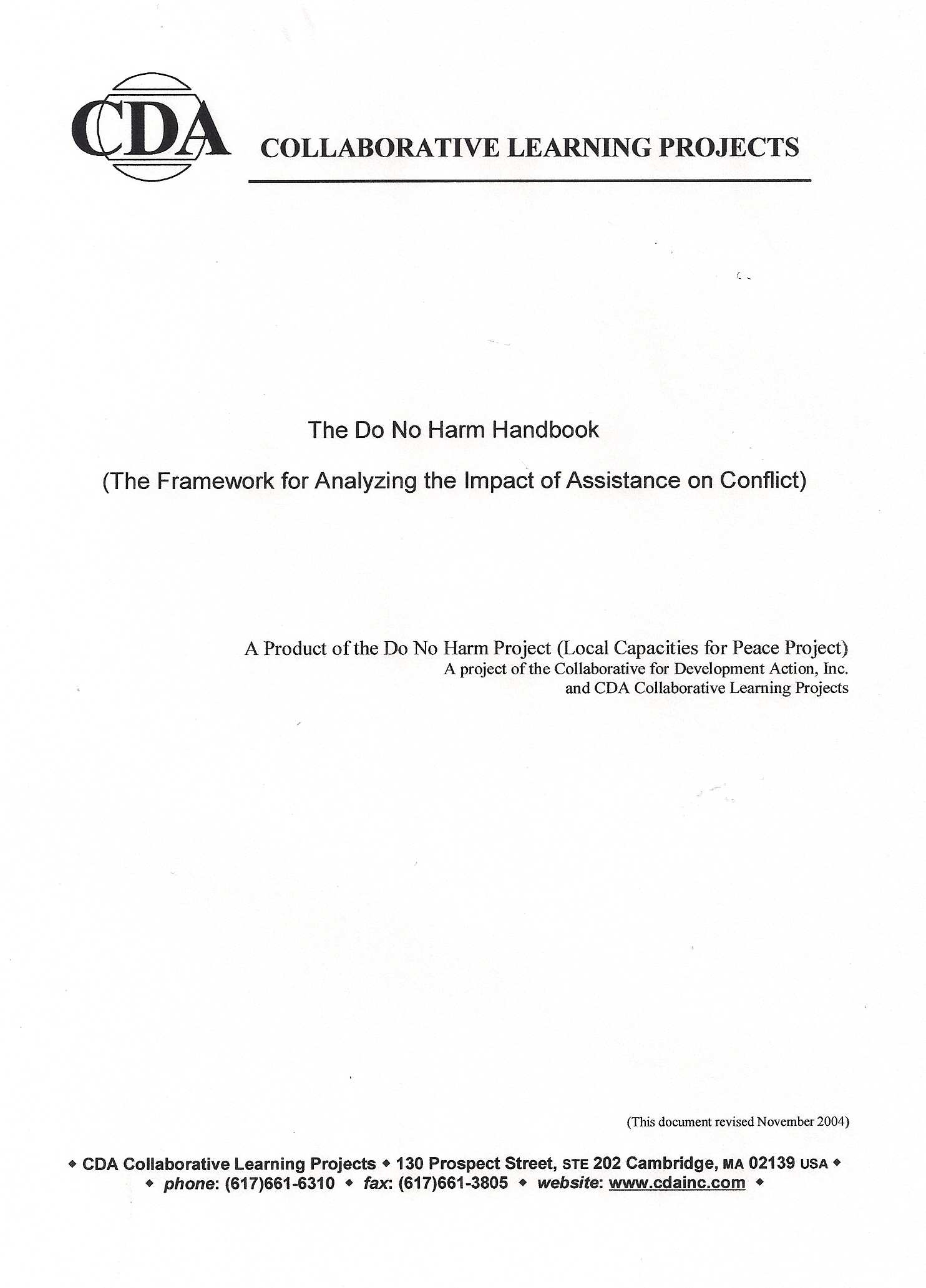
Phi Beta Iota: An extremely important document, last revised in 2004 but timeless in value. What most people do not realize about aid is that:
a) most aid is delivered without actually asking the people what they need or want
b) most aid organizations deliver less than 20% of donations to the field, in many cases less than 5%
c) aid generally creates black markets and incentives corruption — it prolongs conflicts to keep the aid coming for criminal exploitation purposes
d) there is no vehicle at this time for harmonizing micro-aid to the household and village levels and that appears to be the most urgent need
e) aid to one tribe can be destabilizing if other tribes feel slighted — there are cultural nuances that most national intelligence establishments simply do not understand.