Review (Guest): Conversations with Wall Street – The Inside Story of the Financial Armageddon & How To Prevent the Next One

5 Star, Capitalism (Good & Bad), Congress (Failure, Reform), Corruption, Country/Regional, Crime (Corporate), Crime (Government), Culture, Research, Economics, Executive (Partisan Failure, Reform), Justice (Failure, Reform), Politics, Power (Pathologies & Utilization)
0Shares
Amazon Page

Peter Ressler, Monika Mitchell

5 Stars

Co-authors Peter Ressler and Monika Mitchell have been 20-year Wall Street insiders as partners in an executive search firm. Their book is a page-turning account of the 2007-8 meltdown and continuing unsolved issues that will inevitably lead to the next crises. Woven throughout their analysis are conversations with dozens of top executives from Lehman, Goldman Sachs, Morgan Stanley, AIG, Deutsche Bank, UBS, Citibank, Bank of America, Wells Fargo and many hedge funds and private equity firms.

Only the executives' first names are used (for obvious reasons), which makes their recorded interviews with the authors more revealing, with all the vivid expletives un-redacted. We hear first-hand of how Wall Street's culture actually worked based on the “buyer beware” treatment of sophisticated clients. Pension funds were considered “big boys” who should do their own due diligence and against whom it was OK to bet that the securities sold to them would blow up. These were the market makers who, unlike the partnerships of yore, regularly took both sides of deals with their often unsuspecting customers while pushing ratings agencies to stamp these toxic products as triple-A. The prevailing culture is reflected in their language: “eat what you kill,” “ripping the face off” clients and the jungle rule of “survival of the fittest” (often incorrectly associated with Charles Darwin rather than originally coined by Herbert Spencer, a British economist of that era who wrote for The Economist).

Continue reading “Review (Guest): Conversations with Wall Street – The Inside Story of the Financial Armageddon & How To Prevent the Next One”

Josh Kilbourn: 51 Months of Recession – Report Card

03 Economy, Civil Society, Commerce, Corruption, Government, Media
0Shares
Josh Kilbourn

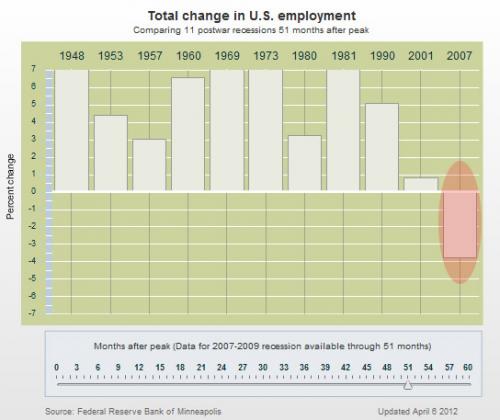
51 Months After The Start Of The Recession, Here Is The Report Card

Tyler Durden

ZeroHedge, 04/06/2012

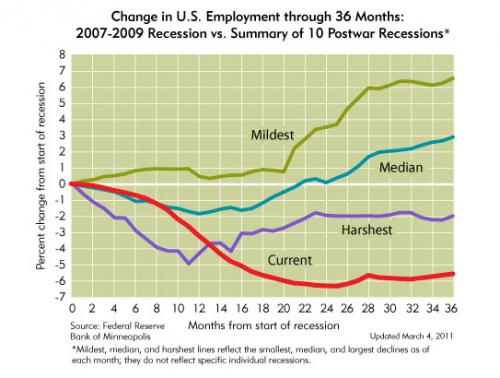
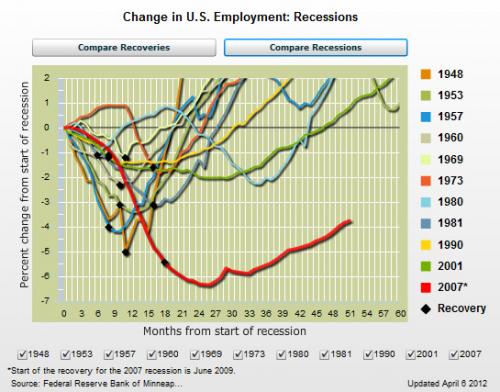
Recovery? What Recovery? 4 years after central banks have progressively injected over $7 trillion in liquidity into the global markets (and thus, by Fed logic, the economy), and who knows how many trillion in fiscal aid has been misallocated, to halt the Second Great Depression which officially started in December 2007, the US “recovery” is the weakest in modern US history! How many more trillions will have to be printed (and monetized) before the central planners realize that fighting mean reversion by using debt to defeat recore debt, just doesnt't work? Our guess – lots.

Incidentally, the US has now generated 3 million jobs since the trough of the recession in September 2010, until which point it had previously lost 8 million. Unfortunately, since the real labor force has grown by 4.6 million over the same period, or at the conventionally accepeted 90,000 labor pool entrants per month for 51 months, despite what the BLS may say, because America is after all growing, this means that the Obama administration has created a negative 1.6 million jobs net of demographics, which in turn have cost the US a modest $5.1 trillion in new debt, or an even modest $3.1 million in debt for every job lost.

Chart 1 – the current “recovery” in the context of all previous ones:

Click on Image to Enlarge

Chart 2 – Min, Max and Average… and now

Click on Image to Enlarge

Chart 3 – in bar chart format

Click on Image to Enlarge

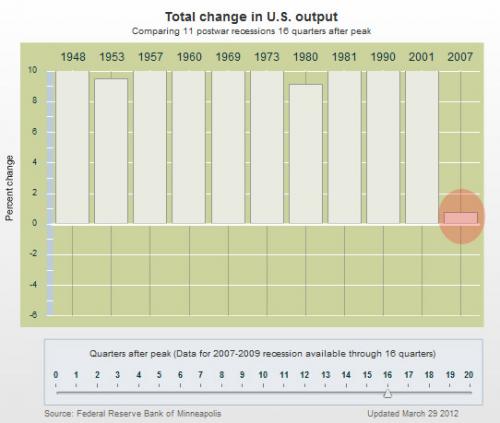
Chart 4 – There is good news: 16 quarters after the start of the recession, US output has turned positive. Just barely.

Click on Image to Enlarge

Phi Beta Iota: What is one to do when the government, with the full complicity of the two parties that monopolize power through various illegitimate means, the full complicity of the five major media corporations whose “mouthpieces” bury their intelligence along with their integrity, all lie to the public? Have we really become a nation of idiot sheep?  At what point is the government impeachable for lies to the public?

See Also:

THE OPEN SOURCE EVERYTHING MANIFESTO: Transparency, Truth & Trust

Journal: Reflections on Integrity UPDATED + Integrity RECAP

Chuck Spinney: Re-Industrialization of the USA

03 Economy
0Shares
Chuck Spinney

WEEKEND EDITION APRIL 6-8, 2012

Does It Matter Where the Factories Are?
by GÉRARD DUMÉNIL and DOMINIQUE LÉVY, Counterpunch
 The crisis that began in 2008 has brought the deindustrialization of the US and Europe, at the center of the global economic system, to the forefront of the debate. President Barack Obama has made it a key issue of his re-election campaign. There is a new word, “insourcing,” the opposite of “outsourcing” or sub-contracting. The idea is to return industrial production to national territory.
. . . . . .

As long as the general neoliberal framework, with all its elements — the hegemony of the capitalist classes and financial institutions, the complicity of senior management, financialization and globalization — remains unchallenged by “financial repression”, of the kind that took place in the US during the postwar period, all attempts to fight the process of deindustrialization, no matter how successful, will continue to be retrograde. They undermine what remains of the social gains made in the preceding decades, without making any clear contribution to the re-establishment of growth and the rebuilding of employment.

GÉRARD DUMÉNIL and DOMINIQUE LÉVY are economists and co-authors of  The Crisis of Neoliberalism, Harvard University Press, Cambridge (Massachusetts), 2011/.

Phi Beta Iota:  This is a very important article.  A government with intelligence and integrity would re-industrialize using the Open Source Everything ethos combined with the localized food-energy-water model.  As the authors point out, as long as criminal mind-sets continue to dominate government and industry, re-industrializing in the old form will make no difference to the public at large.

See Also:

THE OPEN SOURCE EVERYTHING MANIFESTO: Transparency, Truth & Trust

IVN Steele on Electoral Reform Part 11: Constitutional Amendment

Access
0Shares
Robert David STEELE Vivas

Steele on Electoral Reform – Part 11: Constitutional Amendment

Congress shall work toward a Constitutional Amendment that places Election Integrity outside the power of the government. That amendment, whose terms shall be formulated via the National Initiative for Democracy (National Ballot Initiatives). It might include but not be limited to such initiatives as: 1. Elimination of personhood for any organization

2. Affirmation of universal voter registration
3. Abolishment of the Electoral College
4. Balanced Budget
5. Termination of the Federal Reserve
6. Constraint on size and budget of the US Government
7. Re-enfranchises convicts who complete their sentences

NOTE: DC Statehood does not require Constitutional Amendment.

As with all of the other elements (this makes eleven in all), this one is still subject to crowd-sourcing and perhaps a mix of Citizen Wisdom Councils and National Ballot Initiatives.

My bottom line is that the eleven element together are more than able to attract, unify, and mobilize 100 million voters who can “occupy” the home offices of their Senators and Representatives and DEMAND, as a condition for NOT beginning recall actions against each of them, that this bill be introduced, passed into law, and signed by the President before 4 July 2012.

Time is the one strategic variable that cannot be bought nor replaced.  In my view 2012 has the potential to be a transformation year, but only if We the People mobilize, unify (Reform Coalition), and demand in unison–publish and read across the land a Statement of Demand, while insisting that each Member sign a Pledge as the price of being allowed to remain — on probation — as an incumbent.

Learn More

Previous: Part 10: Legislation

Next: Part 12: The Stakeholders

Sepp Hasslberger: Mark Boyer on Scientist Develops Self-Sustaining Solar Reactor That Produces Clean Hydrogen Fuel

05 Energy, Earth Intelligence
0Shares
Sepp Hasslberger

Mark Boyer

Scientist Develops Self-Sustaining Solar Reactor That Produces Clean Hydrogen Fuel

Hydrogen is a fuel that has seemingly limitless potential, but scientists have only been able to produce it from fossil fuels, like natural gas. That is, until now. A doctoral student in mechanical engineering at the University of Delaware has designed a new type of reactorthat produces hydrogen using nothing more than concentrated sunlight, zinc oxide, and water. And best of all, the zinc oxide used by the reactor can be reused, meaning that once the reactor is up and running, it would be self-sustaining.

Doctoral candidate Erik Koepf designed a large cylindrical reactor that is made of heat-insulating ceramic materials. With some help from gravity, zinc oxide powder is fed into the system from 15 hoppers, and concentrated sunlight enters through a quartz window and the aperture ring.

Click on Image to Enlarge

This week, Koepf will bring his reactor to Switzerland, where it will be tested for the first time at the Swiss Federal Institute of Technology in Zurich. In the testing phase, concentrated light equal to the energy of 10,000 suns will be focused on the reactor, bringing the temperature up to about 3,000 degrees Fahrenheit. Then the zinc oxide will be added, creating a reaction that will convert the powder into zinc vapor. Finally, the zinc will be reacted with water, producing hydrogen.

“The idea is to create a small, well-insulated cavity and subject it to highly concentrated sunlight from above,” Koepf explained in a release. If successful, the reactor could represent a major breakthrough, providing a new source of emission-free, completely sustainable fuel. Koepf’s advisor professor Ajay Prasad says he can imagine huge arrays of these devices in the desert producing hydrogen on an industrial scale.

Steve Aftergood: Scientific Accomplishment vs. Scientific Secrecy

Corruption, Government, Law Enforcement, Military
0Shares
Steven Aftergood

DALE CORSON AND SCIENTIFIC FREEDOM

Dale R. Corson, a nuclear physicist who died last week, is best remembered as the Cornell University President who peacefully led his campus through the turmoil and upheaval of the Vietnam era.  But he also played an influential role in deliberations over the role of secrecy in scientific research.

Dr. Corson chaired a 1982 committee of the National Academy of Sciences that produced a landmark study entitled “Scientific Communication and National Security,” which became known as the Corson Report.

In sober and measured tones, the Corson Report pushed back against calls for increased secrecy in government-funded science:

“Current proponents of stricter controls advocate a strategy of security through secrecy. In the view of the Panel security by accomplishment may have more to offer as a general national strategy. The long-term security of the United States depends in large part on its economic, technical, scientific, and intellectual vitality, which in turn depends on the vigorous research and development effort that openness helps to nurture…  Controls on scientific communication could adversely affect U.S. research institutions and could be inconsistent with both the utilitarian and philosophical values of an open society.”

President Reagan cited Dr. Corson in National Security Decision Directive 189, “National Policy on the Transfer of Scientific, Technical and Engineering Information,” which seemed to affirm that fundamental research should remain unrestricted to the maximum extent possible.  In fact, however, that directive imperfectly reflected the input of the Corson Report, noted Harold C. Relyea in his book “Silencing Science: National Security Controls and Scientific Communication.”

Still, many of the issues identified by Dr. Corson and his colleagues, and the concerns they expressed, remain current today and have not reached an unequivocal resolution, as evidenced most recently by the latest U.S. government policy on dual use biological research.

Continue reading “Steve Aftergood: Scientific Accomplishment vs. Scientific Secrecy”