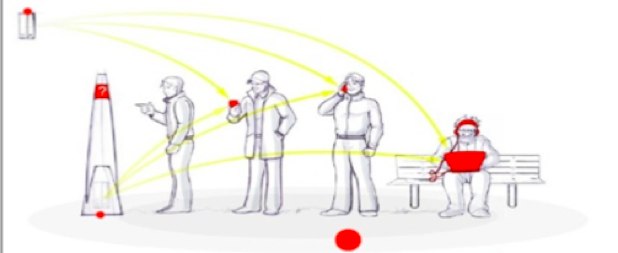
On January 7, 2010 I was ushered into a small private dinner with Secretary Hillary Clinton at the State Department along with the inventor of Twitter, Jack Dorsey, Eric Schmidt, CEO of Google and a few others. We were there to talk about technology and 21st Century Diplomacy. As we mingled I noticed next to me the small table that Thomas Jefferson wrote the first drafts of the Declaration of Independence. I was inspired by the history around us as we discussed the unfolding history before us. I was sitting in front of Secretary Clinton and when she asked me a question I said, “Secretary Clinton, the last bastion of dictatorship is the router.” That night seeded some of the ideas that were core to Secretary Clinton’s important Internet Freedoms Speech on January 21, 2010.
Phi Beta Iota: This is the kind of initiative that the Open Source Agency (OSA) could and should sponsor, integrating exploitation of and proliferation of the Open Source Tri-Fecta (open source software, open spectrum, and open source intelligence or decision-support).
Doc Searls has posted a slideshow explaining how Amazon’s user experience is broken, in the context of a discussion about vendor relationship management (VRM), which is about evolving a world where customers have at least symmetry in the power relationship of customer and vendor. The slides are old (January 2010) and things might have changed, but I don’t think they’ve changed as much as they should’ve, because I still experience similar frustrations when I visit Amazon.
Phi Beta Iota: Amazon is a great company with an extraordinary cloud offering and enormous potential they have chosen to leave unattended. They rejected a 2007 proposition (Amazon as the Hub of the World Brain) that would have seen them create a markeplace for informed relationships and knowledge by the call or page, and they have rejected all suggestions for enabling buyers, readers, and reviewers to “co-create” the Amazon experience. It's a pity mostly because the world need multiple forms of M4IS2 hybrids, and this is something Amazon could have provided as a service of common concern, with both the cloud for melded shared information and the authors and their readers as the human intelligence component.
“Idiot America” is great, informative book about concepts we see everyday. Also, many of the 1-star reviews are likely biased because of some of the political and religious topics noted. I think this book is definitely a full, 5-star book.
The Following comments aren't meant to be particularly negative towards the United States and the concepts in this book aren't exclusive to the USA. The concepts in “idiot America” exist all over the entire world. “Idiot America” is a superbly covered account of something that's very prevalent in the US.
Charles Pierce provides the history of “cranks” (con artists and showmen) from the founding of the nation to current examples today in contemporary America. I focused on TV and Radio because of it's widespread impact on the populace today (even in the age of the growing Internet, which is becoming dominant). Much of TV and Talk Radio promote misinformation based on emotion, histrionics, shock, being loud, and over-the-top attempts to get ratings.
The author notes “The 3 Great Premises: and applies them to many instances in this book:
1. Any theory is valid if it moves units (rating, and making money).
2. Anything can be true if it is said loudly enough.
3. Fact is what enough people believe (the Truth is what you believe).
There are many examples in this book. Here are just a few:
Plant operator Tokyo Electric Power Co. also acknowledged that one of the factors contributing to a rapid meltdown of reactor cores was the failure to keep emergency batteries safe from the tsunami, preventing a key emergency cooling system from performing its intended function.
Meanwhile, Tepco said one of the key causes of a rapid meltdown at Unit No. 1 was the failure of two emergency cooling mechanisms—the suppression pool and the isolation condenser—to perform their intended functions.
“We have here about 2,000 tons that you are looking (at), and you can stand here as long as you want to,” she tells me before quickly adding, “If we take one of these bundles out of the water I will give you 20 seconds to leave this room alive.”
Have you heard…….failure is one of the biggest indicators of future success in an entrepreneur. Many venture capitalists won't invest in a new enterprise if the founder has never undergone failure – why?
From failed efforts it is proven that we have our best learning experiences, we grow, and we gain the experiences necessary for future significant successes. The fact is that businesses will not assume the risks necessary for innovation and developments if they're not ok with the idea of failing on some level.
There are those who are so afraid of failing they will do anything to avoid it. The problem with fearing failure is that you ultimately avoid risk, and this can stunt your richest experiences. Apparently those who have never faced a failure in a product, division or business don't have the experience that is valued in business. However, no-one wants to fail!
The key is to manage for failures. Be prepared to share what went wrong and dissect it. Another strategy is to create a “disengagement process” for getting out of a project that is showing triggering signs of failure.
It could be assumed that it is simply less disappointing and easier to not work that hard and not reach success. The excuse is built in to the equation already. What would happen if you tried your hardest and it didn't work out? The real question is – what if you didn't? What could you be losing out on by never trying at all?
What are you doing to minimise the risk of failure? We might be able to help.
I’m excited to let you know about an upcoming free teleseminar by colleagues of mine, Michael Dowd and Connie Barlow. This couple is well known for their work in translating the various evolutionary sciences into practical wisdom for meeting the challenges of everyday life.
The focus of their hour-long audio seminar will be, as they summarize it: “Why the Stone-Age instincts we’ve all inherited can so often challenge us in our modern-day settings—and how new discoveries in the evolutionary and human sciences offer perspectives that are both practical and profound.”
Michael and Connie were the ones who launched me into my own evolutionary perspective, which expanded and deepened into the vision in my book REFLECTIONS ON EVOLUTIONARY ACTIVISM.
I'm beginning to see an emerging whole-life curriculum to bring actionable evolutionary understandings into virtually every aspect of life, just as feminist and ecological understandings have spread into every niche. The first rough outline of such an “evolutionizing” curriculum might look something like this:
* Evolutionize yourself and your relationships:
Connie and Michael's class
* Evolutionize your groups, organizations and communities:
Peggy Holman's ENGAGING EMERGENCE
* Evolutionize your society and social systems:
Tom Atlee's REFLECTIONS ON EVOLUTIONARY ACTIVISM
Robert Wright's NON-ZERO
John Stewart's EVOLUTION'S ARROW
Paul Ehrlich and Robert Ornstein's NEW WORLD, NEW MIND
* Evolutionize your worldview
Elisabet Sahtouris' EARTHDANCE
Thomas Berry and Brian Swimme's THE UNIVERSE STORY
Michael Dowd's THANK GOD FOR EVOLUTION
David Sloan Wilson's EVOLUTION FOR EVERYONE
There are many other dimensions that could be included in such a curriculum — evolutionizing technology, education, heatlh care, you name it — and dozens of other really fine books and other resources that could be used — but the general idea in this outline intrigues me and, I hope, others who might act on it.
I invite you get a good whiff of how this perspective could play out in your own life. Check out Connie and Michael's free evening teleclass this Wednesday (May 18th) — “Evolutionize Your Life: The Science of How to Decode Human Behavior, Eliminate Self-Judgment, and Create a Big-Hearted Life of Purpose and Joyful Integrity”. You can read more about it and register at http://bit.ly/EvolutionizeLifeClass .