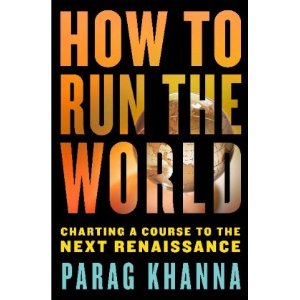
Review: How to Run the World–Charting a Course to the Next Renaissance

5 Star, Diplomacy, Peace, Poverty, & Middle Class, Politics, Power (Pathologies & Utilization), Public Administration, Stabilization & Reconstruction, Strategy
0Shares
Amazon Page

Parag Khanna

5.0 out of 5 starsExtraordinary Personal Effort, Constrained by Publisher

February 21, 2011

I received a copy of this book at my request from the author himself (I am unemployed, and globally available).

I gave the author's first book, The Second World: How Emerging Powers Are Redefining Global Competition in the Twenty-first Century, a five star leaning toward six review. This book is carried from a high four to a low five because of the concluding insights, but it also disappoints in relation to both the contributing experiences (as recounted in the Acknowledgments), and the broader literature that is not evident in this book, very possibly because of page limits set by the publisher. For more, see my Worth A Look: Book Review Lists (Positive) and also Worth A Look: Book Review Lists (Negative) at Phi Beta Iota the Public Intelligence Blog. Indeed, the author's work, his professional network, and his multi-cultural insights are a perfect complement to my own–he knows much that I do not know, and vice versa. The index is mediocre–that is on the publisher, not the author, and I suspect that other publisher constraints kept this book from being all that the author would normally have offered. The publisher has also been remiss in not offering “Look Inside the Book” details to Amazon, a free service.

The author's focus is on the failure of state-based diplomacy and the emergence as well as the need for more mega-diplomacy, which he quite ably defined as a constantly shifting mélange of hybrid relationships that full integrate nations, states, businesses, and non-governmental organizations–what they know, what they can share, and what they can do TOGETHER. Although the author is clearly a strong proponent of public-private partnerships, this is an area where others have done more nuanced work, generally limited to one sector. Panarchy: Understanding Transformations in Human and Natural Systems, and Paul Hertzog's work (Panarchy.com) are where we are all headed. On a second reading I picked up an easy to miss and rather startling emphasis, not fully developed, on the need to re-map colonial territories to diminish incentives for the military-industrial complex while boosting cross-border economic collaboration. The author sees, better than most, the harm done by artificial boundaries inconsistent with natural and tribal boundaries.

Continue reading “Review: How to Run the World–Charting a Course to the Next Renaissance”

Senator (D-MD): Leaks Should Be a Felony + RECAP

07 Other Atrocities, Misinformation & Propaganda
0Shares
Marcus Aurelius Recommends

[Congressional Record: February 15, 2011 (Senate)]

[Page S753-S754]

STATEMENTS ON INTRODUCED BILLS AND JOINT RESOLUTIONS

By Mr. CARDIN:
S. 355. A bill to improve, modernize, and clarify the espionage statutes contained in chapter 37 of title 18, United States Code, to promote Federal whistleblower protection statutes and regulations, to
deter unauthorized disclosures of classified information, and for other purposes; to the Committee on the Judiciary.

Full Text at Federation of American Scientists

Phi Beta Iota: The Senator from Maryland would benefit from greater moral and intellectual reflection.  Were the greatest Senator from New York, Daniel Patrick Moynihan, still living, he would be the first to point out that our current path is toward unbridaled tyranny, rule by secrecy, and the death of the Republic.  Maryland is home to the National Security Agency (NSA), which continues to process less than 2% of its total collection, and which continues to be largely irrelevant to the security and prosperity of the United States of America–it is a pork trough for contractors based in Maryland and elsewhere. Leaks occur because of cognitive dissonance: ethical employees confronted with BOTH unethical employers AND the absence of an internal trusted vehicle for reporting grotesque violations against the public interest.  What the Senator is doing is adding protection to the fraud, waste, and abuse that is virtually synonymous with NSA contracting (and CIA, NRO, and DIA contracting, but who's counting….).  We recollect that the US crew of the USS Liberty was threatened with dishonoable discharges and prisons if they talked about the FACT that Israeli forces attacked their ship, clearly identified as a US naval vessel, murdering and wounding many of the crew.  When secrecy is used to protect high crimes and misdemeanors, and against the public interest, it is tyranny.  When secrecy is used to protect fraud, waste, and abuse, and truth is not an allowable defense, it is fascism.

See Also:

Continue reading “Senator (D-MD): Leaks Should Be a Felony + RECAP”

USA Spectrum Out of Control & Self-Destructing

07 Other Atrocities, 10 Security, Advanced Cyber/IO, Computer/online security, Corruption, Cyberscams, malware, spam, InfoOps (IO), Military, Mobile, Officers Call, Politics of Science & Science of Politics, Power Behind-the-Scenes/Special Interests, Real Time, Secrecy & Politics of Secrecy, Standards, Technologies
0Shares
DefDog Recommends...

Interesting, and if the point about Garmin is true, what is the relationship between them and the Air Force? The Air Force has gotten into a lot of areas that include tracking to the individual level (RFI) under the guise of tracking logistics….

US Air Force raises concerns over LightSquared's LTE network messing with GPS

Following a navigation system's instructions without driving into a ravine is hard enough as it is — can you even imagine how hard it'd be if you kept losing GPS reception every time you drove within range of an LTE tower? There have been a few anecdotal concerns raised over the last several weeks that LightSquared's proposed LTE network — which would repurpose L-band spectrum formerly used for satellite — is too close to the spectrum used by the Global Positioning System, leading to unintentional jamming when the towers overpower the much weaker GPS signals. Things have gotten a little more interesting, though, now that the US Air Force Space Command has officially piped in. General William Shelton has gone on record saying that “a leading GPS receiver manufacturer just … has concluded that within 3 to 5 miles on the ground and within about 12 miles in the air GPS is jammed by those towers,” calling the situation “unbelievable” and saying he's “hopeful the FCC does the right thing.”

Read rest of article….

Phi Beta Iota: Electromagnetic conflicts have been a known issue since the 1980's.  The Soviets had emission control standards ten times tougher than the US, which had (and continues to have) virtually no standards at all.  This is one reason why US forces in Afghanistan are so severely hampered, with drones, aircraft, radars, and various other “systems” all interfering with one another.  Elsewhere, notably in England, modern cars come to a complete stop within a  couple of kilometers of certain Royal Air Force emitting stations.  All of this can be attributed to at least four root problems:

1.  An acquisition archipelago (nothing sytematic about it) so stupid and out of control as to defy belief.  No standards, no brains, no integrity.

2.  Service-centric and mission-centric “preferred contractor” and “proprietary single point solutions” standard operating processes that are deliberately not orchestrated with other services, civilian elements of the government, or other nations.

3.  A lack of integrity among senior officers who should know better.

4.  A lack of integrity in Congress, where the focus is on collecting the 5% kick-back from delivered programs, not on actually serving the public interest by insuring affordability, interoperability, sustainability, and utility.

See Also:

Continue reading “USA Spectrum Out of Control & Self-Destructing”

NIGHTWATCH Comment on US Mid-East Policy

02 Diplomacy, 07 Other Atrocities
0Shares

Special comment. Readers are watching the crumbling of the US policy architecture in the Middle East during the past four decades which stressed regional stability over all other considerations. That policy did not restrain Israel but did help limit conflicts,  It also had many negative consequences for devout Muslims and supporters of the Palestinians.

The 2011 uprisings do not invalidate that policy relative to its effectiveness in earlier times, but show how legacy policies can atrophy, if not updated and refreshed skillfully. Three months ago, leaders who have been ousted or are now under stress were lauded by the US media as allies in the fight against Islamist terrorists. Suddenly in the US press, there is no threat of terrorism any longer, only of suppression of “universal human right”s by regimes that had US backing.

Readers, it is an astonishing coincidence that former allies are now labeled dictators and that the dictators are almost all US allies. The leaders of Hamas and Hezbollah, as dictatorial as any, face no uprisings. Nor does Asad in Syria or Bashir in Sudan. All are military-backed regimes in one sense or another. What are the probabilities of Arab turbulence only in countries friendly to the US, from Senegal to Djibouti?

As for the rising tide of human rights , apparently in the Middle East that is a male phenomenon. Women protest in public at great personal risk. It also seems targeted only at leaders, not at government systems. It is shallow as well as misogynist.

A final point is that the uprisings are different country-by-country. Like diseases that mimic each others' symtoms, they look and sometimes sound alike but are not in underlying impulses or ultimate goals. That means that one policy will not fit all.

Continue reading “NIGHTWATCH Comment on US Mid-East Policy”

Why Isn’t Wall Street in Jail? + US Fraud RECAP

03 Economy, 07 Other Atrocities, 11 Society, Commerce, Commercial Intelligence, Corporations, Corruption, Cultural Intelligence, Government, Law Enforcement, Money, Banks & Concentrated Wealth, Officers Call, Power Behind-the-Scenes/Special Interests
0Shares
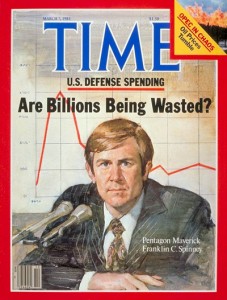
Chuck Spinney Recommends...

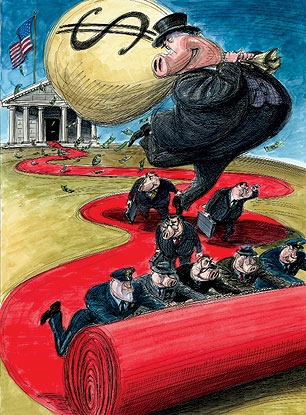
Phi Beta Iota: With a tip of the hat to Rolling Stone and author Matt Taibbi, reproducing the entire article was the only way to show the emphasis added by Brother Chuck.  Updated to add photo and observe that this particular article is rocketing around the Internet.  See also our review of GRIFTOPIA.

UPDATE: Three comments from Facebook:

  • Robert Smith Socrates became disheartened. Machiavelli was on to something – power corrupts. I suspect that a true and totally transparent democracy of ideas and information are requisite groundwork for an enduring democracy.
  • Robert David Steele Vivas Transparency, truth, and trust. James Madison and Thomas Jefferson both understood, Will Durant says it best (see my review of his Philosophy and the Social Problem)
  • Lynn Wheeler In the late 90s, got asked by NSCC (before they merged with DTC) to look at improving integrity of trading transactions (in part because had recently done something similar for payment transactions) … after putting some amount of work int…it was suspended. The comment was that a side-effect of improving the integrity would have also greatly increased transparency and visibility (which apparently is antithetical to trading culture … some x-over with recent RS article focusing on secrecy as a fraud-enabler).

Why Isn't Wall Street in Jail?

Financial crooks brought down the world's economy — but the feds are doing more to protect them than to prosecute them

Matt Taibbi. Rolling Stone, 16 February 2011

Over drinks at a bar on a dreary, snowy night in Washington this past month, a former Senate investigator laughed as he polished off his beer.

“Everything's fucked up, and nobody goes to jail,” he said. “That's your whole story right there. Hell, you don't even have to write the rest of it. Just write that.”

I put down my notebook. “Just that?”

“That's right,” he said, signaling to the waitress for the check. “Everything's fucked up, and nobody goes to jail. You can end the piece right there.”

Nobody goes to jail. This is the mantra of the financial-crisis era, one that saw virtually every major bank and financial company on Wall Street embroiled in obscene criminal scandals that impoverished millions and collectively destroyed hundreds of billions, in fact, trillions of dollars of the world's wealth — and nobody went to jail. Nobody, that is, except Bernie Madoff, a flamboyant and pathological celebrity con artist, whose victims happened to be other rich and famous people.

This article appears in the March 3, 2011 issue of Rolling Stone. The issue is available now on newsstands and will appear in the online archive February 18.

Entire Piece with Emphasis from Chuck Spinney Below the Line

Suicide turns attention to Fairfax County school discipline procedures

04 Education, 07 Other Atrocities, Advanced Cyber/IO
0Shares

Suicides are never associated with a single cause, experts say. But Nick's difficulties – based on interviews with family, friends, experts and school officials, and more than 100 pages of case documents – allow a close look at how consequences intended to help a student correct course instead can fuel a growing despair.

His story follows patterns described by parents in at least a dozen other Fairfax cases with similar disciplinary consequences. Even first-time offenders are out of school for long periods – a month, two months, longer if an appeal is filed. When they return, more than half are not returned to their original schools and can face difficult transitions – new teachers, new friends and new classes.

Read full article….

Phi Beta Iota: We grieve for this family, and this post is a contribution to the public dialog.  In Fairfax County, the school is an extension of the police, not an extension of the family.   Originally inspired by the spread of very young Hispanic gangs into the schools–the police did a phenomenal job in shutting that down–today the police are an alternative to intelligent internal discipline.  The schools have failed to evolve and adapt to digital natives to the point that the brightest students are dropping out or turning out, with the schools becoming advanced child care.  This is not a new problem, but these suicides do offer an opportunity for re-examining what we regard as very poor administration of the Fairfax County school system philosophy and practice.

See Also:

TED: Sugata Mitra–The child-driven education

Journal: It’s Official–Social Media EDUCATES

Open Space Technology (OST)

Worth a Look: Live Language Lessons Online

Worth a Look: Books Reviews on Education for Freedom & Innovation

Review: The World Is Open–How Web Technology Is Revolutionizing Education

Review: Making Learning Whole–How Seven Principles of Teaching can Transform Education

Review: Why Don’t Students Like School–A Cognitive Scientist Answers Questions About How the Mind Works and What It Means for the Classroom

Review: Reflexive Practice–Professional Thinking for a Turbulent World

Review: Ideas and Integrities–A Spontaneous Autobiographical Disclosure

Review: Philosophy and the Social Problem–The Annotated Edition

Participatory Budgeting Practices, Games, Resources

03 Economy, Budgets & Funding, Collective Intelligence
0Shares
Tom Atlee Across Phi Beta Iota

Dear friends,

Recently I've seen a swirl of information (mostly on the National Coalition for Dialogue and Deliberation listserv) about participatory budgeting.  Below, you'll find a sampling of this info, in relatively raw form.  I do not know enough to sort it all out, but it looks really fascinating.

Most of this material is about online public budgeting exercises, but some of it also describes the kind of face-to-face, seriously empowered mass-participatory civic budgeting processes developed in Brazil which have spread widely in the last decade or so.

I had no idea there was so much activity in this arena.  Given

(a) the attention currently focused on the budget crisis,

(b) the dire impact of that crisis at all levels of government in so many places,

(c) the extreme consequences that could arise from this or that approach to addressing the crisis, and

Continue reading “Participatory Budgeting Practices, Games, Resources”